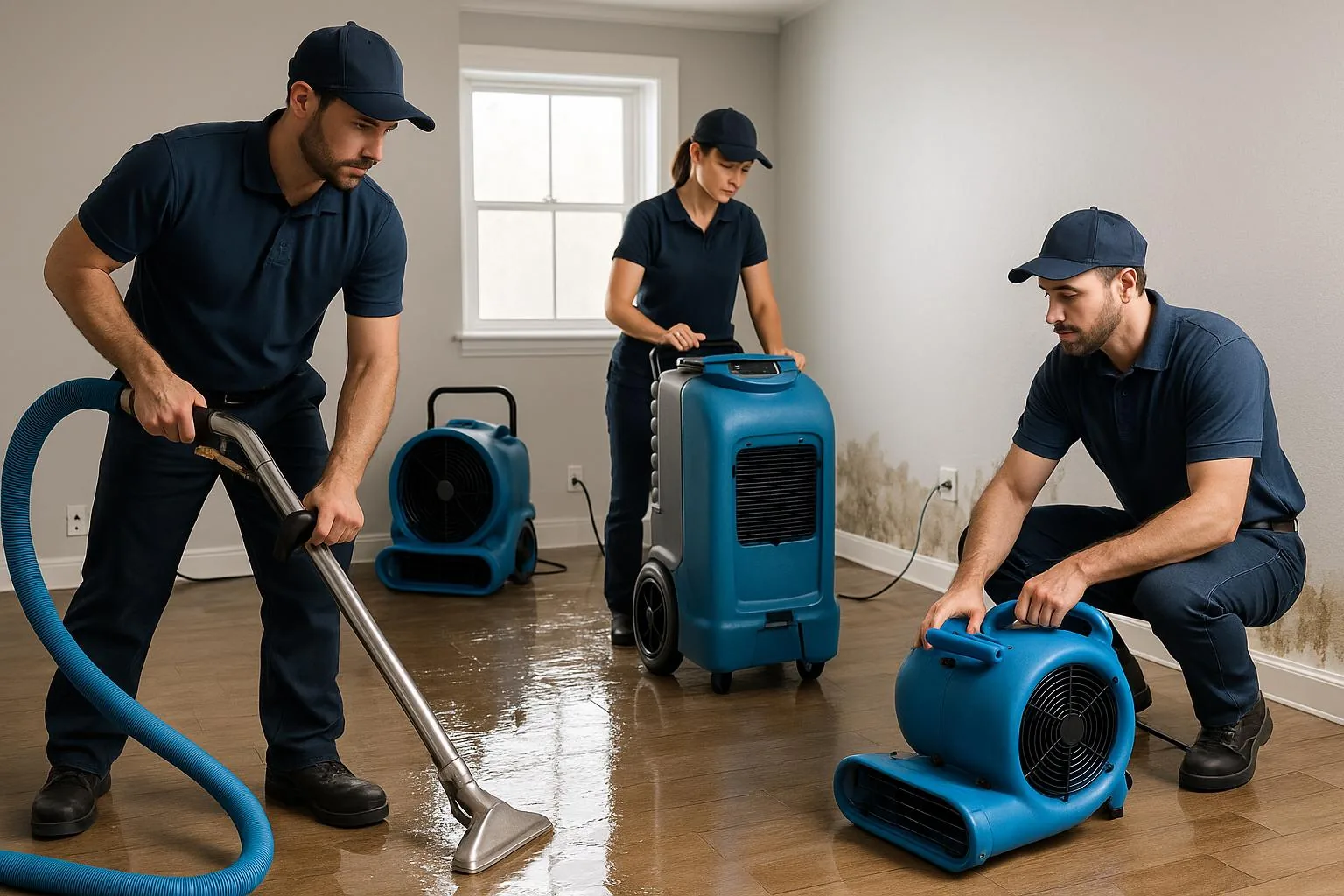
Your Mitigation Work Deserves Full Payment. We Build the File to Support It.
We partner with water mitigation contractors to document mitigation work to IICRC standards and resolve insurance disputes over drying scope and equipment.
Why Water Mitigation Contractors Partner With DCS
Water mitigation claims are among the most frequently disputed in the insurance industry. Insurance companies routinely challenge the number of drying days, the equipment placed, the demolition scope, and the category of water damage. Mitigation contractors who lack professional support for their customers often spend more time disputing with insurance companies than doing the work.
When DCS is involved, we document the mitigation scope to IICRC S500 standards from the start. We review the insurance estimate, prepare detailed arguments for the full scope of work, and resolve disputes quickly. Our background in insurance claims and construction means we understand both the technical side of mitigation and the insurance side of the claim.
IICRC Water Damage Categories:
- Category 1 (Clean Water): Water from a sanitary source such as a supply line or faucet. Lowest contamination risk.
- Category 2 (Gray Water): Water with significant contamination that may cause illness. Includes dishwasher overflow, washing machine discharge, and toilet bowl overflow without feces.
- Category 3 (Black Water): Grossly contaminated water that may contain pathogenic agents. Includes sewage, flooding from rivers or streams, and water that has been standing long enough to support microbial growth.
The Mitigator's Exact Role in a Water Claim
Water mitigation is the emergency phase of a property claim: the work that stops the loss from getting worse before any rebuild begins. The mitigation contractor is the first technical professional on site and the only party who can capture the conditions as they actually existed, the water category, the affected materials, the moisture readings, and the day-by-day drying progress, before that evidence is altered by the work itself. That contemporaneous record is the foundation the mitigation portion of the claim stands on.
DCS handles the insurance side. We translate the IICRC S500 documentation into a defended scope, reconcile the mitigation invoice against the carrier estimate, and resolve the disputes that routinely arise over drying days, equipment placement, water category, and demolition. The mitigation company keeps doing the technical work to standard; we press for payment of the full invoice and for the reconstruction that follows to be funded.
Establish Category and Class
Determine the water category (contamination) and class (evaporation load) at intake under S500. These two findings drive the entire required scope, the equipment count, and the claim value.
Document the Drying
Daily atmospheric and material moisture readings prove each day of equipment was justified and that drying continued to a documented dry standard rather than an arbitrary day count.
Justify the Demolition
Document which porous and contaminated materials had to be removed and why, so the demolition scope is defended rather than cut as excessive.
IICRC S500 Classes of Water Intrusion
Where the category describes contamination, the S500 class describes the amount of water and the evaporation load. A qualified restorer determines the class under the current ANSI/IICRC S500 standard and documents the affected surfaces and low-permeance materials. The class informs the equipment count and drying duration.
Class 1: Least Water
The smallest amount of water absorption and the lowest evaporation load. Only part of a room or area is affected, or materials with low porosity hold minimal moisture. Requires the least equipment and shortest drying time.
Class 2: Significant Water
A larger affected area, often with wet carpet and cushion and moisture wicking up walls, and a faster evaporation load than Class 1. Requires more aggressive drying.
Class 3: Greatest Evaporation Load
Saturated ceilings, walls, insulation, carpet, and subfloor can produce the greatest evaporation load and the most equipment-intensive drying of the standard classes. Water entry direction does not by itself determine the class.
Class 4: Specialty Drying
Involves wet materials with very low permeance and porosity such as hardwood, plaster, brick, concrete, and stone. May require specialized drying methods and longer drying times. Qualified restorers select suitable temperature, humidity, airflow, and equipment and verify progress with material moisture measurements.
The S500 Documentation That Gets Mitigation Invoices Paid
Mitigation invoices are paid or cut short based on whether the daily record proves the scope. A complete S500-aligned documentation set converts a drying-days argument from opinion into reconcilable evidence.
Category and class determination
A documented finding of the water category (contamination) and class (evaporation load) at intake, with photographs, before remediation alters the evidence. This sets the entire required scope.
Daily atmospheric readings
Temperature, relative humidity, and grains per pound recorded each day at the affected area, the unaffected area, and outside, showing the drying system was performing and the goal not yet met.
Moisture mapping and material readings
Moisture-content readings on affected materials over time, mapped to the structure, proving each day of equipment was justified until materials reached the dry standard.
Equipment log and scope of work
A record of air movers, dehumidifiers, and air scrubbers placed, with placement rationale tied to the class, plus a written scope of work for removals and antimicrobial application.
Line-item estimate and invoice
A line-item estimate (typically Xactimate, the carrier standard) reconciled to the mitigation invoice so the desk adjuster can verify and pay the scope.
Proof of Loss
The carrier-required sworn statement of the claimed amount, submitted complete and on time to keep the claim moving and protect the policyholder timeline rights.
How Mitigation Invoices Get Cut and How We Counter It
Mitigation is one of the most disputed segments of any property claim. These are the patterns we see most, and the documentation that defends against each.
Flat-rate equipment days
The carrier pays a fixed number of equipment days regardless of conditions. We counter with daily atmospheric and material moisture readings showing the structure had not reached the documented dry goal.
Category downgrade
A Category 2 or 3 loss is paid as Category 1 to avoid the larger required scope. We document the contamination source and category at intake, before remediation alters the evidence.
Demolition denial
Necessary removal of porous or contaminated materials is called excessive. We document why each material had to be removed under S500 and the contamination present.
Equipment-count reduction
The carrier pays for fewer air movers or dehumidifiers than the class requires. We tie the equipment count to the documented class and affected square footage.
Antimicrobial and PPE stripped
Contamination-control line items are removed on a downgraded category. We restore them by documenting the actual category and the protocols S500 requires.
Reconstruction left unfunded
The mitigation is paid but the rebuild that follows is underscoped. We prepare the reconstruction claim so the full repair is funded, not just the dry-out.
How the DCS Partnership Funds the Full Job
A mitigation company that does the dry-out and then watches the carrier cut the invoice spends more time disputing than working. The DCS partnership closes that gap. We are licensed public adjusters, not a restoration company and not a referral mill, and we build and defend the insurance claim, pressing for payment of the full mitigation invoice and for the reconstruction that follows to be funded.
For the homeowner
- Professional representation on the valuation from day one
- Mitigation and reconstruction both documented and funded
- Correct water category and class claimed, not a downgrade
- Contingency fee only: no recovery, no fee
For the mitigation contractor
- The full mitigation invoice documented and pressed, not conceded to a flat rate
- No time lost arguing drying days with desk adjusters
- Demolition and category scope defended with S500 documentation
- A more complete, more satisfied customer outcome
Why DCS: We Adjusted Water Claims From the Carrier Side
Our founder spent 2010 to 2017 as a field adjuster and team lead for an insurance carrier, evaluating exactly these mitigation invoices from the inside. We know how a desk adjuster reconciles a drying log, where the flat-rate equipment cut comes from, how a category gets quietly downgraded, and how the reconstruction gets left unfunded. We document to the S500 standard we know carriers respect, which is why our claims tend to be evaluated on the merits.
A licensed public adjuster, not a law firm.
Dependable Claims Specialists - Public Insurance Adjusters handles claim valuation, documentation, and negotiation on behalf of the policyholder. Texas Firm License #3134924; Florida Firm License #W820363. Public adjusting fees are capped by statute (Texas Insurance Code Chapter 4102 at 10 percent; for Florida home and condo unit claims, Florida Statute 626.854 usually at 20 percent, or 10 percent within a year after a declared emergency). Bad faith, lawsuits, and statutory penalties are the practice of law and are handled by an attorney, not by a public adjuster.
How We Support Water Mitigation Contractors
IICRC-Standard Documentation
We document the mitigation scope to IICRC S500 standards including moisture readings, equipment logs, and photographic evidence.
Drying Scope Disputes
When the insurance company disputes drying days or equipment, we prepare the documentation and argument to resolve the dispute.
Category Documentation
We document the category of water damage and argue for the appropriate mitigation scope and cost.
Demolition Scope Support
We document the necessity of demolition work and argue for the full scope of affected materials.
Reconstruction Claims
We prepare claims for reconstruction work following mitigation, documenting the full scope of repairs.
Team Training
Free training for mitigation teams on IICRC documentation standards and claims documentation best practices.
Free Claims Documentation Training for Your Team
We offer complimentary on-site or virtual training for your staff on how to properly document insurance claims, what to do when insurance is involved, and how to protect your customers and your business. This is not a sales pitch. It is practical education that makes your team more valuable to every client you serve.
What We Expect From Network Water Mitigation Partners
Dependable Claims Specialists - Public Insurance Adjusters refers water mitigation contractors to policyholders whose claims involve drying and contamination control. Because our reputation rides on every referral, contractors in our network meet a clear set of expectations. If you are a water mitigation contractor in the Houston, Texas, or South Florida market and want to partner with us, here is what we look for.
Proper Licensing and Insurance
Required state and local licenses, IICRC WRT and ASD certification for assigned techs, general liability coverage, and workers compensation as applicable. We verify these before adding a contractor to the referral network.
IICRC S500 / S520 Documentation
Daily drying logs, atmospheric readings, moisture mapping, and contamination categorization aligned with IICRC S500 (water) and S520 (mold) standards. Our training program covers documentation that supports a fully reimbursed mitigation invoice.
Communication With the Adjuster
Network partners coordinate with us during the claim. Respond to documentation requests, provide supplementary photographs and logs when asked, and meet on-site for re-inspections when necessary.
Scope and Estimate Discipline
Mitigation scopes that match the documented conditions, equipment days that match the drying logs, and invoices that hold up under carrier review. We do not refer contractors who pad scope or chase Cat-event price markups.
Workmanship and Warranty
Network partners stand behind their mitigation work and pass-through any manufacturer warranties on materials. Callbacks for re-emergent moisture or odor issues are handled with the homeowner outside the claim file.
Customer Experience
Policyholders are typically dealing with disrupted living conditions when mitigation starts. Containment discipline, on-time arrival, and clear communication are baseline expectations. Negative customer feedback is grounds for removal from the referral network.
If your water mitigation company meets these expectations and you want to grow your insurance-related work in the Houston market, we would welcome the conversation. Email intake@dcspia.com or call 833-4UR-LOSS to introduce yourself.
Frequently Asked Questions
How does DCS support water mitigation companies?
What IICRC standards apply to water damage mitigation?
What are the categories of water damage?
Do you offer training for water mitigation technicians?
What are the classes of water damage under IICRC S500 and why do they matter?
How does an insurer challenge the number of drying days, and how do you defend it?
Why does the water category change the value of the mitigation claim?
Does mitigation also require a Proof of Loss and a line-item estimate?
Is mold remediation covered, and what standard applies?
Does Texas or Florida law require the insurer to pay the mitigation claim promptly?
What does a public adjuster cost on a mitigation claim?
The carrier already cut our mitigation invoice. Can it still be corrected?
Commercial Claims We Handle in Houston
When a mitigation job is part of a commercial claim, these are the Houston-specific claim pages DCS handles for Harris County businesses, served from our Webster, TX headquarters.
