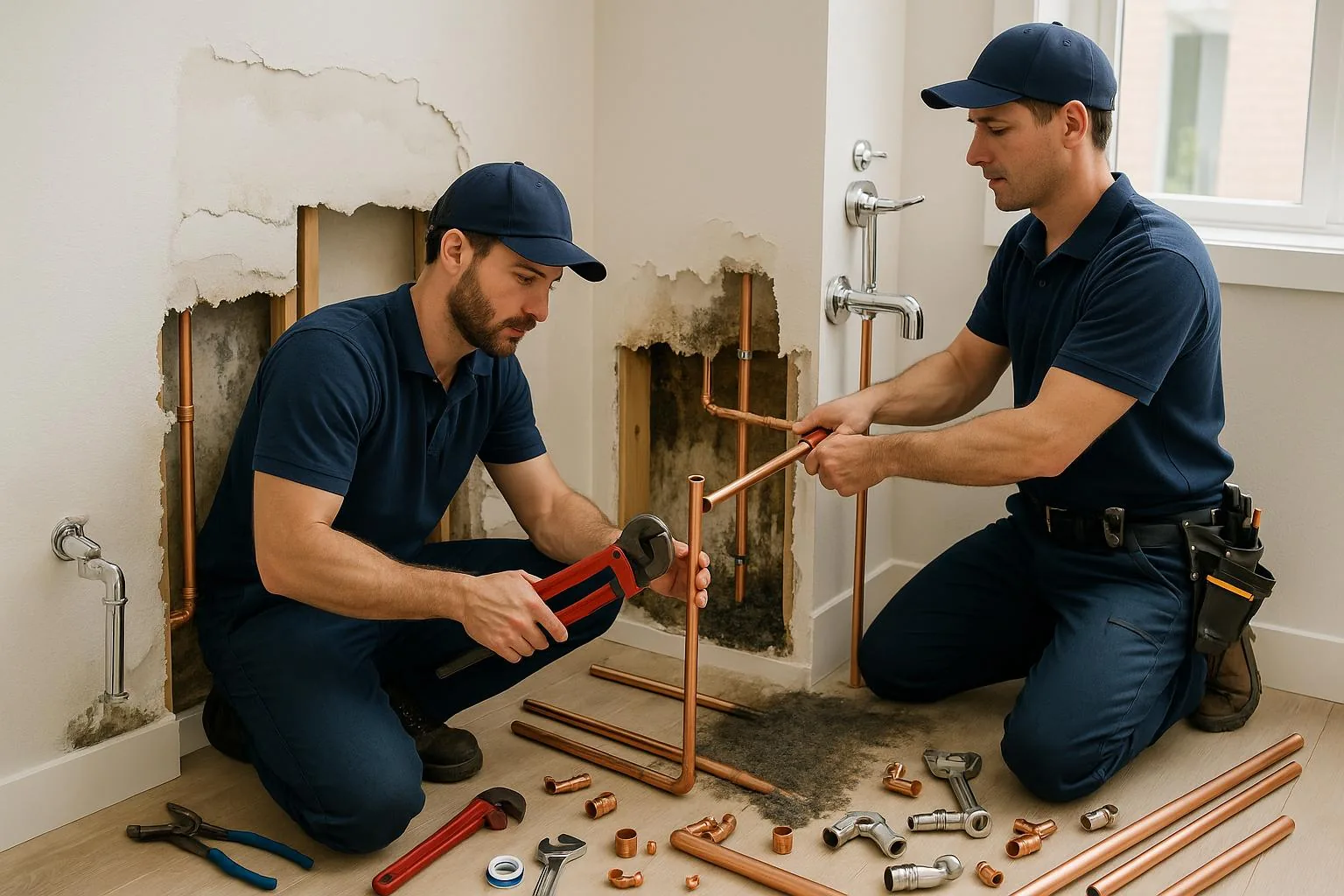
The Pipe Is Fixed. Now Make Sure the Whole Claim Is Paid.
We partner with plumbing contractors to document not just the pipe repair but all resulting damage, access costs, and restoration work on insurance claims.
Why Plumbing Contractors Partner With DCS
A plumbing failure is rarely just a plumbing problem. Water from a burst pipe, failed supply line, or slab leak spreads quickly and causes damage to walls, floors, ceilings, cabinetry, and contents. The plumbing repair is only the beginning of the claim. The full scope of damage is often far larger than the initial insurance estimate reflects.
We document the reasonable covered repair scope and support the claim with estimates, photographs, and contractor findings. No settlement, complete project funding, or supplement approval is guaranteed; deductibles, limits, exclusions, fees, and actual repair costs can leave an owner-funded amount.
The Plumber's Exact Role in a Property Claim
On a water-loss claim the plumbing contractor is the technical witness to the cause of loss. Long before a settlement number exists, the carrier has to answer one question: what failed, and was that failure sudden and accidental or the result of long-term seepage or wear? That answer decides whether the claim is covered at all. The plumber is the only party on site who can authoritatively identify the failed component, the mechanism of failure, and the approximate timeline. That makes plumber documentation the foundation the entire claim is built on.
DCS handles the second half: translating that field evidence into a coverage position and a fully documented scope. We separate three distinct buckets that carriers treat very differently: (1) the failed component itself, usually an owner expense; (2) the access and tear-out needed to reach it, often a covered sub-limit; and (3) the resulting damage to the building and contents, the largest covered portion. Keeping these straight on the front end is what prevents a covered loss from being denied as an excluded maintenance issue.
The Failed Component
The burst supply line, cracked drain, failed water heater, or corroded fitting. Standard HO-3 and HO-5 forms typically exclude the failed part itself but cover the water damage it causes. We identify this line early so expectations are honest.
Access and Tear-Out
The cost to open walls, ceilings, cabinets, or break a slab to reach a hidden pipe. Many policy forms include a specific access (tear-out) provision that funds this and the restoration of what was opened. We locate and claim it.
Resulting Damage
Wet drywall, flooring, subfloor, framing, cabinetry, insulation, and damaged contents. This is the largest covered portion of most plumbing claims and the part most often underscoped on the first carrier estimate.
Plumbing-Related Claim Types We See Most
Not every water loss is the same claim. The cause of loss changes the coverage analysis, the documentation needed, and the scope of resulting damage. These are the most common plumbing-driven property losses across Houston, the rest of Texas, and South Florida.
Burst or Frozen Supply Lines
A pressurized supply line that lets go (often during a hard freeze, as Texas saw in February 2021) discharges clean water continuously until shut off. Damage spreads fast across multiple rooms and floors. The discharge is generally a covered sudden event; the resulting damage is the bulk of the claim.
Slab Leaks
A supply or drain line under the foundation slab leaks, requiring detection, breaking the slab for access, the pipe repair, and restoration of the slab and all affected flooring. The access and restoration scope is large and frequently underscoped. Coverage turns on the policy form and whether the loss was sudden.
Water Heater Failures
A ruptured tank or failed connection can release 40 to 80 gallons and feed continuously off the supply. The tank itself is usually owner expense; the flooring, drywall, and contents damage in the surrounding rooms is typically the covered loss.
Drain, Sewer, and Backup Losses
Drain-line failures and sewer backups introduce Category 2 or Category 3 contaminated water, which raises the required mitigation scope. Backup of sewers and drains is often covered only by a specific endorsement, so confirming that endorsement is the first step.
Appliance Supply-Line Failures
Failed braided lines feeding dishwashers, refrigerators, and washing machines are a leading cause of insured water losses. The small failure point can run for hours undetected, soaking subfloor and cabinetry. Whether the resulting damage is covered depends on your policy and the facts, so document it.
Hidden Wall and Ceiling Leaks
A pinhole or fitting leak inside a wall or above a ceiling can saturate framing and create mold conditions before it is discovered. The sudden-versus-seepage timeline is the contested issue, which is why dated cause-of-loss documentation is decisive.
The Cause-of-Loss Documentation That Gets Plumbing Claims Paid
Carriers approve or deny water claims on the strength of the cause-of-loss record. A clean, dated documentation set converts a coverage argument from opinion into evidence. Here is the documentation that wins these claims, and what each piece proves.
Cause-of-loss photographs
Clear images of the failed component before it is removed, the failure point itself, and the path of water travel from the source. These establish that the loss was sudden and accidental rather than long-term seepage.
Written plumber assessment
A short report stating what failed, the mechanism (freeze, corrosion, fitting failure, etc.), and the approximate timeline. This is the technical foundation for the coverage position.
Moisture and drying records
Where mitigation occurred, moisture-meter readings, mapping, and daily drying logs document the extent of saturation and justify the demolition scope.
Line-item repair estimate
A detailed Xactimate estimate (the carrier-standard platform) for access, demolition, drying, and restoration, priced to current market values so it holds up under desk review.
Proof of Loss
The carrier-required sworn statement of the claimed amount. Submitting a complete, accurate Proof of Loss on time keeps the claim moving and protects the policyholder timeline rights.
How the DCS Partnership Funds the Full Job
A plumber who walks away after fixing the pipe leaves the homeowner facing a half-funded repair and a carrier estimate that rarely covers the real cost of restoration. The DCS partnership closes that gap. We are not a referral mill and we are not a construction company. We are licensed public adjusters who build and negotiate the insurance claim so the money is there to do the complete job, from access through final restoration.
For the homeowner
- Professional representation on the valuation from day one
- Access and tear-out coverage identified and claimed in full
- Resulting damage to building and contents fully documented
- Contingency fee only: no recovery, no fee
For the plumbing contractor
- A documented full repair scope rather than a partial repair
- No time lost arguing scope with desk adjusters
- Supplements prepared and pressed when demolition reveals more
- A more complete, more satisfied customer outcome
Why DCS: We Adjusted These Claims From the Carrier Side
Our founder spent 2010 to 2017 as a field adjuster and team lead for an insurance carrier, evaluating exactly these water-loss claims from the inside. That experience is the difference. We know how a desk adjuster reads a cause-of-loss photo, where the sudden-versus-seepage line gets drawn, which access and tear-out provisions get overlooked, and how the first estimate gets built short. We document to the standard we know carriers respect, which is why our claims tend to be evaluated on the merits rather than rejected on a technicality.
A licensed public adjuster, not a law firm.
Dependable Claims Specialists - Public Insurance Adjusters handles claim valuation, documentation, and negotiation on behalf of the policyholder. Texas Firm License #3134924; Florida Firm License #W820363. Public adjusting fees are capped by statute (Texas Insurance Code Chapter 4102 at 10 percent; for Florida home and condo unit claims, Florida Statute 626.854 usually at 20 percent, or 10 percent within a year after a declared emergency). Questions of bad faith, lawsuits, and statutory penalties are the practice of law and are handled by an attorney, not by a public adjuster.
How We Support Plumbing Contractors
Full Damage Documentation
We document all damage resulting from the plumbing failure, including water damage to walls, floors, ceilings, and contents.
Access and Tear-Out Coverage
We identify and document access coverage for the cost of opening walls, floors, or slabs to reach hidden pipes.
Slab Leak Claims
We handle the full scope of slab leak claims including detection, access, repair, and restoration of the slab and all affected finishes.
Mold Prevention Documentation
We document the conditions that create mold risk and argue for prompt, thorough drying and remediation to prevent secondary damage.
Supplement Claims
We prepare supplement claims for damage discovered after the initial inspection or during demolition.
Team Training
Free training for plumbing teams on claims documentation, what to photograph, and how to identify all damage related to a plumbing failure.
Free Claims Documentation Training for Your Team
We offer complimentary on-site or virtual training for your staff on how to properly document insurance claims, what to do when insurance is involved, and how to protect your customers and your business. This is not a sales pitch. It is practical education that makes your team more valuable to every client you serve.
What We Expect From Network Plumbing Partners
Dependable Claims Specialists - Public Insurance Adjusters refers plumbing contractors to policyholders whose claims involve plumbing damage. Because our reputation rides on every referral, contractors in our network meet a clear set of expectations. If you are a plumbing contractor in the Houston, Texas, or South Florida market and want to partner with us, here is what we look for.
Proper Licensing and Insurance
For Texas plumbing, the business Responsible Master Plumber and other applicable requirements, plus general liability coverage, workers compensation as applicable, and local permitting credentials. We verify the licenses and registrations required for the business and the people supervising and performing the work before adding a contractor to the referral network.
Cause-of-Loss and Mitigation Documentation
Clear photographs of the failure point, the failed component, and the path of water travel. A written cause-of-loss assessment supports the policyholder's claim. Our training program covers documentation that connects the loss to a covered peril.
Communication With the Adjuster
Network partners coordinate with us during the claim. Respond to documentation requests, provide supplementary photographs when asked, and meet on-site for re-inspections when necessary.
Scope and Estimate Discipline
Repair scopes that match the documentation, line items that reflect current market pricing, and estimates that hold up under carrier review. We do not refer contractors who pad scope or chase Cat-event price markups.
Workmanship and Warranty
Network partners stand behind their work with manufacturer-aligned warranties on parts and labor. Callbacks for warranty issues are handled with the homeowner outside the claim file.
Customer Experience
Policyholders should feel respected at every interaction. Clean job sites, on-time arrival, and clear communication are baseline expectations. Negative customer feedback is grounds for removal from the referral network.
If your plumbing company meets these expectations and you want to grow your insurance-related work in the Houston market, we would welcome the conversation. Email intake@dcspia.com or call 833-4UR-LOSS to introduce yourself.
Frequently Asked Questions
How does DCS help plumbing contractors with insurance claims?
What is a slab leak claim and how is it handled?
Does insurance cover the cost of finding a hidden leak?
Do you offer training for plumbing contractors?
Does homeowners insurance pay for the plumbing repair itself or only the water damage?
What is the difference between a sudden plumbing leak and a long-term seepage exclusion?
How are supplements handled when more damage is found after demolition begins?
What documents prove a plumbing-loss claim and get it paid?
Does Texas or Florida law require the insurer to pay promptly?
How much does a public adjuster cost on a plumbing claim?
Can the homeowner pick their own plumber and still use DCS?
What if the carrier already paid but the amount will not cover the full repair?
Commercial Claims We Handle in Houston
When a plumbing failure turns into a commercial claim, these are the Houston-specific claim pages DCS handles for Harris County businesses, served from our Webster, TX headquarters.
