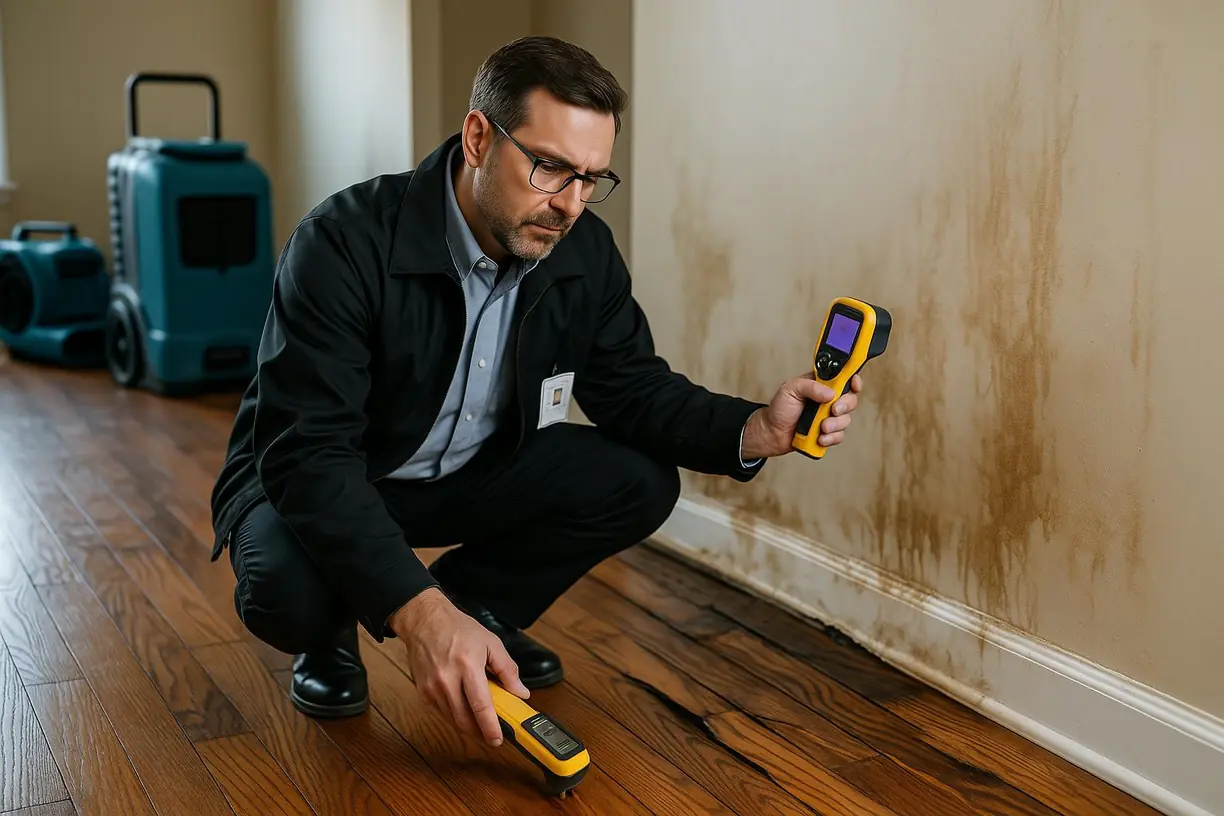
Sewage Is a Biohazard, Call a Public Adjuster When You Call Remediation
A sewer backup is Category 3 contaminated water and a genuine health hazard. Professional remediation should begin quickly, but the documentation that proves both coverage and the full contaminated scope has to be captured before materials and contents are removed and disposed of.
Call DCS at the same time you call your remediation company. We confirm your endorsement, characterize the cause, and document the Category 3 scope while the crew works, so nothing that gets thrown out goes undocumented and the claim reflects the full loss.
Learn More: Water Mitigation and Your Insurance ClaimQuick Answer
A sewer or drain backup is water and waste flowing back into your property through floor drains, toilets, or fixtures. Standard Texas homeowner and commercial property policies generally EXCLUDE backup unless you carry a 'Water Backup and Sump Discharge or Overflow' endorsement. A backup directly caused by a covered flood may fall under an NFIP flood policy, so the source and causal sequence matter. When the endorsement is in place, the loss is typically Category 3 (contaminated) water under IICRC S500, requiring removal of porous materials and antimicrobial treatment. A public adjuster confirms the endorsement and its limit, documents the full contaminated scope, and pursues the complete settlement.
Sewer Backup Is the One Water Loss People Assume Is Covered, and Often Is Not
A sewer backup happens when wastewater that should flow away from your property instead reverses and comes up through the lowest drains, floor drains, tubs, toilets, and showers. Because that water has passed through the sanitary sewer, it is treated as grossly contaminated, which changes both the cleanup requirements and how the claim is handled.
A sewer or drain backup unrelated to flooding generally requires applicable water-backup coverage under your property policy. NFIP flood insurance can cover backup damage when the backup directly results from a covered flood. We document both the source and the causal sequence, then review the property and flood policies, their limits, and their exclusions.
- Toll Free:833-4UR-LOSS
- Texas Office:936-522-6627
- Florida Office:954-849-3405
Common Damage Types We Document
- Category 3 / Black Water: Sewage backup is grossly contaminated water under IICRC S500, requiring removal of porous materials and antimicrobial protocols, not just drying.
- Flooring and Subfloor: Carpet, pad, and often subflooring that contacted contaminated water typically must be removed rather than dried in place.
- Drywall and Insulation: Wicked contamination in lower wall sections and insulation usually requires controlled removal up to a documented height.
- Contents and Personal Property: Porous contents that contacted Category 3 water generally cannot be salvaged and are documented for the claim.
- Mechanical and Finished Basements/Lower Levels: Lower-level finishes, mechanicals, and stored property are frequently the hardest-hit and most disputed.
- Cleaning, Sanitizing, and Disposal: Antimicrobial treatment, contaminated-material disposal, and post-remediation verification are part of a correctly scoped backup loss.
What Causes a Sewer Backup, and Why It Drives a Contaminated-Water Scope
The cause determines both coverage and cleanup. A backup is Category 3 water, which means the correct remediation is removal-and-sanitize, not dry-in-place. Carriers that scope it as ordinary water damage underpay these losses.
Sewer and drain backups have several common causes. A blockage or surcharge in the municipal main can force wastewater back up private laterals. Tree roots commonly intrude into and obstruct the lateral line between the property and the main. Aging or collapsed clay or cast iron laterals restrict flow. Grease, wipes, and debris build up and block lines. And heavy rainfall can overwhelm older or combined storm-and-sanitary systems, causing wastewater to back up into connected properties. Sump pump failure during heavy rain is a related cause that many backup endorsements also address.
Whatever the cause, the result is contaminated water, and the IICRC S500 standard classifies sewage backup as Category 3, grossly contaminated. That classification matters financially because Category 3 remediation is not a dry-it-out job. Porous materials that contacted the water, carpet and pad, often subflooring, the lower portions of drywall and insulation, and porous contents, generally must be removed and disposed of, with antimicrobial treatment and post-remediation verification. A carrier that concedes the backup but scopes it as if it were clean Category 1 water systematically underpays the loss.
Documentation on a backup claim runs on two tracks at once. The coverage track confirms the endorsement, its limit, and the correct cause-of-loss characterization (backup versus flood versus a covered sudden discharge). The damage track documents the contaminated scope to S500 standards, category and class, materials affected, removal heights, and disposal. We build both, because a backup claim can be lost either by being pushed into an excluded category or by being conceded and then underscoped.
What You Need to Know
My basement or lower level flooded with sewage. What should I document?
Document the cause, the contamination, and everything removed, before disposal. Photograph and video the standing water, the entry points (floor drains, toilets, fixtures), the high-water line, and every affected material. Keep an itemized list of contents removed and disposed of, with photos, because porous Category 3 contents generally cannot be salvaged. Retain the plumber's or municipality's findings on the cause (main surcharge, root intrusion, collapsed lateral). This record supports both the coverage characterization and the contaminated-scope valuation.
What Decides a Sewer-Backup Payout - the Endorsement, the Sub-Limit, and the Category 3 Scope
Sewer and drain backup is one of the few water losses a standard policy may exclude outright, and even when it is covered the contaminated scope is routinely written as if the water were clean. These are the coverage caveats, sublimits, and endorsements that most often move the number on a Texas or Florida backup claim, and how DCS handles each.
Check backup coverage and any flood-related cause
A sewer or drain backup unrelated to flooding generally requires applicable water-backup coverage under your property policy. NFIP flood insurance can cover backup damage when the backup directly results from a covered flood. We document both the source and the causal sequence, then review the property and flood policies, their limits, and their exclusions.
The backup endorsement carries its own sub-limit
The water-backup endorsement typically provides a separate limit lower than your dwelling limit, not your full Coverage A. The only reliable figure is the one on your own declarations page and endorsement. DCS confirms the limit at the start of the claim and structures the scope to the coverage actually in force, so you are not surprised by a cap mid-claim.
Document whether flooding caused the backup
Whether rising surface water or a problem in the sewer line caused the backup can decide which policy applies. We record how and where the water entered (floor drains, toilets and fixtures, or doors and walls), the rainfall and flood conditions on the date, and the condition of the line, so the cause is shown by evidence rather than assumed.
Sewage is Category 3 - a dry-out scope underpays the loss
Under the IICRC S500 standard, sewage backup is grossly contaminated (Category 3) water. Correct remediation means removing porous materials that contacted it - carpet, pad, often subfloor, lower drywall and insulation, and porous contents - plus antimicrobial treatment and post-remediation verification, not just drying. When a carrier concedes the backup but writes a dry-out scope, the estimate falls far short. DCS documents the category, class, removal heights, and disposal so the scope reflects a contaminated loss.
Sump-pump failure is often part of the same endorsement
The same water-backup / sump-overflow endorsement frequently also addresses overflow from a failed sump pump during heavy rain. If you rely on a sump, this is a distinct covered cause worth confirming. DCS checks the endorsement language for sump coverage and documents whether the loss originated from a sump overflow versus a sewer-main surcharge.
Mold from a covered backup is almost always capped
Mold or fungi remediation arising from a covered backup is usually subject to a sublimit - commonly $5,000 to $10,000 - unless a higher mold endorsement was purchased. Contaminated water sitting in porous lower-level materials is a strong mold driver. DCS pushes for prompt documented mitigation and the full covered remediation scope, and identifies when a higher mold limit applies.
Document the date of every carrier contact and decision
DCS documents the date of every acknowledgment, request, inspection, decision, and payment so the claim record is complete while the contaminated scope is documented and submitted, and a supplement later is straightforward to support.
Coverage varies by carrier, policy form, and endorsement. These are common patterns in Texas and Florida homeowner and commercial property policies - not a description of your specific policy. Review your declarations page and endorsements, or have DCS review them with you. Educational information, not legal advice.
Handling the Claim Yourself vs Engaging DCS PIA
Texas policyholders can negotiate their own claim. Hiring a licensed public insurance adjuster is optional. The table below sets out, side by side, how the same claim tasks get done in each path so you can make an informed decision.
| Claim handling task | Self-represented | DCS PIA representation |
|---|---|---|
| A dated record of the claim | A manual calendar and a memory of phone calls; hard to reconstruct months later. | Every carrier contact, request, inspection and payment logged and timestamped from day one. |
| Scope of loss documentation | Photos plus a written list; rarely matches the carrier's estimating system line-by-line. | Xactimate estimate built in the same software the carrier uses, line-item-matched to scope. |
| Hidden or secondary damage assessment | You decide what to document. | Moisture mapping, thermal imaging, and engineering referrals when warranted; ensuing-loss tracking. |
| Appraisal clause invocation when valuation differs | Available to any insured under the policy appraisal clause. | Invoked when carrier scope materially undervalues the loss; appraisal and umpire fees disclosed up front. |
| Supplement filings for damage discovered during repair | You prepare the claim. | Tracked through repair; supplement scopes filed against the carrier as new damage is exposed. |
| Additional Living Expense / Extra Expense documentation | Receipts assembled at the end of displacement, often incomplete. | Receipt and mileage log discipline from day one; ALE / Extra Expense submitted per policy form. |
| Mold sub-limit endorsement pursuit | Your choice. | Mold cause, species, and remediation protocol documented to IICRC S520; sub-limit pursued. |
| Fee structure | No third-party fee. You handle the claim yourself. | In Texas: no recovery, no fee, and the public adjuster fee is capped under Tex. Ins. Code § 4102.104. Florida claims follow a separate written agreement. Hiring a public adjuster is optional. |
Educational comparison, not legal advice. Hiring a Texas-licensed public insurance adjuster is optional and capped at 10% of the recovery under Tex. Ins. Code § 4102.104. Public adjusters represent policyholders on claim valuation and negotiation. Legal claims for bad faith or prompt-payment damages are handled by attorneys, not public adjusters.
Tips That Protect Your Claim
Do Not Contact the Water
Sewage backup is a biohazard. Avoid contact, keep children and pets away, and let a licensed remediation company handle extraction with proper protection.
Confirm Your Endorsement First
Find your declarations page and look for a water-backup / sump-overflow endorsement and its limit. This single fact frames the entire claim.
Document Before Removal
Photograph and video the standing water, entry points, high-water line, and all damaged materials and contents before anything is thrown out.
Inventory What Gets Disposed
Keep an itemized, photographed list of contaminated contents removed. Category 3 porous items generally cannot be salvaged and must be claimed, not silently discarded.
Preserve the Cause Evidence
Keep the plumber's report or municipal finding on what caused the backup (root intrusion, main surcharge, collapsed lateral). Cause drives coverage.
Call DCS Before Accepting a Scope
Have the cause-of-loss characterization and the Category 3 scope reviewed before you accept any estimate or sign a release.
How to Reduce Your Risk
Ask your agent whether your policy carries a water-backup / sump-overflow endorsement, and what the limit is. Many homeowners do not have it and assume they do.
Install a backwater (backflow) prevention valve on your sewer lateral to reduce the risk of municipal-main backups entering your property.
Keep grease, wipes, and fibrous debris out of drains; they are a leading cause of lateral blockages.
If you have mature trees near the sewer lateral, have the line camera-inspected periodically for root intrusion.
If you rely on a sump pump, maintain it and consider a battery backup so a power loss during heavy rain does not cause an overflow.
For older homes with clay or cast iron laterals, a camera inspection can identify deterioration before it causes a backup.
Critical: Document the Damage Before Permanent Repairs
Protect people first, notify your insurer promptly, and document damage before repairs when safe. Take photos or video, keep receipts, and give the insurer a reasonable opportunity to inspect before nonurgent permanent repairs where practical. Do not wait for a claim to settle before addressing urgent safety needs or preventing further damage. Follow qualified professional and public-health guidance for contaminated or hazardous materials; document them safely before disposal when possible, but do not keep unsafe items merely for an inspection.
What to Do Right Now
Stop Using Water
Stop running water and using fixtures so you do not add to the backup, and keep everyone away from the contaminated area.
Confirm Your Endorsement
Locate your declarations page and confirm whether a water-backup endorsement applies and at what limit.
Document Before Cleanup
Photograph and video the standing water, entry points, high-water line, and all affected materials and contents.
Call a Licensed Remediation Company
Category 3 water requires professional removal and sanitizing. Request the S500 category/class designation and removal documentation.
Inventory Disposed Contents
Itemize and photograph every contaminated item removed before it is discarded.
Preserve the Cause Finding
Keep the plumber or municipal report identifying what caused the backup.
Contact DCS Before the Adjuster Arrives
We review the endorsement, characterize the cause, and document the contaminated scope so the claim reflects the full covered loss.
Why Professional Representation Matters
Sewer backup claims can fail in two opposite ways, denied at the coverage gate (no endorsement, or recharacterized as flood) or conceded and then underscoped as if the water were clean. Both require documentation and policy analysis that most policyholders are not equipped to assemble while also dealing with a biohazard in their home or business.
Coverage turns on a specific endorsement and the correct cause-of-loss characterization. We confirm the endorsement and document the entry path to keep a covered backup from being pushed into an excluded flood category.
Sewage is Category 3 water. We document category, class, removal heights, and disposal so the scope reflects a contaminated loss, not a dry-out.
Porous contaminated contents generally cannot be salvaged. We inventory and value them so disposed property is claimed rather than lost.
The endorsement sub-limit and its terms vary by carrier. We read the specific language and structure the claim to the coverage actually in force.
We document the date of every acknowledgment, decision, and payment on these claims so the record of the claim is complete.
The insurance company has a team of professionals working for them. You deserve one working for you.
Why Policyholders Trust DCS PIA
We bring carrier-side experience, construction expertise, and genuine care to every claim.
We confirm your water-backup endorsement and its limit before estimating, so the claim is built on the coverage actually in force.
We characterize the cause of loss, backup versus flood versus sudden discharge, with documentation, not assumption.
We document the loss to IICRC S500 Category 3 standards so the contaminated scope is fully captured.
Our construction background supports accurate valuation of removal, sanitizing, and rebuild costs.
We work on contingency under Texas Insurance Code Chapter 4102. No recovery means no fee.
Frequently Asked Questions
Related Texas Claim Types We Handle
Property losses rarely fall into a single category. Explore related claim types DCS PIA documents and negotiates for Texas policyholders - each handled on a no recovery, no fee basis.
A Property Claim Is a Process With Tripwires - Not Just a Form
Filing is the easy part. Once you report a loss, the carrier runs a process governed by your policy’s conditions and by timelines that move faster than most people expect - and most underpaid and denied claims trace back to a single step the policyholder never knew was load-bearing.
A sewer-backup claim can fail in two opposite ways the process below has to guard against - denied at the coverage gate because no backup endorsement exists or because the loss was recharacterized as excluded flood, or conceded and then underscoped as a clean dry-out instead of the Category 3 removal-and-sanitize the loss actually requires.
Duties After Loss
Policies impose duties after loss, which may include prompt notice, reasonable protection from further damage, records and cooperation. Follow the requirements in your policy. The effect of any alleged failure depends on the policy, facts and law; ask an attorney about legal consequences or an examination under oath.
Reservation of Rights (ROR)
A reservation-of-rights letter means the carrier is investigating while reserving the right to deny coverage later. It signals the claim is contested - not a settlement - and it changes how every photo, statement, and estimate should be handled from that point forward.
Request for Information (RFI)
Carriers send repeated requests for documents, receipts, measurements, and recorded statements. Incomplete or late responses stall the file and become the carrier’s stated reason to delay payment or pay less than the loss is worth.
Proof of Loss (POL)
A sworn proof of loss is a signed, deadline-bound itemization of your damages. Understate it, overstate it, or miss the deadline, and the figure on that form can be used to cap - or contest - your recovery.
A claim moves at the speed of its documentation. Your policy sets out what you agreed to do after a loss - report it promptly, protect the property from further damage, keep records, and provide the information your carrier asks for. Meeting those obligations, with a scope that reflects the real damage, is what keeps a claim moving. That documentation work is exactly what a licensed public adjuster does.
Each of these is a place a legitimate claim quietly loses value. This is why policyholders hire DCS PIA - Dependable Claims Specialists, licensed public insurance adjusters - to document the loss, build the proof of loss, answer the carrier’s requests on time, and negotiate the valuation correctly from day one. You handle one claim in your life; the carrier handles thousands. A public adjuster levels that.
DCS represents policyholders on claim valuation and negotiation. Interpreting your legal rights, bad-faith, and litigation are matters for a licensed attorney - not a public adjuster. This is general educational information, not legal advice.
Educational Information - Not Legal Advice
The information on this page is for general educational purposes only. Dependable Claims Specialists is a licensed public adjusting firm - not a law firm. Public adjusters help policyholders inspect, document, evaluate, and negotiate property insurance claims, which includes reading and applying your policy in the ordinary course of adjusting (coverage parts, exclusions, endorsements, scope). We do not practice law and we do not provide legal advice. For legal opinions, demand letters, Chapter 542A pre-suit notices, statutory remedies under the Insurance Code, or litigation, consult a licensed attorney in your state. Texas public adjusters operate under TX Ins. Code Chapter 4102; Florida public adjusters operate under FL Statute §626.854.
