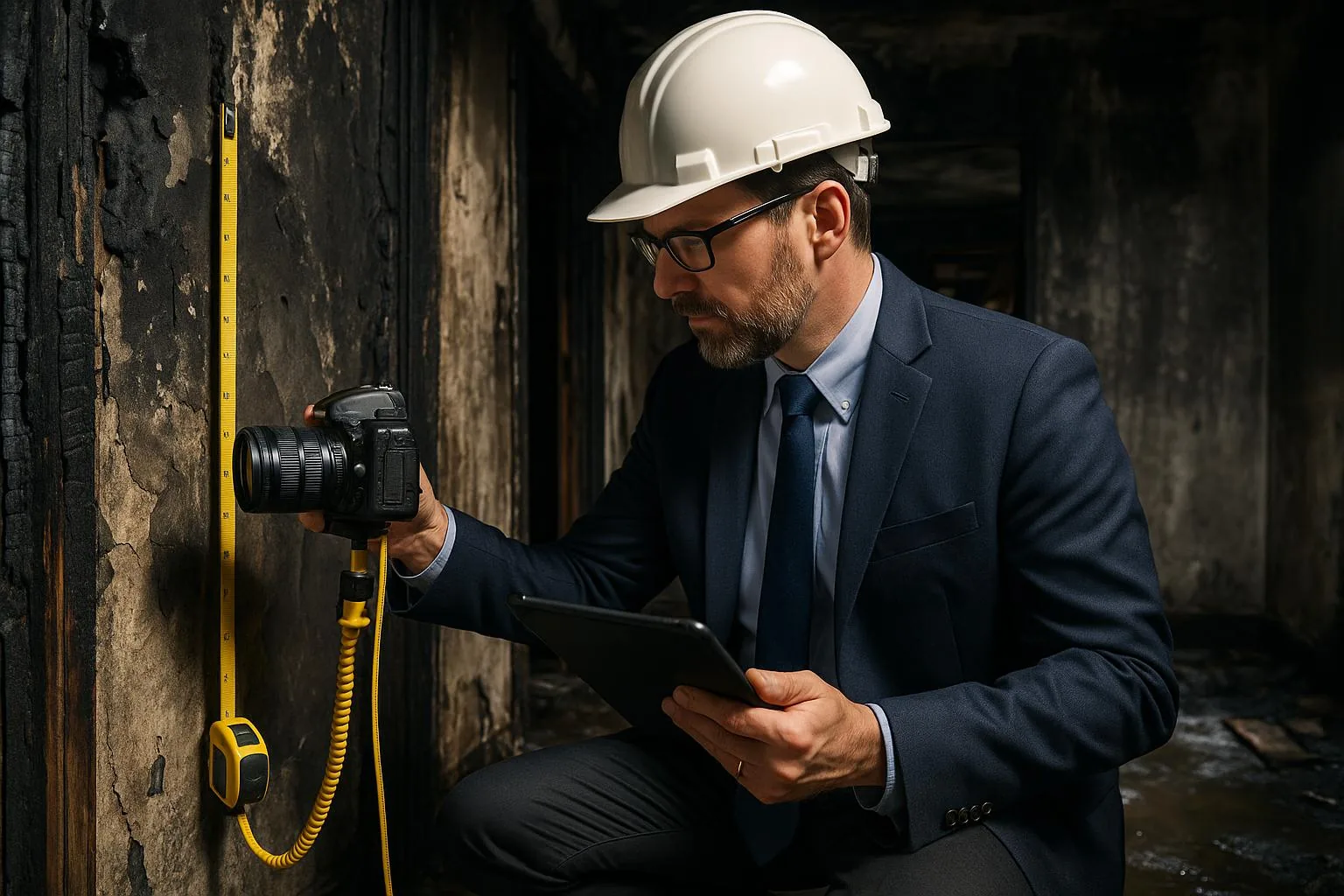
Stop the Damage Now - Dispatch a board-up, smoke, and soot mitigation crew
Smoke residue is acidic and continues etching surfaces every hour it sits. Board-up secures the property; soot mitigation stops the damage from spreading into unaffected rooms.
Most standard property policies obligate the insured to take reasonable steps to mitigate further damage. Failing to do so can give the carrier grounds to reduce or deny the claim.
Independent referral - no fees, no commissions. DCS does not accept any compensation from network vendors. Vendors are paid for their work through the insurance claim DCS is adjusting. Recommendations are based on what is best for your claim, not on who pays us.
Quick Answer
Smoke and soot damage is far more destructive than the fire itself, yet carriers often only pay for visible charring. Hidden particles in your HVAC and wall cavities are toxic and corrosive. DCS conducts specialized air quality and residue testing to document the full scope of contamination, pursuing settlements that cover complete remediation.
Smoke and Soot Travel Farther Than the Fire Ever Did
A kitchen fire that is extinguished in minutes can fill an entire home with acidic soot and toxic smoke residue. Smoke travels through every opening, penetrates HVAC systems, and deposits corrosive residue on every surface it touches. The visible char in the room of origin is only a fraction of the total loss.
Insurance adjusters frequently scope fire claims based on what they can see: the burned area. We scope fire claims based on what the smoke did, which is almost always far more extensive. Our inspections include air quality testing, HVAC contamination assessment, and a room-by-room evaluation of soot deposition and odor penetration.
- Toll Free:833-4UR-LOSS
- Texas Office:936-522-6627
- FL:954-849-3405
Common Damage Types We Document
- Structural Fire Damage: Charred framing, damaged drywall, burned flooring, and compromised structural members
- Smoke and Soot Damage: Acidic soot deposition on walls, ceilings, contents, and inside HVAC systems throughout the home
- Water Damage from Firefighting: Extensive water damage from fire suppression efforts, often affecting multiple floors
- Personal Property Loss: Burned, smoke-damaged, and water-damaged furniture, clothing, electronics, and valuables
- HVAC Contamination: Smoke and soot drawn into ductwork, deposited on coils, and distributed throughout the system
- Odor Penetration: Smoke odor absorbed into drywall, insulation, wood framing, and soft furnishings
The Chemistry of Fire: Why Smoke and Soot Are More Dangerous Than the Flames
Most people think of fire damage as what the flames burned. In reality, the smoke and soot produced by a fire are often more destructive and more expensive to remediate than the fire itself. Understanding the chemistry of combustion helps explain why smoke damage extends so far beyond the fire room and why it must be treated as a serious health and structural hazard.
When materials burn, they release a complex mixture of gases and particles. Burning plastics release hydrogen chloride (HCl), which combines with moisture to form hydrochloric acid. Burning wood releases acetic acid. Burning synthetic fabrics release hydrogen cyanide and other toxic compounds. The soot that settles on surfaces is not just carbon. It is a mixture of partially burned organic compounds, acids, and heavy metals that is corrosive to metals, textiles, and electronics.
Wet soot, produced by slow-burning fires with high moisture content, is sticky and smears easily. It is particularly damaging to porous surfaces like drywall, wood, and fabric. Dry soot, produced by fast-burning fires, is powdery and penetrates more deeply into porous materials. Protein soot, produced by burning food or grease, is nearly invisible but has an extremely strong odor and is very difficult to remove.
The HVAC system is one of the most critical areas to assess after a fire. If the system was running during or after the fire, it may have drawn smoke and soot throughout the entire duct system, depositing contamination in every room of the home. Simply cleaning visible surfaces without addressing HVAC contamination will result in ongoing odor and health issues.
Smoke odor is not just unpleasant. It is a sign that volatile organic compounds (VOCs) are still off-gassing from contaminated surfaces. Proper remediation requires not just cleaning but also sealing or replacing contaminated materials. Homes that are not properly remediated after a fire can have indoor air quality problems for years.
What You Need to Know
Personal Property Inventory
Creating a complete inventory of damaged personal property is one of the most time-consuming and important parts of a fire claim. Every item must be listed with its description, age, and replacement cost. We assist with this process and use professional contents specialists when the volume of loss is large.
What Your Policy Covers After a Fire — and the Caps, Caveats & Endorsements That Decide the Payout
A fire claim is won or lost on policy details most homeowners never see until they file. These are the coverage caveats, sublimits, and endorsements that most often move the number on a Texas or Florida fire and smoke claim — and how DCS handles each.
Smoke and soot are covered everywhere they traveled — not just the burn room
Direct physical loss from fire includes the smoke and soot damage the fire produced, which migrates through HVAC ducts, wall cavities, and every opening into rooms far from the origin. Carriers routinely scope only the visibly charred area. DCS documents soot deposition, odor penetration, and HVAC contamination room by room so the covered scope reflects where the smoke actually went, not just where the flames reached.
Ordinance or Law pays the code-upgrade cost of rebuilding
Standard policies pay to rebuild what was there — not to bring the undamaged portions up to current electrical, structural, or life-safety code, which modern codes often require when you rebuild. Ordinance or Law coverage funds that gap and is usually written in three parts: loss to the undamaged portion, demolition cost, and increased cost of construction. It is one of the most commonly unclaimed fire-coverage dollars; DCS confirms the endorsement and scopes every code-driven upgrade.
Contents are paid at ACV unless you have Replacement Cost contents
Without a Replacement Cost contents endorsement, smoke- and fire-damaged personal property is paid at Actual Cash Value — replacement cost minus depreciation — which can cut a contents payment dramatically on older furniture, clothing, and electronics. With the endorsement, the depreciation is recoverable once items are replaced and documented. DCS builds the full room-by-room inventory and tracks the recoverable depreciation through to payment.
Debris removal is usually a percentage add-on with its own cap
Removing fire debris, demolition, and hauling is covered, but the standard form typically funds it as an additional amount equal to a set percentage of the loss (commonly around 5 percent of the direct damage) before a separate sub-limit applies. On a heavy fire, debris and demolition can exceed that built-in amount. DCS scopes debris and demolition as distinct line items and flags when the percentage add-on is being exhausted.
Recoverable depreciation is held back until you complete repairs
On a replacement-cost policy, the carrier commonly pays Actual Cash Value first and releases the 'recoverable depreciation' only after the rebuild is finished and invoiced — money many homeowners never go back to collect. DCS documents the completed scope and submits the supplement so the held-back depreciation is actually recovered, not forfeited.
A coinsurance shortfall can penalize an underinsured rebuild
Many policies require Coverage A to be carried at a set percentage of full replacement cost (often 80 percent). If the dwelling limit was set too low, a coinsurance penalty can proportionally reduce even a partial fire payment. DCS reviews the declarations and replacement-cost basis early so this penalty is identified and addressed rather than discovered at settlement.
Additional Living Expense / Loss of Use covers displacement
When fire or smoke makes the home uninhabitable, Coverage D (Additional Living Expense / Loss of Use) pays the increased cost of temporary housing, meals above your normal grocery budget, pet boarding, laundry, and storage for the reasonable time to repair or rebuild. ALE is one of the most underused fire coverages. DCS tracks displacement costs from day one and pursues the full reasonable period.
Smoke-contaminated electronics: replace, do not just wipe clean
Soot is acidic and electrically conductive, so smoke-exposed electronics can pass a power-on test and then fail weeks later from internal corrosion. Carriers often try to 'clean' rather than replace. DCS documents the contamination against industry restoration criteria and advocates replacement when cleaning cannot reasonably guarantee reliable function.
Coverage varies by carrier, policy form, and endorsement. These are common patterns in Texas and Florida homeowner and commercial property policies — not a description of your specific policy. Review your declarations page and endorsements, or have DCS review them with you. Educational information, not legal advice.
Handling the Claim Yourself vs Engaging DCS PIA
Texas policyholders have the right to negotiate their own claim. Hiring a licensed public insurance adjuster is optional. The table below sets out, side by side, how the same claim tasks get done in each path so you can make an informed decision.
| Claim handling task | Self-represented | DCS PIA representation |
|---|---|---|
| Statute deadline tracking (Tex. Ins. Code §§ 542.055-542.057) | Manual calendar; missed deadlines do not always trigger remedies without documentation. | Structured Chapter 542 timeline maintained from day one; every carrier action timestamped. |
| Scope of loss documentation | Photos plus a written list; rarely matches the carrier's estimating system line-by-line. | Xactimate estimate built in the same software the carrier uses, line-item-matched to scope. |
| Hidden or secondary damage assessment | Visible damage only. | Moisture mapping, thermal imaging, and engineering referrals when warranted; ensuing-loss tracking. |
| Appraisal clause invocation when valuation differs | Available to any insured but rarely invoked because the policy mechanic is unfamiliar. | Invoked when carrier scope materially undervalues the loss; appraisal and umpire fees disclosed up front. |
| Supplement filings for damage discovered during repair | Often skipped after the initial check is cashed. | Tracked through repair; supplement scopes filed against the carrier as new damage is exposed. |
| Additional Living Expense / Extra Expense documentation | Receipts assembled at the end of displacement, often incomplete. | Receipt and mileage log discipline from day one; ALE / Extra Expense submitted per policy form. |
| Mold sub-limit endorsement pursuit | Frequently left unclaimed. | Mold cause, species, and remediation protocol documented to IICRC S520; sub-limit pursued. |
| Fee structure | No third-party fee. You handle the claim yourself. | Contingency fee capped under Tex. Ins. Code § 4102.158; no recovery, no fee. Hiring a public adjuster is optional under Texas law. |
Educational comparison, not legal advice. Hiring a Texas-licensed public insurance adjuster is optional and capped at 10% of the recovery under Tex. Ins. Code § 4102.158. Public adjusters represent policyholders on claim valuation and negotiation. Legal claims for bad faith or prompt-payment damages are handled by attorneys, not public adjusters.
Tips That Protect Your Claim
Do Not Re-Enter Until Cleared
Wait for the fire marshal to declare the structure safe before re-entering. Structural damage, toxic air quality, and electrical hazards are serious risks in a fire-damaged home.
Do Not Run the HVAC
If your HVAC system ran during or after the fire, it may have distributed soot throughout the ductwork. Do not run the system again until it has been professionally inspected. Running it will spread contamination further.
Document Before Any Cleanup
Photograph every room, every surface, and every damaged item before any cleaning or restoration work begins. Once surfaces are cleaned, the evidence of the extent of smoke damage is gone.
Save All Damaged Items
Do not discard any damaged personal property until it has been inventoried and documented. The insurance company adjuster needs to see the damage to pay for it.
Track All Living Expenses
If you cannot live in your home, track every hotel, meal, and other additional expense from the first day. These are reimbursable under your Additional Living Expenses coverage.
Do Not Accept a Quick Settlement
Fire claims are among the most complex and most frequently undervalued. A quick settlement offer almost never reflects the true cost of restoration. Contact us before accepting anything.
How to Reduce Your Risk
Install interconnected smoke alarms on every level of your home, inside every bedroom, and outside every sleeping area. Test them monthly.
Never leave cooking unattended. Cooking is the leading cause of residential fires in the United States.
Keep a fire extinguisher in the kitchen and know how to use it. Replace or recharge it after any use.
Have your chimney cleaned and inspected annually if you use a fireplace or wood stove.
Do not overload electrical outlets or use damaged extension cords. Have an electrician inspect your home if you have older wiring.
Keep dryer lint traps clean and have the dryer vent duct cleaned annually. Dryer fires are a leading cause of residential fires.
Store flammable liquids in approved containers away from heat sources.
Create and practice a home fire escape plan with two exits from every room and a designated meeting point outside.
Critical: Protect Your Claim Before Starting Any Repairs
Do not begin full repairs until your claim is fully settled. Damage is evidence. Altering or removing it before your insurer has properly documented it can eliminate coverage entirely. Insurance companies only pay for what can be proven. Only perform emergency repairs necessary to prevent further damage, and document everything with photos and video before touching anything.
What to Do Right Now
Get Everyone Out and Call 911
Your life and the lives of your family members are the only priority. Do not attempt to fight a fire that has spread beyond a small, contained area.
Wait for the All-Clear
Do not re-enter the structure until the fire department and fire marshal have declared it safe. Structural instability and toxic air are serious hazards even after the flames are out.
Document Everything Before Cleanup
Photograph every room, every wall, every ceiling, and every damaged item before any cleaning begins. Capture the soot lines, water damage from firefighting, and the extent of smoke spread throughout the home.
Secure the Property
Board windows and doors if needed to prevent unauthorized entry. Your policy requires you to protect the property from further damage.
Contact Your Insurance Company
Report the claim and write down the claim number and adjuster name. Do not give a recorded statement without representation.
Contact DCS PIA Immediately
Fire claims are time-sensitive. Soot begins permanently etching surfaces within 72 hours. We will mobilize quickly to document the full extent of damage before it worsens.
Create a Personal Property Inventory
Begin listing every damaged item: furniture, clothing, electronics, appliances, and valuables. Photograph each item. This inventory is the foundation of your personal property claim.
Track All Living Expenses
Save every receipt for hotel, food, clothing, and other expenses incurred because you cannot live in your home. These are reimbursable under your policy.
Only a Fool Represents Themselves
Fire claims are the most complex and most frequently undervalued claims in residential insurance. The scope of damage extends far beyond what is visible, the personal property inventory is enormous, and the restoration process involves dozens of decisions that affect your final settlement. Navigating this alone, against a carrier whose adjuster has handled hundreds of fire claims, is an enormous disadvantage.
Smoke damage to rooms far from the fire is routinely missed by insurance adjusters who focus on the visible burn area. We inspect every room and every surface.
HVAC contamination is almost always underestimated or excluded from initial estimates. Proper assessment requires specialized testing, not just a visual inspection.
Personal property inventories are time-consuming and emotionally exhausting. Without professional assistance, policyholders routinely miss items and undervalue what they do document.
Ordinance and Law coverage, which pays for code-required upgrades during rebuilding, is frequently left unclaimed because policyholders do not know it exists.
The emotional toll of a house fire makes it extremely difficult to negotiate effectively. Having a professional advocate removes you from the negotiation and lets you focus on your family.
The insurance company has a team of professionals working for them. You deserve one working for you.
Get a Licensed Public Adjuster on Your SideWhy Policyholders Trust DCS PIA
We bring carrier-side experience, construction expertise, and genuine care to every claim.
We have handled fire claims ranging from kitchen fires to total losses and know how to document the full scope of smoke and soot damage.
We work with certified industrial hygienists and air quality specialists to document HVAC contamination and smoke penetration.
Our personal property specialists help you build a complete inventory so you do not leave any covered loss unclaimed.
We work on contingency. No recovery means no fee.
DCS personnel bring a background in construction and remodeling that supports a deep understanding of restoration costs and building code requirements.
Frequently Asked Questions
Related Texas Claim Types We Handle
Property losses rarely fall into a single category. Explore related claim types DCS PIA documents and negotiates for Texas policyholders — each handled on a no recovery, no fee basis.
More Related Claim Types
A Property Claim Is a Process With Tripwires — Not Just a Form
Filing is the easy part. Once you report a loss, the carrier runs a process governed by your policy’s conditions and tight statutory deadlines — and most underpaid and denied claims trace back to a single step the policyholder never knew was load-bearing.
A fire claim hinges on policy lines homeowners rarely see until they need them — full-home smoke and soot scope versus the visible burn room, Ordinance or Law dollars for code-required rebuild upgrades, debris-removal limits, contents paid at depreciated value without a replacement-cost endorsement, and a coinsurance penalty if Coverage A was set below replacement cost.
Duties After Loss
Your policy pays only if you satisfy its post-loss conditions — prompt notice, protecting the property from further damage, documenting and itemizing what was lost, producing records, and cooperating with the investigation (including a possible examination under oath). Fall short on one and the carrier can reduce or deny the claim.
Reservation of Rights (ROR)
A reservation-of-rights letter means the carrier is investigating while reserving the right to deny coverage later. It signals the claim is contested — not a settlement — and it changes how every photo, statement, and estimate should be handled from that point forward.
Request for Information (RFI)
Carriers send repeated requests for documents, receipts, measurements, and recorded statements. Incomplete or late responses stall the file and become the carrier’s stated reason to delay payment or pay less than the loss is worth.
Proof of Loss (POL)
A sworn proof of loss is a signed, deadline-bound itemization of your damages. Understate it, overstate it, or miss the deadline, and the figure on that form can be used to cap — or contest — your recovery.
The carrier is also on a clock. Under Texas Insurance Code §542 (the Prompt Payment of Claims Act) it has fixed deadlines to acknowledge, decide, and pay a covered claim — roughly 15 / 15 / 5 days — and owes 18% annual interest when it misses them. See the full Texas claim-deadline rules →
Each of these is a place a legitimate claim quietly loses value. This is why policyholders hire DCS PIA — Dependable Claims Specialists, licensed public insurance adjusters — to document the loss, build the proof of loss, answer the carrier’s requests on time, and negotiate the valuation correctly from day one. You handle one claim in your life; the carrier handles thousands. A public adjuster levels that.
DCS represents policyholders on claim valuation and negotiation. Interpreting your legal rights, bad-faith, and litigation are matters for a licensed attorney — not a public adjuster. This is general educational information, not legal advice.
Educational Information - Not Legal Advice
The information on this page is for general educational purposes only. Dependable Claims Specialists is a licensed public adjusting firm - not a law firm. Public adjusters help policyholders inspect, document, evaluate, and negotiate property insurance claims, which includes reading and applying your policy in the ordinary course of adjusting (coverage parts, exclusions, endorsements, scope). We do not practice law and we do not provide legal advice. For legal opinions, demand letters, Chapter 542A pre-suit notices, statutory remedies under the Insurance Code, or litigation, consult a licensed attorney in your state. Texas public adjusters operate under TX Ins. Code Chapter 4102; Florida public adjusters operate under FL Statute §626.854.
