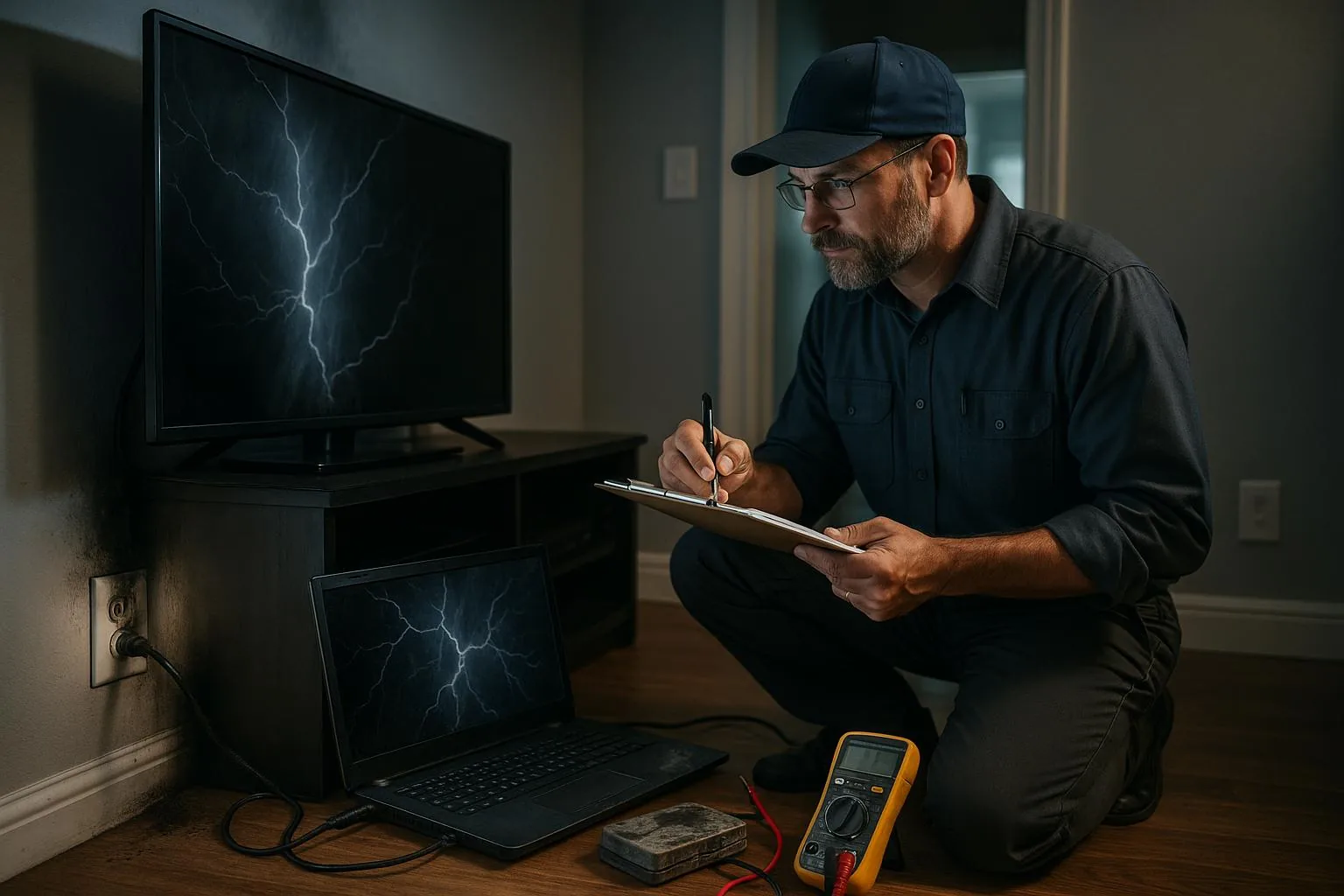
Stop the Damage Now - Dispatch a licensed electrician for a safety inspection
Lightning damage to wiring and electronics is often invisible until it ignites a fire later. A licensed electrical inspection documents the surge damage and clears the property for re-energization.
Most standard property policies obligate the insured to take reasonable steps to mitigate further damage. Failing to do so can give the carrier grounds to reduce or deny the claim.
Independent referral - no fees, no commissions. DCS does not accept any compensation from network vendors. Vendors typically bill their work to the insurance claim; coverage depends on your policy and the claim outcome. Recommendations are based on what is best for your claim, not on who pays us.
Quick Answer
Lightning strike insurance claims are frequently undervalued because adjusters only scope visible charring or fire damage, ignoring internal electrical surges that fry wiring, HVAC systems, and appliances. A licensed public adjuster documents the hidden electrical damage and pursues the complete system replacement your policy provides.
Lightning Damage Is Rarely Limited to the Strike Point
When lightning strikes a home or the ground nearby, the electrical surge travels through every conductive path it can find. This includes your electrical wiring, plumbing, cable and phone lines, and any appliance or electronic device connected to those systems. The visible damage at the strike point, such as a scorched roof or shattered tree, is often the least expensive part of the claim.
The hidden damage to electrical systems, appliances, HVAC equipment, and structural components is where the real cost lies. We inspect every system in the home and document all damage caused by the lightning event, not just what is visible on the surface.
- Toll Free:833-4UR-LOSS
- Texas Office:936-522-6627
- Florida Office:954-849-3405
Common Damage Types We Document
- Electrical System Damage: Damaged wiring, breakers, panels, outlets, and fixtures throughout the home
- Appliance and Electronics Damage: Refrigerators, ovens, washers, dryers, televisions, computers, and smart home devices
- HVAC System Damage: Air handlers, compressors, thermostats, and control boards damaged by electrical surge
- Structural Damage: Roof damage, chimney damage, and structural damage at the strike point
- Plumbing System Damage: Damage to water heaters, pumps, and fixtures connected to grounded plumbing
- Fire Risk: Lightning strikes can ignite fires in attics, walls, and structural cavities that may not be immediately visible
The Physics of Lightning: How a Strike Damages an Entire Home
Lightning is one of the most powerful forces in nature. Understanding how it behaves when it strikes a structure explains why the damage is so extensive and why a thorough inspection of every system is essential.
A lightning bolt carries an enormous amount of electrical energy in an extremely short time. When it strikes a home, the energy must find a path to ground. It travels through any conductive material available, including electrical wiring, plumbing pipes, cable and telephone lines, and structural metal components. The surge travels at the speed of light through these pathways, overwhelming the capacity of any device connected to them.
Surge protectors and circuit breakers are designed to handle normal electrical fluctuations. A direct or nearby lightning strike produces a surge that is orders of magnitude beyond what these devices are designed to handle. A whole-house surge protector reduces but does not eliminate the risk. Even a nearby strike that does not directly hit the home can induce a damaging surge through the power lines serving the property.
Fire is a serious secondary risk from lightning. The enormous heat of the strike can ignite wood framing, insulation, and other combustible materials in the attic or within wall cavities. These fires can smolder for hours before becoming visible. If your home is struck by lightning, contact the fire department to check for hidden fire. If you notice smoke, burning odors, sparks, or other danger, leave safely and call 911. Do not enter an attic or wall cavity to investigate.
Common ways lightning claims are minimized include limiting the scope to only the visible strike point, excluding appliances and electronics that were not specifically listed in the claim, arguing that appliance failures were due to age rather than the lightning event, and disputing whether a nearby strike (rather than a direct strike) caused the damage. We document the lightning event with weather records and inspect every system to build a complete claim.
What You Need to Know
Direct Strike vs. Side Flash vs. Ground Current
Lightning can damage a home through a direct strike, a side flash (when lightning jumps from a struck object to a nearby structure), or ground current (when the electrical energy spreads outward through the ground from the strike point). All three can cause significant damage. We document the type of strike and how it affected the structure.
What Your Policy Covers After a Lightning Strike - and the Surge Caveats, Caps & Endorsements That Decide the Payout
A lightning claim is won by proving the strike and inventorying every system it touched. These are the coverage caveats, sublimits, and endorsements that most often move the number on a Texas or Florida lightning-damage claim - and how DCS handles each.
Direct lightning is covered - non-lightning power surge may not be
Lightning is a named peril on virtually every homeowner policy, so damage from a direct or nearby strike is covered. But a power surge that is NOT caused by lightning (a utility fault, a downed line, a transformer failure) is treated differently and may be excluded unless an Equipment Breakdown or power-surge endorsement is in force. The entire claim can turn on this cause classification, so DCS documents the lightning event with certified lightning-strike verification data from national lightning-detection networks tying a strike to your address and time, defeating a 'general surge' label.
Equipment Breakdown may matter for a separate covered failure
A covered lightning strike may damage appliances, HVAC components, wiring, and other insured equipment under the applicable dwelling or contents coverage. DCS documents the cause of each failure and checks valuation terms, limits, and exclusions. We also review any Equipment Breakdown endorsement (sometimes called home systems protection) when it is relevant to a separate covered failure.
Electronics and appliances are frequently paid at ACV
Many policies settle damaged electronics and appliances at Actual Cash Value - replacement cost minus depreciation for age and condition - unless you carry replacement-cost coverage on contents. A three-year-old TV or a ten-year-old refrigerator can be depreciated heavily. DCS confirms the contents valuation method on your declarations and, where replacement cost applies, tracks the recoverable depreciation holdback through to recovery after items are replaced.
A complete device-by-device inventory drives the number
Lightning damage is paid on what you can document. DCS builds a room-by-room inventory of every affected appliance, electronic, and device with make, model, serial number, and age, paired with a licensed electrician's findings on surge-specific failure modes (burned circuit boards, blown traces). Items left off the inventory are simply not paid, so completeness is the single biggest lever on a lightning settlement.
Resulting fire is covered as a separate fire loss
When a strike ignites framing or insulation in the attic or a wall cavity, that fire damage is covered under the fire peril - including smoke damage and the water damage from extinguishing it. These fires can smolder unseen for hours. DCS documents the strike point, the fire-spread pattern, and the full structural, smoke, and firefighting-water scope so the fire half of the loss is not collapsed into a few patched shingles.
Whole-house surge protection does not cap your recovery
Having a surge protector installed does not by itself reduce what the policy may cover after a strike that overwhelms it - a direct or nearby lightning surge is orders of magnitude beyond what point-of-use or panel devices are rated to absorb. Carriers sometimes imply protected homes should have less damage. DCS rebuts that with the electrician's findings showing the surge exceeded the device's clamping capacity.
Required electrician inspection and code upgrades belong in the claim
After a strike, a licensed electrician must inspect the system before the home is reoccupied, and damaged wiring that fails inspection has to be replaced. The cost of that inspection and any code-required upgrades triggered by the repair are typically part of the covered loss (and may draw on Ordinance or Law coverage). DCS makes sure the inspection fee and code-driven electrical work are scoped, not absorbed by the homeowner.
Coverage varies by carrier, policy form, and endorsement. These are common patterns in Texas and Florida homeowner and commercial property policies - not a description of your specific policy. Review your declarations page and endorsements, or have DCS review them with you. Educational information, not legal advice.
Handling the Claim Yourself vs Engaging DCS PIA
Texas policyholders can negotiate their own claim. Hiring a licensed public insurance adjuster is optional. The table below sets out, side by side, how the same claim tasks get done in each path so you can make an informed decision.
| Claim handling task | Self-represented | DCS PIA representation |
|---|---|---|
| A dated record of the claim | A manual calendar and a memory of phone calls; hard to reconstruct months later. | Every carrier contact, request, inspection and payment logged and timestamped from day one. |
| Scope of loss documentation | Photos plus a written list; rarely matches the carrier's estimating system line-by-line. | Xactimate estimate built in the same software the carrier uses, line-item-matched to scope. |
| Hidden or secondary damage assessment | You decide what to document. | Moisture mapping, thermal imaging, and engineering referrals when warranted; ensuing-loss tracking. |
| Appraisal clause invocation when valuation differs | Available to any insured under the policy appraisal clause. | Invoked when carrier scope materially undervalues the loss; appraisal and umpire fees disclosed up front. |
| Supplement filings for damage discovered during repair | You prepare the claim. | Tracked through repair; supplement scopes filed against the carrier as new damage is exposed. |
| Additional Living Expense / Extra Expense documentation | Receipts assembled at the end of displacement, often incomplete. | Receipt and mileage log discipline from day one; ALE / Extra Expense submitted per policy form. |
| Mold sub-limit endorsement pursuit | Your choice. | Mold cause, species, and remediation protocol documented to IICRC S520; sub-limit pursued. |
| Fee structure | No third-party fee. You handle the claim yourself. | In Texas: no recovery, no fee, and the public adjuster fee is capped under Tex. Ins. Code § 4102.104. Florida claims follow a separate written agreement. Hiring a public adjuster is optional. |
Educational comparison, not legal advice. Hiring a Texas-licensed public insurance adjuster is optional and capped at 10% of the recovery under Tex. Ins. Code § 4102.104. Public adjusters represent policyholders on claim valuation and negotiation. Legal claims for bad faith or prompt-payment damages are handled by attorneys, not public adjusters.
Tips That Protect Your Claim
Document the Strike Point When Safe
After emergency responders have cleared the scene, photograph damage from a safe location. Do not enter unsafe areas, handle damaged electrical equipment, or delay urgent safety work to take photographs.
List Every Affected Appliance and Electronic
After emergency responders have cleared any fire hazard and a licensed electrician has confirmed the electrical system is safe, inventory affected appliances and electronics. Have qualified technicians test suspected surge-damaged equipment; do not energize or handle damaged devices yourself.
Have the Fire Department Check for Hidden Fire
If your home is struck by lightning, contact the fire department to check for hidden fire. If you notice smoke, burning odors, sparks, or other danger, leave safely and call 911. Do not enter an attic or wall cavity to investigate.
Do Not Use the Electrical System Until Inspected
Have a licensed electrician inspect the entire electrical system before using it after a lightning strike. Damaged wiring is a fire and shock hazard.
Obtain Weather Records
Request weather records or lightning strike data for your address on the date of the event. This documentation supports the cause of loss.
Report Promptly
Report the claim to your insurer as soon as possible. Some policies have time limits for reporting lightning damage.
How to Reduce Your Risk
Install a whole-house surge protector at your electrical panel. This provides the first line of defense against lightning-induced surges.
Use point-of-use surge protectors for all valuable electronics and appliances.
Consider a lightning protection system (lightning rods and grounding cables) for your home if you are in a high-lightning area.
Unplug valuable electronics before a storm arrives, if it is safe to do so. Once thunder is nearby, avoid touching electrical equipment, cords, and outlets.
Install surge-protected power strips for home entertainment systems and computers.
Have your electrical panel inspected if your home is more than 20 years old. Older panels may not handle surges as well as modern equipment.
Keep trees trimmed away from the home to reduce the risk of a struck tree causing damage to the structure.
Install a battery backup for your sump pump to protect against flooding during power outages caused by lightning.
Critical: Document the Damage Before Permanent Repairs
Protect people first, notify your insurer promptly, and document damage before repairs when safe. Take photos or video, keep receipts, and give the insurer a reasonable opportunity to inspect before nonurgent permanent repairs where practical. Do not wait for a claim to settle before addressing urgent safety needs or preventing further damage. Follow qualified professional and public-health guidance for contaminated or hazardous materials; document them safely before disposal when possible, but do not keep unsafe items merely for an inspection.
What to Do Right Now
Ensure Safety First
If your home is struck by lightning, contact the fire department to check for hidden fire. If you notice smoke, burning odors, sparks, or other danger, leave safely and call 911. Do not enter an attic or wall cavity to investigate.
Document the Strike Point and All Damage
After emergency responders have cleared the scene, photograph damage from a safe location. Do not enter unsafe areas or handle damaged electrical equipment.
List Every Affected Device
After emergency responders have cleared any fire hazard and a licensed electrician has confirmed the electrical system is safe, inventory affected appliances and electronics. Have qualified technicians test suspected surge-damaged equipment; do not energize or handle damaged devices yourself.
Have the Electrical System Inspected
Call a licensed electrician to inspect the entire electrical system before reoccupying the home.
Report the Claim to Your Insurer
Notify your insurance company promptly. Obtain the claim number and adjuster name.
Contact DCS PIA Before the Adjuster Arrives
We will document all affected systems and ensure the full scope of damage is included in your claim.
Do Not Accept a Settlement Without Review
Lightning claims are frequently scoped incompletely. Review any settlement offer with us before accepting.
Why Professional Representation Matters
Lightning damage claims are frequently undervalued because adjusters focus on the visible strike point and miss the extensive damage to electrical systems, appliances, and structural components throughout the home. Without a systematic inspection of every system, significant damage goes undocumented and unpaid.
Adjusters often limit the scope to the visible strike point and do not inspect every electrical circuit and appliance.
Appliance and electronics claims require detailed documentation. Without a complete inventory, items are missed.
Disputes about whether appliance failures were caused by the lightning event or by pre-existing age require evidence and expertise to resolve.
Attic and structural damage from lightning-ignited fires is frequently missed in initial inspections.
Electrical system repair costs are often underestimated in initial estimates. We ensure all required repairs are included.
The insurance company has a team of professionals working for them. You deserve one working for you.
Why Policyholders Trust DCS PIA
We bring carrier-side experience, construction expertise, and genuine care to every claim.
We inspect every system in the home after a lightning event, not just the visible strike point.
We work with licensed electricians to document electrical system damage and ensure repair costs are complete.
We work on contingency. No recovery means no fee.
Our construction background gives us a detailed understanding of electrical system repair costs.
We have handled lightning damage claims across Texas and Florida and know the common scope disputes.
Frequently Asked Questions
Related Texas Claim Types We Handle
Property losses rarely fall into a single category. Explore related claim types DCS PIA documents and negotiates for Texas policyholders - each handled on a no recovery, no fee basis.
More Related Claim Types
A Property Claim Is a Process With Tripwires - Not Just a Form
Filing is the easy part. Once you report a loss, the carrier runs a process governed by your policy’s conditions and by timelines that move faster than most people expect - and most underpaid and denied claims trace back to a single step the policyholder never knew was load-bearing.
Lightning claims hinge on whether the damage was a direct strike (covered under the lightning peril) or a power surge (which may need a separate endorsement) - and on inventorying every fried appliance, HVAC board, and length of wiring before the carrier scopes only the visible strike point.
Duties After Loss
Policies impose duties after loss, which may include prompt notice, reasonable protection from further damage, records and cooperation. Follow the requirements in your policy. The effect of any alleged failure depends on the policy, facts and law; ask an attorney about legal consequences or an examination under oath.
Reservation of Rights (ROR)
A reservation-of-rights letter means the carrier is investigating while reserving the right to deny coverage later. It signals the claim is contested - not a settlement - and it changes how every photo, statement, and estimate should be handled from that point forward.
Request for Information (RFI)
Carriers send repeated requests for documents, receipts, measurements, and recorded statements. Incomplete or late responses stall the file and become the carrier’s stated reason to delay payment or pay less than the loss is worth.
Proof of Loss (POL)
A sworn proof of loss is a signed, deadline-bound itemization of your damages. Understate it, overstate it, or miss the deadline, and the figure on that form can be used to cap - or contest - your recovery.
A claim moves at the speed of its documentation. Your policy sets out what you agreed to do after a loss - report it promptly, protect the property from further damage, keep records, and provide the information your carrier asks for. Meeting those obligations, with a scope that reflects the real damage, is what keeps a claim moving. That documentation work is exactly what a licensed public adjuster does.
Each of these is a place a legitimate claim quietly loses value. This is why policyholders hire DCS PIA - Dependable Claims Specialists, licensed public insurance adjusters - to document the loss, build the proof of loss, answer the carrier’s requests on time, and negotiate the valuation correctly from day one. You handle one claim in your life; the carrier handles thousands. A public adjuster levels that.
DCS represents policyholders on claim valuation and negotiation. Interpreting your legal rights, bad-faith, and litigation are matters for a licensed attorney - not a public adjuster. This is general educational information, not legal advice.
Educational Information - Not Legal Advice
The information on this page is for general educational purposes only. Dependable Claims Specialists is a licensed public adjusting firm - not a law firm. Public adjusters help policyholders inspect, document, evaluate, and negotiate property insurance claims, which includes reading and applying your policy in the ordinary course of adjusting (coverage parts, exclusions, endorsements, scope). We do not practice law and we do not provide legal advice. For legal opinions, demand letters, Chapter 542A pre-suit notices, statutory remedies under the Insurance Code, or litigation, consult a licensed attorney in your state. Texas public adjusters operate under TX Ins. Code Chapter 4102; Florida public adjusters operate under FL Statute §626.854.
