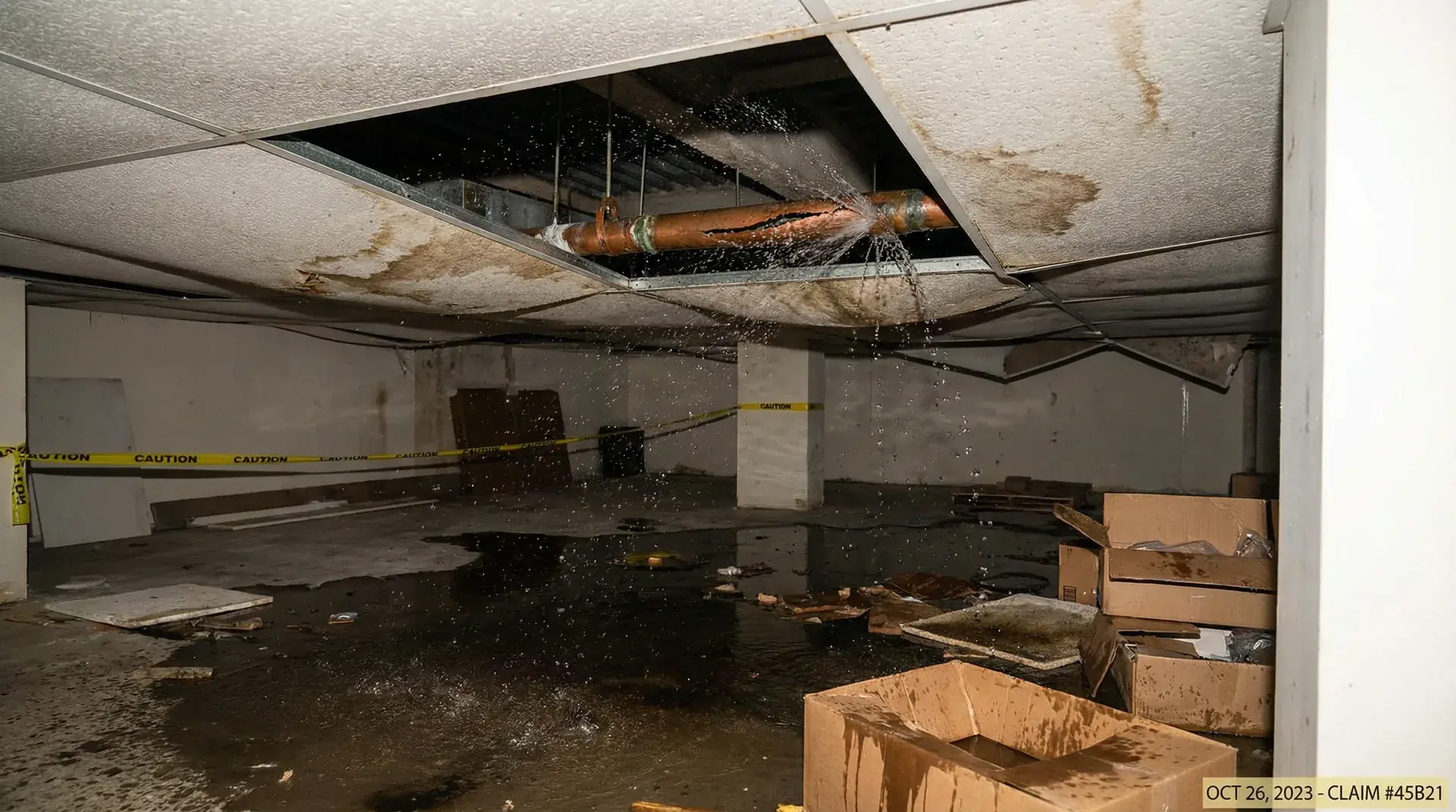
Stop the Damage Now - Dispatch a commercial plumber and water mitigation team
Commercial plumbing losses often touch multiple suites, common areas, and BI coverage. Stop the source and dry the structure before the operational impact escalates.
Most standard property policies obligate the insured to take reasonable steps to mitigate further damage. Failing to do so can give the carrier grounds to reduce or deny the claim.
Independent referral - no fees, no commissions. DCS does not accept any compensation from network vendors. Vendors are paid for their work through the insurance claim DCS is adjusting. Recommendations are based on what is best for your claim, not on who pays us.
Quick Answer
Commercial plumbing claims are often wrongfully denied as 'maintenance issues' or undervalued by adjusters who ignore hidden moisture migration. A licensed public adjuster uses thermal imaging and moisture mapping to prove the leak was sudden and accidental, working to ensure your business recovers the full cost of structural drying, mold remediation, and business interruption.
Commercial Plumbing Claims Are Rarely What They Appear to Be on Paper
A plumbing leak at a commercial property can cause damage that extends far beyond the visible wet area. Water migrates through walls, under flooring, and into structural cavities, creating conditions for mold growth and long-term structural deterioration. The full scope of damage is rarely visible without moisture mapping and thermal imaging.
Commercial plumbing claims are among the most disputed property claims in both Texas and Florida. Carriers routinely challenge them on four fronts: whether the loss was sudden and accidental (vs. gradual/maintenance), whether the scope of secondary damage is covered, whether mold remediation is included, and whether the business interruption period is justified.
The most common point of failure is the distinction between "the leak" and "the damage the leak caused." Commercial property policies typically exclude the cost of repairing the failed pipe itself (considered a maintenance cost), but they cover the ensuing damage,saturated drywall, insulation, subfloor, cabinetry, fixtures, contents and the business interruption that follows. Understanding that line is the difference between a five-figure offer and a six-figure settlement on the same loss.
There is also a category-of-water problem unique to commercial losses. Category 1 (clean water) claims are settled differently from Category 2 (gray water) and Category 3 (black water / sewer backup) losses. Carriers sometimes concede a loss occurred but dispute the category to avoid paying antimicrobial protocols, selective demolition, and contents disposal. Getting the category right,with documentation from a licensed water-damage restorer operating under the IICRC S500 standard,is often worth tens of thousands of dollars in recovery.
We document the source, path, category, class and full extent of water damage using professional moisture mapping equipment and IICRC-standard restoration documentation, then present a complete claim that includes all affected materials, contents, mold remediation, and business interruption losses.
- Toll Free:833-4UR-LOSS
- Texas Office:936-522-6627
- FL:954-849-3405
Common Damage Types We Document
- Structural Water Damage: Water damage to walls, floors, ceilings, insulation, and structural framing caused by the plumbing leak.
- Business Personal Property: Damage to equipment, inventory, furniture, and business personal property caused by water intrusion.
- Mold and Microbial Growth: Secondary mold growth resulting from water intrusion that was not immediately detected or remediated.
- Business Interruption: Lost revenue and continuing expenses during the period your business operations are suspended due to covered water damage.
- Remediation and Restoration: The cost of professional water extraction, drying, dehumidification, antimicrobial treatment and structural restoration.
- Code Upgrade Requirements: Code-required upgrades triggered by the repair work, which may be covered under Ordinance or Law coverage.
- Equipment Breakdown Overlap: When the failure originates in mechanical equipment (water heater, chiller, boiler), Equipment Breakdown endorsements may apply in addition to property coverage.
- Access and Repair Costs: The cost of breaking and restoring concrete slabs, walls or floors to access the failed line is often a disputed coverage question.
How Commercial Plumbing Leaks Cause Damage
Water from a plumbing leak follows the path of least resistance, migrating through wall cavities, under flooring, and into structural assemblies. In commercial buildings, water can travel significant distances from the source before becoming visible, and in multi-story structures it routinely moves down between floors. The IICRC S500 standard,the industry reference for water-damage restoration,identifies the initial 24 to 48 hour window as the point at which microbial growth typically begins in concealed water-damaged materials. Moisture meters and thermal imaging cameras are the documented methods for mapping concealed water migration. Without proper moisture mapping, portions of the damage may be missed in the initial claim, and once walls are closed back up the opportunity to document concealed damage is substantially harder to recover.
- Water damage is consistently among the most common commercial property insurance claims.
- Secondary mold remediation can materially increase the total cost of a commercial water damage loss relative to dry-out-only scope.
- Scope-of-damage disputes are a common reason commercial water claims are underpaid or denied.
- Category of water (IICRC S500 Category 1, 2, or 3) directly drives the required remediation protocol,and therefore the claim value.
- Business interruption losses are calculated separately from property damage, and both are potentially recoverable under most commercial property policies with the appropriate endorsement.
- The IICRC S500 standard defines industry-accepted drying goals, sanitation protocols, and documentation requirements for water-damage remediation.
What You Need to Know
Is my commercial plumbing leak covered, or will the carrier call it a maintenance issue?
Commercial property policies typically cover water damage from sudden and accidental plumbing failures, but exclude damage resulting from gradual leaks, deferred maintenance, or deterioration. Insurers sometimes deny or limit commercial plumbing claims by characterizing the loss as a maintenance issue. The distinction is a factual question that depends on the nature of the failure (fatigue crack vs. long-term corrosion), the age and condition of the system, and the timeline of the visible damage. Documenting the failure mode,often with an engineering or forensic plumbing report,is what separates a covered loss from a denied one.
Can I claim business interruption losses while my business is closed for water repairs?
If a plumbing leak forces you to close or significantly curtail your business operations, your business interruption coverage may apply. The covered period begins when your operations are affected and ends when the property is restored to its pre-loss condition (the "period of restoration"). Carriers sometimes try to shorten the period of restoration by arguing that faster repair methods were available. We document the realistic restoration timeline and present a complete claim for lost revenue and continuing expenses supported by tax returns, profit-and-loss statements, and payroll records.
A plumbing leak in my space damaged a neighboring tenant. Who pays?
A plumbing failure in one tenant space frequently damages adjacent tenants. The coordination between the building owner's property policy, tenant property policies, and general liability coverage is one of the most contentious areas of commercial plumbing claims. Getting the liability carrier involved early, preserving subrogation rights, and keeping documentation segregated by affected party can materially change the final recovery for everyone involved.
What Your Commercial Property Policy Covers on a Plumbing Loss — and the Caveats, Sublimits & Endorsements That Decide the Payout
A commercial plumbing claim is won or lost on policy details most business owners never read until water is on the floor. These are the coverage caveats, sublimits, and endorsements that most often move the number on a Texas or Florida commercial water-damage claim — and how DCS handles each.
Sudden & accidental is covered — gradual deterioration is excluded
Commercial property forms cover water damage from a sudden, accidental plumbing failure but exclude loss from continuous or repeated seepage, wear, corrosion, and deferred maintenance. Carriers routinely recast a fatigue crack or burst as 'a maintenance issue.' Because the classification turns on the failure mode, DCS documents it with the failed component, the timeline of visible damage, and forensic plumbing support to defeat a 'gradual' label.
The failed pipe is excluded — the ensuing damage is covered
The cost to repair the pipe, fitting, or appliance that failed is treated as a maintenance cost and is generally not covered; what is covered is the ensuing damage the water caused — saturated drywall, insulation, subfloor, fixtures, contents, and the business interruption that follows. DCS structures the claim around that covered resulting damage so the carrier cannot use the excluded pipe to shrink the whole loss.
Equipment Breakdown can pay the failed unit itself
When the failure originates in mechanical equipment — a water heater, chiller, boiler, or pressurized system — an Equipment Breakdown endorsement can cover the equipment itself plus related ensuing damage, in addition to the property policy's coverage of the broader structural loss. Claims that should use both coverages are often paid under only one. DCS coordinates the two so nothing is left on the table.
IICRC S500 water category drives the remediation scope
Losses are classified as Category 1 (clean), Category 2 (gray), or Category 3 (black/contaminated), and the category dictates antimicrobial protocols, selective demolition, and contents disposal — and therefore claim value. Carriers sometimes concede the loss but dispute the category to pay less. DCS has the loss documented by a restorer operating under S500, with category, class, moisture maps, and drying logs preserved for the file.
Mold is commonly capped by a separate sublimit
Many commercial forms limit or exclude mold, often with a specific 'limited fungi/bacteria' sublimit, unless a higher endorsement was purchased. Mold that results from a covered sudden water loss can still be covered through the ensuing-loss provision up to that sublimit. DCS documents the causal chain from the covered water event to the mold and identifies when a higher mold limit applies.
Sewer/drain backup is excluded without an endorsement
A backup of sewers, drains, or a sump pump is excluded by the base water exclusion and is covered only if a Water/Sewer Backup endorsement was added, frequently with its own separate limit. DCS checks the declarations for this endorsement before the carrier leans on the exclusion to deny a Category 3 loss.
Access and tear-out to reach the failed line
Breaking and restoring a slab, wall, or floor to reach the failed line is often a disputed coverage question that turns on the policy's access/tear-out and ensuing-loss language. The pipe repair is usually excluded, but the demolition and restoration to reach it is frequently covered as ensuing damage. DCS argues this with the controlling policy language on every slab-leak and concealed-line loss.
Business Income, the period of restoration & coinsurance
If the loss suspends or curtails operations, Business Income and Extra Expense cover lost net income and continuing expenses over the period of restoration — a period carriers try to shorten by claiming faster repair methods were available. Business income limits can also carry a coinsurance condition that penalizes underinsurance unless an Agreed Value option waives it. DCS documents the realistic restoration timeline and checks the coinsurance/Agreed Value position before the carrier applies a penalty.
Coverage varies by carrier, policy form, and endorsement. These are common patterns in Texas and Florida homeowner and commercial property policies — not a description of your specific policy. Review your declarations page and endorsements, or have DCS review them with you. Educational information, not legal advice.
Handling the Claim Yourself vs Engaging DCS PIA
Texas policyholders have the right to negotiate their own claim. Hiring a licensed public insurance adjuster is optional. The table below sets out, side by side, how the same claim tasks get done in each path so you can make an informed decision.
| Claim handling task | Self-represented | DCS PIA representation |
|---|---|---|
| Statute deadline tracking (Tex. Ins. Code §§ 542.055-542.057) | Manual calendar; missed deadlines do not always trigger remedies without documentation. | Structured Chapter 542 timeline maintained from day one; every carrier action timestamped. |
| Scope of loss documentation | Photos plus a written list; rarely matches the carrier's estimating system line-by-line. | Xactimate estimate built in the same software the carrier uses, line-item-matched to scope. |
| Hidden or secondary damage assessment | Visible damage only. | Moisture mapping, thermal imaging, and engineering referrals when warranted; ensuing-loss tracking. |
| Appraisal clause invocation when valuation differs | Available to any insured but rarely invoked because the policy mechanic is unfamiliar. | Invoked when carrier scope materially undervalues the loss; appraisal and umpire fees disclosed up front. |
| Supplement filings for damage discovered during repair | Often skipped after the initial check is cashed. | Tracked through repair; supplement scopes filed against the carrier as new damage is exposed. |
| Additional Living Expense / Extra Expense documentation | Receipts assembled at the end of displacement, often incomplete. | Receipt and mileage log discipline from day one; ALE / Extra Expense submitted per policy form. |
| Mold sub-limit endorsement pursuit | Frequently left unclaimed. | Mold cause, species, and remediation protocol documented to IICRC S520; sub-limit pursued. |
| Fee structure | No third-party fee. You handle the claim yourself. | Contingency fee capped under Tex. Ins. Code § 4102.158; no recovery, no fee. Hiring a public adjuster is optional under Texas law. |
Educational comparison, not legal advice. Hiring a Texas-licensed public insurance adjuster is optional and capped at 10% of the recovery under Tex. Ins. Code § 4102.158. Public adjusters represent policyholders on claim valuation and negotiation. Legal claims for bad faith or prompt-payment damages are handled by attorneys, not public adjusters.
Tips That Protect Your Claim
Document All Damage Before Cleanup
Photograph and video all visible water damage, wet materials, and affected areas before any water extraction or cleanup begins. This documentation is essential to your claim.
Mitigate Further Damage Immediately
Stop the source of the leak if possible, extract standing water, and begin drying the affected area. Your policy requires you to mitigate further loss. Keep all receipts for emergency mitigation work.
Request Moisture Mapping Documentation
Ask your water mitigation contractor to provide moisture readings and thermal imaging documentation. This data supports the scope of your claim and documents the extent of hidden water damage.
Preserve Damaged Materials for Inspection
Do not dispose of damaged flooring, drywall, or other materials until the insurance adjuster has inspected them. Preserve samples if possible.
Do Not Accept a Limited Scope
Insurance adjusters sometimes limit the scope of water damage claims to only the visibly wet areas. We use moisture mapping data to document the full extent of water migration and ensure the complete scope is included in your claim.
Track Business Interruption Losses
If the water damage forces you to close or reduce operations, begin tracking lost revenue and continuing expenses from the first day of impact. This documentation is required for your business interruption claim.
Know Your Category and Class
Ask your restoration contractor to document the IICRC S500 water category (1, 2 or 3) and class (1-4). Category and class drive the required scope of remediation and therefore the claim value.
Pull Your Policy Before the Adjuster Does
Review your declarations page, water-damage endorsements, mold endorsement and business interruption endorsement BEFORE the carrier's adjuster shows up. Knowing your coverage limits and exclusions prevents surprises later.
Review Before You Accept
Have the scope independently reviewed before you sign anything that releases the carrier. Once a proof of loss or release is signed, reopening the claim becomes substantially harder. A second set of eyes on the estimate frequently surfaces missed items.
Critical: Protect Your Claim Before Starting Any Repairs
Do not begin full repairs until your claim is fully settled. Damage is evidence. Altering or removing it before your insurer has properly documented it can eliminate coverage entirely. Insurance companies only pay for what can be proven. Only perform emergency repairs necessary to prevent further damage, and document everything with photos and video before touching anything.
What to Do Right Now
Stop the source of the leak and shut off water supply to the affected area.
Contact your insurance carrier to report the loss and obtain a claim number.
Begin emergency water extraction and drying to mitigate further damage.
Document all damage with photographs and video before cleanup begins.
Request moisture mapping documentation and IICRC S500 category/class designation from your mitigation contractor.
Preserve samples of damaged materials (drywall, flooring, insulation) in case later inspection is needed.
Begin a business interruption log from day one,revenue lost, continuing expenses, extra expenses incurred.
Contact DCS PIA before signing any documents, proof of loss, or accepting any settlement offers.
Only a Fool Represents Themselves
Commercial water damage claims are among the most frequently disputed claim types because the full scope of damage is often hidden.
Insurance adjusters routinely limit claims to visible damage, missing water that has migrated into walls, floors, and structural cavities.
Mold coverage disputes are common and require documentation of the relationship between the covered water loss and the resulting mold growth.
Business interruption claims require detailed financial documentation that most policyholders are not prepared to provide.
Early mistakes,including premature cleanup, failure to document damage, or accepting an initial offer,can permanently reduce your recovery.
Equipment Breakdown vs. property-policy coordination is rarely handled correctly without representation.
Multi-tenant losses create liability and subrogation complexity that requires professional handling from day one.
The insurance company has a team of professionals working for them. You deserve one working for you.
Get a Licensed Public Adjuster on Your SideWhy Policyholders Trust DCS PIA
We bring carrier-side experience, construction expertise, and genuine care to every claim.
We have documented commercial water damage losses across Texas and Florida since 2010.
We use professional moisture mapping equipment and thermal imaging to document the full extent of hidden water damage.
We document every line item of your structural and contents loss in Xactimate, the same software insurance carriers use. DCS has been Xactimate Level 2 certified.
We coordinate property, Equipment Breakdown, and business interruption coverage so nothing gets left on the table.
We handle multi-tenant and liability-overlap losses with the coordination those claims require.
We handle the entire claims process from initial documentation through final settlement.
We work on contingency. We only get paid when you do, and our fee is a percentage of the settlement we recover for you.
Frequently Asked Questions
Related Texas Claim Types We Handle
Property losses rarely fall into a single category. Explore related claim types DCS PIA documents and negotiates for Texas policyholders — each handled on a no recovery, no fee basis.
A Property Claim Is a Process With Tripwires — Not Just a Form
Filing is the easy part. Once you report a loss, the carrier runs a process governed by your policy’s conditions and tight statutory deadlines — and most underpaid and denied claims trace back to a single step the policyholder never knew was load-bearing.
A commercial plumbing loss layers its own coverage tripwires onto the claim process — proving the failure was sudden rather than gradual deterioration, separating the excluded failed pipe from the covered ensuing damage, clearing the IICRC S500 water-category dispute, and protecting the Business Income period of restoration the carrier will try to shorten.
Duties After Loss
Your policy pays only if you satisfy its post-loss conditions — prompt notice, protecting the property from further damage, documenting and itemizing what was lost, producing records, and cooperating with the investigation (including a possible examination under oath). Fall short on one and the carrier can reduce or deny the claim.
Reservation of Rights (ROR)
A reservation-of-rights letter means the carrier is investigating while reserving the right to deny coverage later. It signals the claim is contested — not a settlement — and it changes how every photo, statement, and estimate should be handled from that point forward.
Request for Information (RFI)
Carriers send repeated requests for documents, receipts, measurements, and recorded statements. Incomplete or late responses stall the file and become the carrier’s stated reason to delay payment or pay less than the loss is worth.
Proof of Loss (POL)
A sworn proof of loss is a signed, deadline-bound itemization of your damages. Understate it, overstate it, or miss the deadline, and the figure on that form can be used to cap — or contest — your recovery.
The carrier is also on a clock. Under Texas Insurance Code §542 (the Prompt Payment of Claims Act) it has fixed deadlines to acknowledge, decide, and pay a covered claim — roughly 15 / 15 / 5 days — and owes 18% annual interest when it misses them. See the full Texas claim-deadline rules →
Each of these is a place a legitimate claim quietly loses value. This is why policyholders hire DCS PIA — Dependable Claims Specialists, licensed public insurance adjusters — to document the loss, build the proof of loss, answer the carrier’s requests on time, and negotiate the valuation correctly from day one. You handle one claim in your life; the carrier handles thousands. A public adjuster levels that.
DCS represents policyholders on claim valuation and negotiation. Interpreting your legal rights, bad-faith, and litigation are matters for a licensed attorney — not a public adjuster. This is general educational information, not legal advice.
Educational Information - Not Legal Advice
The information on this page is for general educational purposes only. Dependable Claims Specialists is a licensed public adjusting firm - not a law firm. Public adjusters help policyholders inspect, document, evaluate, and negotiate property insurance claims, which includes reading and applying your policy in the ordinary course of adjusting (coverage parts, exclusions, endorsements, scope). We do not practice law and we do not provide legal advice. For legal opinions, demand letters, Chapter 542A pre-suit notices, statutory remedies under the Insurance Code, or litigation, consult a licensed attorney in your state. Texas public adjusters operate under TX Ins. Code Chapter 4102; Florida public adjusters operate under FL Statute §626.854.
