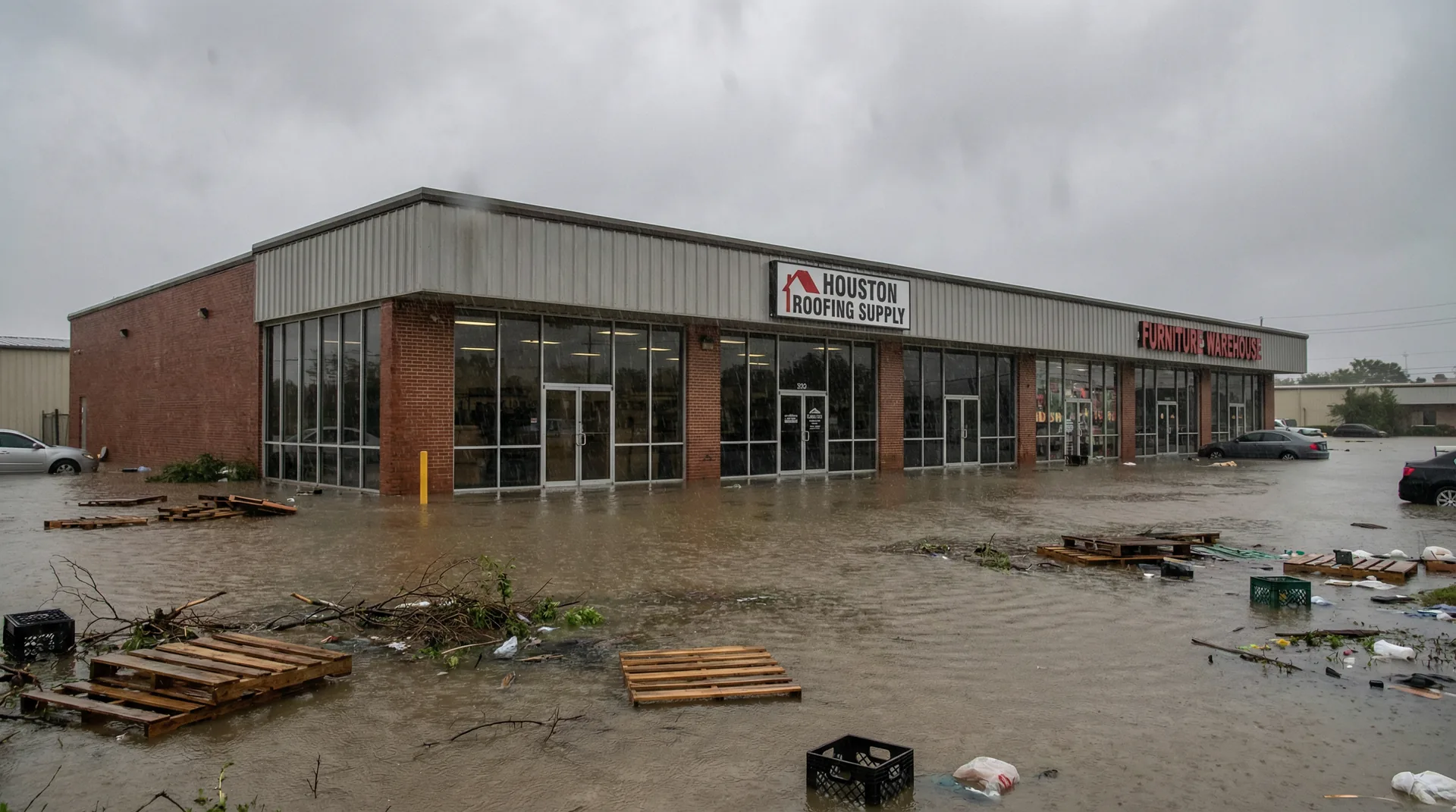
Stop the Damage Now - Dispatch a commercial flood mitigation and pack-out team
Commercial flood water is often contaminated, so prompt pack out of inventory and equipment and structural drying can limit further damage, and delay can lead to more tear out, a longer business interruption and code upgrade costs.
Most standard property policies obligate the insured to take reasonable steps to mitigate further damage. Failing to do so can give the carrier grounds to reduce or deny the claim.
Independent referral - no fees, no commissions. DCS does not accept any compensation from network vendors. Vendors typically bill their work to the insurance claim; coverage depends on your policy and the claim outcome. Recommendations are based on what is best for your claim, not on who pays us.
Quick Answer
Commercial flood claims require separate documentation of building damage, contents, and any potential income loss. DCS reviews the NFIP or private flood policy and documents the affected property. Standard NFIP policies do not cover business interruption; income loss can be considered only under other applicable coverage, subject to its terms.
Commercial Flood Claims Have Unique Rules and Strict Deadlines
Commercial flood insurance claims, whether through the National Flood Insurance Program or a private insurer, operate under different rules than standard commercial property claims. The documentation requirements, deadlines, and coverage limitations are distinct and complex.
Missing a deadline or failing to document your loss correctly can result in a reduced settlement or a denial. We know the NFIP process and private flood policy requirements for commercial properties and help you navigate every step correctly.
We also document business interruption losses and help you pursue all available coverage from both your flood policy and your commercial property policy.
- Toll Free:833-4UR-LOSS
- Texas Office:936-522-6627
- Florida Office:954-849-3405
Common Damage Types We Document
- Structural Flood Damage: Foundation damage, compromised walls and framing, damaged mechanical systems, and structural elements affected by rising water.
- Equipment and Inventory: Damage to business equipment, machinery, inventory, and business personal property caused by floodwater.
- Contamination: Floodwater often carries sewage, chemicals, and other contaminants that require professional remediation.
- Business Interruption: Lost revenue and continuing expenses during the period your business operations are suspended due to flood damage.
Understanding Commercial Flood Risk: How Floodwater Damages a Business and Why Documentation Drives the Claim
Per FEMA, flooding is the most common and costly natural disaster in the United States, and commercial structures concentrate value - inventory, equipment, finishes, and income - exactly where floodwater does the most harm. Understanding how floodwater behaves and what it contaminates explains why precise, early documentation is so critical to a complete commercial flood claim.
Commercial floods are driven by prolonged rainfall, storm surge from hurricanes and tropical systems, flash flooding, and dam or levee failures. The Texas Gulf Coast and the Houston metropolitan area are especially exposed because of flat topography and clay soils that shed water rather than absorb it, and because commercial corridors often sit near bayous, drainage channels, and detention areas that overtop during major events.
Floodwater and sewage require contamination precautions and qualified remediation. A restoration professional should document the water category, affected materials, duration, and site conditions, then determine what can be safely cleaned and dried and what must be removed. Begin safe mitigation promptly; how long materials stayed wet is one factor, not an automatic rule for what is removed or which category applies.
Standard NFIP commercial policies cover direct physical damage to the building and its business personal property but exclude business interruption, loss of use, landscaping, and most below-grade property. Private and excess flood policies may add higher limits and income coverage. Knowing which policy responds to which part of the loss is what determines the total recovery on a commercial flood claim.
Common ways commercial flood claims are minimized include underscoping structural saturation behind finishes, depreciating contents and inventory aggressively, disputing the floodwater line height, and pushing damage onto the wind or property policy to avoid the flood limit (or vice versa). DCS documents the water line, inventories damaged contents and inventory item by item, uses thermal imaging to find hidden moisture, and documents each portion of the loss for the policy that may cover it.
What Commercial Flood Coverage Actually Pays - and the Limits, Exclusions & Layers That Decide the Payout
A commercial flood claim is won or lost on coverage details most business owners never examine until water is on the floor. These are the NFIP and private/excess-flood rules that most often move the number on a Texas or Florida commercial flood loss - and how DCS handles each.
Flood is excluded by your commercial property policy
Standard commercial property forms (ISO Commercial Property, BOP) exclude flood, surface water, storm surge, and rising groundwater. That damage is covered only under a separate NFIP commercial policy or a private/excess flood policy. The threshold question on every claim is whether the water meets the policy definition of a flood (rising surface water) or is something the property policy covers - like wind-driven rain through a storm-created opening or a burst interior pipe. DCS documents the source and path of the water to place the loss under the policy that actually pays.
NFIP commercial limits cap at $500,000 building / $500,000 contents
The NFIP commercial program caps building coverage at $500,000 and business personal property (contents) at $500,000 - two separate limits that must each be carried. For most commercial structures and inventories these limits fall well short of the actual exposure, which is exactly why excess flood coverage exists. DCS confirms what limits are in force, allocates damage between building and contents to use each limit fully, and identifies when the NFIP layer is exhausted and an excess layer must respond.
Standard NFIP commercial pays NO business interruption
The standard NFIP commercial policy excludes business interruption and lost income entirely - there is no coverage for the revenue lost while your doors are closed. Business-interruption recovery on a flood loss must come from a private commercial flood policy that includes it, an excess flood policy, or a separate business income policy. DCS reviews your declarations for any business income coverage and, where it exists, documents the lost income and continuing expenses to pursue it.
Increased Cost of Compliance (ICC) pays toward code-required mitigation
Eligible NFIP building policies may provide up to $30,000 in Increased Cost of Compliance coverage for qualifying elevation, demolition, relocation, or nonresidential floodproofing. A local substantial-damage or qualifying repetitive-loss determination and other policy conditions apply. Building and ICC payments combined cannot exceed the applicable NFIP statutory building maximum, generally $500,000 for nonresidential buildings.
Private and excess flood fill the gaps NFIP leaves
Private flood and excess-flood policies sit above or alongside the NFIP commercial layer and may add higher limits, business interruption, and broader terms NFIP omits. When more than one flood layer applies, allocating the loss across them correctly is what unlocks the full recovery. DCS reviews every layer in the portfolio and coordinates the primary NFIP and excess private claims so each pays its share rather than pointing at the other.
Flood contamination requires qualified remediation
Floodwater and sewage require contamination precautions and qualified remediation. A restoration professional should document the water category, affected materials, duration, and site conditions, then determine what can be safely cleaned and dried and what must be removed. Begin safe mitigation promptly; how long materials stayed wet is one factor, not an automatic rule for what is removed or which category applies.
Confirm the Proof of Loss deadline and requirements
The NFIP Standard Flood Insurance Policy generally requires a signed and sworn Proof of Loss within 60 days after the loss, unless FEMA changes the applicable requirement by an extension or waiver. Confirm the current instructions for your policy and event. DCS helps prepare the damage inventory, estimate, and supporting documentation. If a deadline may have been missed, promptly consult a licensed attorney about legal options and consequences.
Separate the flood loss from the wind loss on the same storm
When a hurricane brings both wind and flood, the wind and wind-driven-rain damage belongs to your commercial property policy and the rising-water damage to your flood policy - two separate claims under two separate sets of rules. Carriers routinely try to push damage onto the other policy. DCS documents the water line, the wind path, and the sequence of damage so each peril is documented for the policy that may cover it, instead of falling into the gap between them.
Coverage varies by carrier, policy form, and endorsement. These are common patterns in Texas and Florida homeowner and commercial property policies - not a description of your specific policy. Review your declarations page and endorsements, or have DCS review them with you. Educational information, not legal advice.
Handling the Claim Yourself vs Engaging DCS PIA
Texas policyholders can negotiate their own claim. Hiring a licensed public insurance adjuster is optional. The table below sets out, side by side, how the same claim tasks get done in each path so you can make an informed decision.
| Claim handling task | Self-represented | DCS PIA representation |
|---|---|---|
| A dated record of the claim | A manual calendar and a memory of phone calls; hard to reconstruct months later. | Every carrier contact, request, inspection and payment logged and timestamped from day one. |
| Scope of loss documentation | Photos plus a written list; rarely matches the carrier's estimating system line-by-line. | Xactimate estimate built in the same software the carrier uses, line-item-matched to scope. |
| Hidden or secondary damage assessment | You decide what to document. | Moisture mapping, thermal imaging, and engineering referrals when warranted; ensuing-loss tracking. |
| Appraisal clause invocation when valuation differs | Available to any insured under the policy appraisal clause. | Invoked when carrier scope materially undervalues the loss; appraisal and umpire fees disclosed up front. |
| Supplement filings for damage discovered during repair | You prepare the claim. | Tracked through repair; supplement scopes filed against the carrier as new damage is exposed. |
| Additional Living Expense / Extra Expense documentation | Receipts assembled at the end of displacement, often incomplete. | Receipt and mileage log discipline from day one; ALE / Extra Expense submitted per policy form. |
| Mold sub-limit endorsement pursuit | Your choice. | Mold cause, species, and remediation protocol documented to IICRC S520; sub-limit pursued. |
| Fee structure | No third-party fee. You handle the claim yourself. | In Texas: no recovery, no fee, and the public adjuster fee is capped under Tex. Ins. Code § 4102.104. Florida claims follow a separate written agreement. Hiring a public adjuster is optional. |
Educational comparison, not legal advice. Hiring a Texas-licensed public insurance adjuster is optional and capped at 10% of the recovery under Tex. Ins. Code § 4102.104. Public adjusters represent policyholders on claim valuation and negotiation. Legal claims for bad faith or prompt-payment damages are handled by attorneys, not public adjusters.
Tips That Protect Your Claim
Do Not Enter Until Safe
Do not re-enter a flood-damaged commercial property until it has been declared safe. Floodwater can contain sewage, chemicals, and electrical hazards.
Document Before Any Cleanup
Take extensive photos and videos of all flood damage before any cleanup or drying begins. Photograph the waterline, all damaged equipment, all damaged inventory, and every affected area.
File Your Proof of Loss on Time
Note the Proof of Loss date as soon as the loss occurs and confirm the current FEMA instructions for your event. We prepare the inventory and estimate that support it.
Begin Tracking Business Interruption
From the moment your operations are affected, begin tracking lost revenue and all continuing expenses. Note that standard NFIP policies do not include business interruption coverage, but your commercial property policy may.
Document All Damaged Inventory
Create a detailed inventory of all damaged or destroyed inventory, including the quantity, description, and value of each item.
Separate Flood Damage from Wind Damage
If your loss involved both wind and flooding, the damages must be carefully separated. Wind damage is typically claimed under your commercial property policy, and flood damage under your flood policy if you carry one.
Critical: Document the Damage Before Permanent Repairs
Protect people first, notify your insurer promptly, and document damage before repairs when safe. Take photos or video, keep receipts, and give the insurer a reasonable opportunity to inspect before nonurgent permanent repairs where practical. Do not wait for a claim to settle before addressing urgent safety needs or preventing further damage. Follow qualified professional and public-health guidance for contaminated or hazardous materials; document them safely before disposal when possible, but do not keep unsafe items merely for an inspection.
What to Do Right Now
Do Not Enter Until Safe
Do not re-enter the property until authorities declare it safe. Floodwater can carry sewage, chemicals, and electrical hazards.
Document the Water Line Immediately
Photograph and video the high-water mark on every wall, fixture, and piece of equipment before any cleanup begins. The flood water line is the single most important piece of evidence in a flood claim.
Inventory All Damaged Equipment and Inventory
Photograph and list every damaged item of equipment, fixtures, and inventory before disposal, including quantity, description, age, and replacement cost.
Begin Mitigation Promptly
Hire a water mitigation company to extract water and begin drying as soon as it is safe. Remove contaminated porous materials per IICRC S500 and document every step with photos and receipts.
Report the Claim Immediately
Notify your flood insurer as soon as possible. The NFIP 60-day Proof of Loss clock runs from the date of loss, not the date you report.
Begin Tracking Business Interruption
From the moment operations are affected, track lost revenue and continuing expenses. NFIP will not pay it, but your commercial property or business income policy may.
Contact DCS PIA Before the Adjuster Arrives
We will be present during the inspection and will prepare the Proof of Loss so it accurately reflects the full scope of your building, contents, and inventory loss.
Do Not Accept a Settlement Without Review
Commercial flood settlements are frequently based on incomplete scopes. We review every estimate and file supplemental claims when additional damage is identified.
Why Professional Representation Matters
Commercial NFIP flood claims are governed by federal regulations with strict deadlines, specific documentation standards, and coverage limitations that differ sharply from a standard commercial property claim. The Proof of Loss must be accurate and complete, scope disputes are common, and the building-versus-contents split and any excess layer all affect the final number. Many policyholders handle their own claims. A public adjuster is optional and can help when the loss is large or complex.
The NFIP Standard Flood Insurance Policy generally requires a signed and sworn Proof of Loss within 60 days after the loss, unless FEMA changes the applicable requirement by an extension or waiver. Confirm the current instructions for your policy and event. DCS helps prepare the damage inventory, estimate, and supporting documentation. If a deadline may have been missed, promptly consult a licensed attorney about legal options and consequences.
NFIP adjusters are typically independent adjusters working under contract, and their scope of damage may not capture all covered building and contents items.
Business personal property and inventory require a detailed item-by-item inventory. Work item by item so nothing is missed. A public adjuster is optional and can help when the loss is large or complex.
Allocating the loss between the NFIP layer and any excess or private flood layer, and between the flood policy and the wind/property policy, is complex and decisive for total recovery.
Standard NFIP commercial policies pay no business interruption - identifying and pursuing income coverage from other applicable policies takes a careful read of every form.
The insurance company has a team of professionals working for them. You deserve one working for you.
Why Policyholders Trust DCS PIA
We bring carrier-side experience, construction expertise, and genuine care to every claim.
We know the NFIP process and private flood policy requirements for commercial properties.
We help you meet every deadline, including the critical 60-day Proof of Loss requirement.
We separate flood damage from wind damage and document each so each policy can review its part of the loss.
We identify and pursue business interruption coverage from all applicable policies.
We are fully licensed and bonded in Texas and Florida.
No recovery, no fee. You pay us nothing unless we help you recover money.
We handle every step from inspection to final settlement.
We help you understand and fulfill every obligation under your policy.
Frequently Asked Questions
Related Texas Claim Types We Handle
Property losses rarely fall into a single category. Explore related claim types DCS PIA documents and negotiates for Texas policyholders - each handled on a no recovery, no fee basis.
More Related Claim Types
A Property Claim Is a Process With Tripwires - Not Just a Form
Filing is the easy part. Once you report a loss, the carrier runs a process governed by your policy’s conditions and by timelines that move faster than most people expect - and most underpaid and denied claims trace back to a single step the policyholder never knew was load-bearing.
Commercial flood claims stack their own tripwires on top of the process below - flood is excluded by your commercial property policy so recovery runs through a separate NFIP commercial or private/excess flood policy, NFIP caps building and contents at $500,000 each and pays no business interruption, and the Proof of Loss requirement and any FEMA extension or waiver must be checked promptly.
Duties After Loss
Policies impose duties after loss, which may include prompt notice, reasonable protection from further damage, records and cooperation. Follow the requirements in your policy. The effect of any alleged failure depends on the policy, facts and law; ask an attorney about legal consequences or an examination under oath.
Reservation of Rights (ROR)
A reservation-of-rights letter means the carrier is investigating while reserving the right to deny coverage later. It signals the claim is contested - not a settlement - and it changes how every photo, statement, and estimate should be handled from that point forward.
Request for Information (RFI)
Carriers send repeated requests for documents, receipts, measurements, and recorded statements. Incomplete or late responses stall the file and become the carrier’s stated reason to delay payment or pay less than the loss is worth.
Proof of Loss (POL)
A sworn proof of loss is a signed, deadline-bound itemization of your damages. Understate it, overstate it, or miss the deadline, and the figure on that form can be used to cap - or contest - your recovery.
A claim moves at the speed of its documentation. Your policy sets out what you agreed to do after a loss - report it promptly, protect the property from further damage, keep records, and provide the information your carrier asks for. Meeting those obligations, with a scope that reflects the real damage, is what keeps a claim moving. That documentation work is exactly what a licensed public adjuster does.
Each of these is a place a legitimate claim quietly loses value. This is why policyholders hire DCS PIA - Dependable Claims Specialists, licensed public insurance adjusters - to document the loss, build the proof of loss, answer the carrier’s requests on time, and negotiate the valuation correctly from day one. You handle one claim in your life; the carrier handles thousands. A public adjuster levels that.
DCS represents policyholders on claim valuation and negotiation. Interpreting your legal rights, bad-faith, and litigation are matters for a licensed attorney - not a public adjuster. This is general educational information, not legal advice.
Educational Information - Not Legal Advice
The information on this page is for general educational purposes only. Dependable Claims Specialists is a licensed public adjusting firm - not a law firm. Public adjusters help policyholders inspect, document, evaluate, and negotiate property insurance claims, which includes reading and applying your policy in the ordinary course of adjusting (coverage parts, exclusions, endorsements, scope). We do not practice law and we do not provide legal advice. For legal opinions, demand letters, Chapter 542A pre-suit notices, statutory remedies under the Insurance Code, or litigation, consult a licensed attorney in your state. Texas public adjusters operate under TX Ins. Code Chapter 4102; Florida public adjusters operate under FL Statute §626.854.
