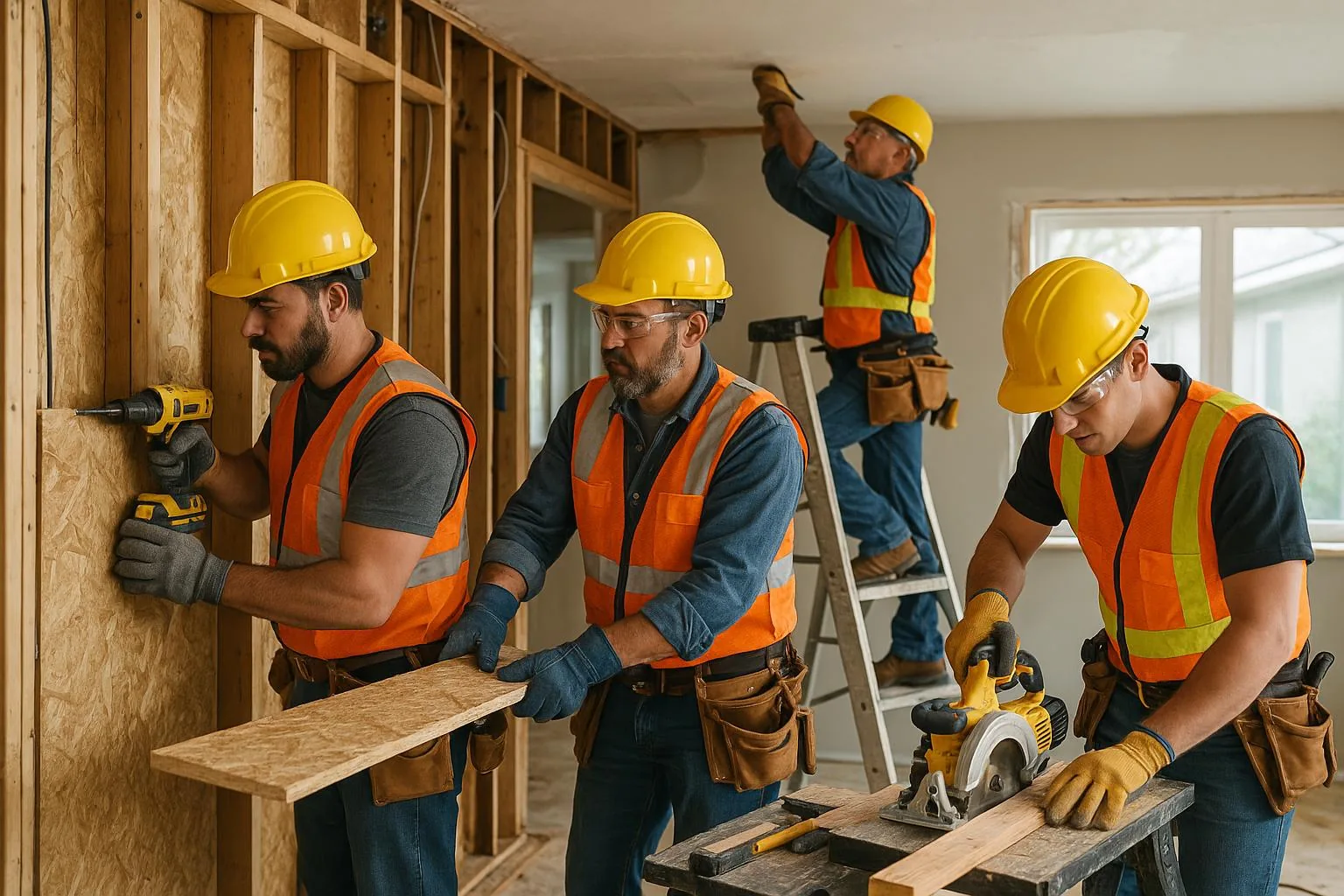
Fully Documented Jobs. Fewer Supplement Disputes. Just Build.
We partner with general contractors to document the full scope of the project on every insurance claim, including overhead, profit, and code upgrades.
Why General Contractors Partner With DCS
General contractors working on insurance repair projects face a unique challenge: the scope of work is determined by an insurance estimate that is often incomplete. Missing line items, omitted overhead and profit, and undiscovered damage that surfaces during demolition can turn a profitable job into a financial dispute.
When DCS is involved from the start, the insurance estimate is reviewed and supplemented before the job begins. When additional damage is discovered during the project, we prepare and submit supplement claims quickly and professionally. Our background in construction and Xactimate estimating means we speak the same language as the contractor and the insurance company.
We also offer free documentation training for your project managers and superintendents. Proper documentation of damage and change conditions is the foundation of every successful supplement claim. We teach your team how to do it right.
Items frequently missing from insurance estimates on general contractor projects:
- - General contractor overhead and profit (10% and 10% or negotiated)
- - Code-required upgrades under Ordinance or Law coverage
- - Temporary protection, shoring, and debris removal
- - Hidden damage discovered during demolition
- - Permits, inspections, and engineering fees
- - Matching requirements for undamaged adjacent materials
The General Contractor's Role on an Insurance Claim
On a property loss large enough to require a rebuild, the general contractor is the entity that coordinates and supervises the trades, pulls permits, manages schedule and safety, and delivers the finished structure back to the owner. A repaint or a single-trade repair does not need a GC. A fire that guts a kitchen, or a water loss that requires removing drywall, replacing cabinetry, rewiring, repiping, and refinishing floors, does - because no single trade can deliver that result alone.
When a repair needs that coordination, the estimate should account for the general contractor's overhead and profit. Whether and how the policy pays it depends on the scope and the policy, which is why DCS documents the coordination the work actually requires.
GC and public adjuster: two different jobs
The contractor's job is to build. The public adjuster's job is to value the loss and negotiate the claim for the property owner, documenting the full cost of the build. DCS represents the policyholder - not the contractor and not the carrier. When DCS handles the insurance side, the GC is freed from arguing scope with a desk adjuster and can focus on production, while the owner gets an advocate whose only job is the correct payout.
Overhead and Profit, Explained
Overhead and Profit, or O&P, compensates the general contractor for the cost and value of coordinating a multi-trade project: supervision, scheduling, jobsite management, administrative overhead, and the contractor's profit margin. In Xactimate it is typically applied as a 10 percent overhead and 10 percent profit markup on the trade costs of a qualifying job. O&P is part of the loss valuation paid to the policyholder; the policyholder then pays the contractor under their construction contract.
Why carriers leave O&P out - and how we put it back
- The omission. Initial estimates, especially on smaller losses, frequently drop O&P even when the scope clearly needs a general contractor to coordinate the trades.
- The test. We document each distinct trade the repair requires - framing, drywall, electrical, plumbing, HVAC, flooring, paint, and so on - to establish that GC coordination is reasonably necessary.
- The valuation. We rebuild the estimate in Xactimate with O&P applied to the qualifying scope, so the number is grounded in the same platform the carrier uses.
- The result. When the trades are documented and the scope is complex, O&P is hard to refuse - and it is often the difference between a profitable insurance job and an underfunded one.
Ordinance or Law and Code Upgrades on a Rebuild
Most homes are built to the code in force the year they went up. When a covered loss forces a rebuild, the local building official applies today's code - which may require upgrades the original structure never had. The base property policy generally pays to restore what was there before the loss. The increased cost of meeting current code is funded by Ordinance or Law coverage, an add-on that many policies include at some limit.
This is one of the most overlooked sources of recovery on a GC project. If the rewire has to meet current electrical code, if the roof needs current wind-mitigation strapping, if insulation or egress requirements have changed, those are real, required costs - but only if they are documented and tied to the covered loss. We work with the contractor and, where needed, the code official to identify which upgrades are required, then present them under Ordinance or Law coverage so the cost of code compliance triggered by the claim is pursued under the policy, not left to the owner.
Typical code-driven upgrades on a rebuild:
- - Electrical service, wiring, and outlet/GFCI requirements brought to current code
- - Roof decking attachment and wind-mitigation strapping (especially in Florida)
- - Insulation and energy-code requirements
- - Egress, stair, and railing requirements
- - Plumbing and drain upgrades exposed during the rebuild
- - Demolition of undamaged portions required by code to complete a compliant repair
The Rebuild Claim Process, Step by Step
Loss reported and acknowledged
The loss is reported to the carrier and a claim number is assigned. Early, thorough documentation of the damage starts here, before demolition or repairs change what an inspection can see.
Pre-job estimate review
Before demolition, DCS reviews the carrier estimate against a full-scope Xactimate estimate to find missing trades, omitted O&P, and absent code-upgrade and protection line items.
Scope alignment
The GC scope, the public adjuster estimate, and the carrier estimate are reconciled line-by-line so the job is based on a documented scope rather than a guess. Urgent safety and mitigation work does not wait for it.
Demolition and discovery
Demolition exposes what the initial inspection could not see - rotted framing, wider water migration, concealed code deficiencies. Each is photographed and documented as it is found.
Supplements
Hidden damage and changed conditions are submitted as documented supplements. Well-supported supplements are typically approved without a fight.
Ordinance or Law and O&P
Code-required upgrades are presented under Ordinance or Law coverage, and O&P is applied to the qualifying multi-trade scope.
Payment, ACV, and recoverable depreciation
The carrier typically issues an initial payment based on actual cash value (replacement cost less depreciation, then reduced by the deductible and any other policy limitations), then releases recoverable depreciation as the work is completed and documented, subject to the policy conditions. We submit the completion documentation and follow up until the release is made.
Appraisal if a dispute remains
If a genuine dispute over the amount of loss persists, the policy Appraisal clause lets each side name an appraiser and a neutral umpire decide. Appraisal resolves the dollar amount - it is a policy process, not a lawsuit.
Documents and Standards That Decide Rebuild Claims
Proof of loss and Xactimate estimates
A sworn proof of loss states the claimed amount; the supporting Xactimate estimate is what the carrier evaluates. Estimates that mirror the carrier's pricing platform and capture every trade carry the most weight.
Supplement narratives and photo logs
A supplement lives or dies on its documentation: dated photos of the discovered condition, moisture readings where relevant, and a written narrative tying the new item to the covered loss.
Restoration standards (IICRC S500 / S700)
For the water and fire portions of a rebuild, the IICRC S500 (water) and S700 (fire and smoke) standards guide how moisture, soot, and odor damage are measured and documented.
Code and permit records
Permit requirements, inspection notes, and written code-official requirements are the backbone of an Ordinance or Law claim. Without them, code upgrades get treated as betterment and denied.
Common Mistakes and Carrier Tactics to Watch For
Omitting O&P on multi-trade jobs
Leaving general-contractor overhead and profit out of an estimate when the repair genuinely needs a GC to coordinate and supervise the trades. The number of trades alone does not decide it; the coordination the scope requires does.
Treating code upgrades as betterment
Carriers may call required code upgrades "improvements" and deny them. If the code official requires the upgrade to complete a compliant repair, it may be claimable under Ordinance or Law coverage when the policy includes it.
Pricing only visible damage
An estimate written off a single walkthrough cannot see what demolition reveals. Starting the job without a supplement plan invites an underfunded scope.
Missing protection, shoring, and debris
Temporary protection, shoring, dumpster and debris removal, and dust containment are real costs that initial estimates often skip.
Depreciating labor aggressively
Excess depreciation shrinks the ACV check. We test whether the depreciation applied is reasonable and pursue the release of recoverable depreciation as the work is done.
Letting the claim stall between payments
Without someone following up on every open item, payments that fund the rebuild can stall. We keep a dated record of every request and response on every file so nothing stalls unnoticed.
Why DCS on a Rebuild Claim
Dependable Claims Specialists - Public Insurance Adjusters works only for the policyholder - never the insurance company. Our founder spent 2010 to 2017 as a carrier-side field adjuster and team lead, writing and approving the very estimates we now review. We know how O&P gets quietly written out, how code upgrades get dismissed as betterment, and what a desk adjuster needs to see to approve a supplement without a fight.
We estimate in Xactimate - the same platform the carrier uses - and document to recognized restoration standards (IICRC S500 for water, S700 for fire and smoke). We are licensed in both states - Texas Firm License 3134924 and Florida Firm License W820363 - and we work on contingency: no recovery, no fee. Public adjusting is claim valuation, documentation, and negotiation. We are not a law firm; bad-faith litigation and demand letters are attorney work, and we will say so plainly when a matter belongs with counsel.
How We Support General Contractors
Pre-Job Estimate Review
We document the reasonable covered repair scope and support the claim with estimates, photographs, and contractor findings. No settlement, complete project funding, or supplement approval is guaranteed; deductibles, limits, exclusions, fees, and actual repair costs can leave an owner-funded amount.
Supplement Preparation
We prepare and submit supplement claims for damage discovered during demolition or conditions that change the scope of work.
Code Upgrade Documentation
We document and argue for code-required upgrades under Ordinance or Law coverage.
Overhead and Profit Recovery
We document and negotiate for general contractor overhead and profit on every qualifying claim.
Dispute Resolution
When the insurance company disputes a supplement or reduces the scope, we prepare the documentation and argument to resolve the dispute.
Team Training
Free claims documentation training for your project managers and superintendents.
Free Claims Documentation Training for Your Team
We offer complimentary on-site or virtual training for your staff on how to properly document insurance claims, what to do when insurance is involved, and how to protect your customers and your business. This is not a sales pitch. It is practical education that makes your team more valuable to every client you serve.
What We Expect From Network General Contractor Partners
Dependable Claims Specialists - Public Insurance Adjusters refers general contractors to policyholders whose claims involve full repair and rebuild work. Because our reputation rides on every referral, contractors in our network meet a clear set of expectations. If you are a general contractor in the Houston, Texas, or South Florida market and want to partner with us, here is what we look for.
Proper Licensing and Insurance
Required state and local licenses for general contracting, general liability coverage at appropriate limits, builders risk where required, and workers compensation. We verify these before adding a contractor to the referral network.
Multi-Trade Scope Documentation
Coordinated scope of work that captures every trade involved, code or ordinance upgrades triggered by the loss, matching considerations across surfaces, and a written narrative that reads cleanly to the carrier. Our training program covers GC-level claims documentation.
Communication With the Adjuster
Network partners coordinate with us during the claim. Respond to documentation requests, provide supplementary photographs and trade-by-trade scope when asked, and meet on-site for re-inspections when necessary.
Scope and Estimate Discipline
Repair scopes that match the documentation, line items that reflect current market pricing for materials and labor across all trades, and estimates that hold up under carrier review. We do not refer contractors who pad scope or chase Cat-event price markups.
Workmanship and Warranty
Network partners stand behind their work with written warranties on labor and pass-through manufacturer warranties on materials. Callbacks for warranty issues are handled with the homeowner outside the claim file.
Customer Experience
Policyholders are living through a disruptive event during a rebuild. Clean job sites, on-time trades, weekly schedule communication, and clear billing are baseline expectations. Negative customer feedback is grounds for removal from the referral network.
If your general contracting company meets these expectations and you want to grow your insurance-related work in the Houston market, we would welcome the conversation. Email intake@dcspia.com or call 833-4UR-LOSS to introduce yourself.
Related Claim and Guide Pages
Fire Damage Claims
The classic full-rebuild loss.
Water Damage Claims
Tear-out and multi-trade repair.
Underpaid Claims
When O&P or code upgrades go unpaid.
Insurance Appraisal Guide
Resolving a dispute over the amount of loss.
Public Adjuster Fee Calculator
Estimate fees under TX and FL fee caps.
Restoration Partners
The mitigation trade that precedes a rebuild.
Hire DCS
Start a free, no-obligation claim review.
Frequently Asked Questions
How does DCS help general contractors with insurance claims?
What is overhead and profit and why does it matter?
When does a claim qualify for general contractor overhead and profit?
Can DCS help when a contractor discovers additional damage during demolition?
What is Ordinance or Law coverage and how does it apply to a rebuild?
What is Xactimate and why do carriers and DCS both use it?
Does the general contractor get paid overhead and profit directly?
How long does an insurance rebuild take?
What does a public adjuster cost on a rebuild claim, and is DCS a law firm?
Do you offer training for general contractor project managers?
Commercial Claims We Handle in Houston
When a rebuild follows a commercial loss, these are the Houston-specific claim pages DCS handles for Harris County businesses, served from our Webster, TX headquarters.
