Stop the Damage Now - Dispatch a structural shoring contractor
Active ground movement can threaten safety. Keep away from affected areas; if life or property is in immediate danger, leave safely and call 911. Follow local emergency officials' instructions. A licensed engineer or geotechnical professional should determine whether temporary shoring or other stabilization is appropriate before anyone enters or begins repair work.
Most standard property policies obligate the insured to take reasonable steps to mitigate further damage. Failing to do so can give the carrier grounds to reduce or deny the claim.
Independent referral - no fees, no commissions. DCS does not accept any compensation from network vendors. Vendors typically bill their work to the insurance claim; coverage depends on your policy and the claim outcome. Recommendations are based on what is best for your claim, not on who pays us.
Quick Answer
Sinkhole insurance claims are frequently denied when adjusters misclassify structural damage as normal settling or earth movement. A licensed public adjuster works with geotechnical engineers to prove sinkhole activity caused the foundation cracks and structural shifting, working to ensure your policy covers comprehensive stabilization and repair.
Sinkhole Claims Are Among the Most Complex in Property Insurance. We Know the Process.
Sinkhole damage claims involve a unique combination of geological science, engineering assessment, and specialized insurance policy provisions. Florida has specific statutory requirements for sinkhole coverage and testing. Texas has different rules. The process is complex. Many policyholders handle their own claims, and a public adjuster is optional.
We manage the sinkhole claim process from initial reporting through final settlement, ensuring that all required testing is conducted, all damage is documented, and all applicable coverage is utilized.
- Toll Free:833-4UR-LOSS
- Texas Office:936-522-6627
- Florida Office:954-849-3405
Common Damage Types We Document
- Foundation Damage: Cracks, settlement, and structural movement in the foundation caused by sinkhole activity
- Structural Damage: Cracks in walls, floors, and ceilings resulting from foundation movement
- Plumbing Damage: Broken pipes and sewer lines from ground movement
- Exterior Damage: Cracked driveways, walkways, and retaining walls from ground subsidence
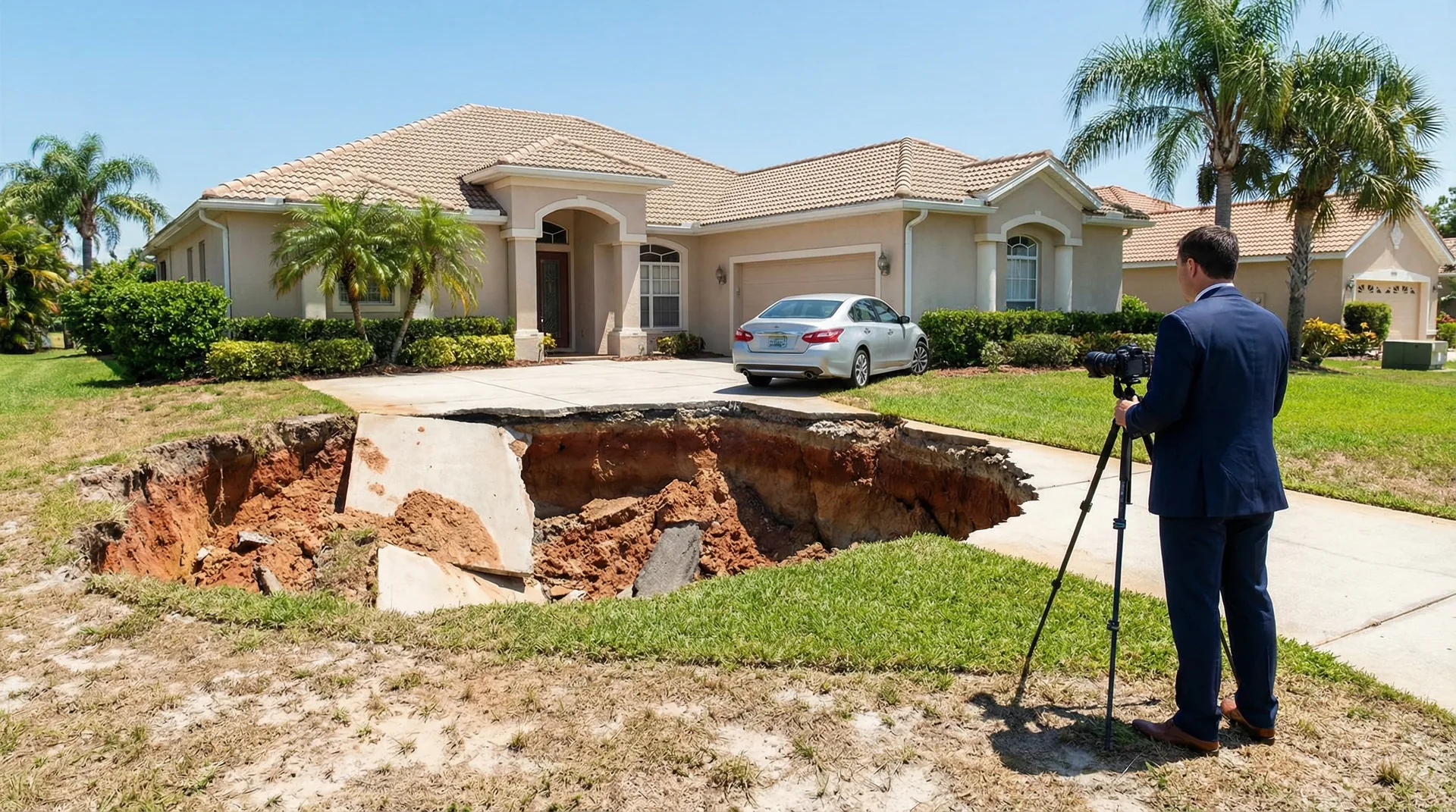
- Catastrophic Ground Cover Collapse: Sudden, dramatic sinkhole formation causing immediate structural failure
- Sinkhole Activity: Gradual subsidence and ground movement that causes progressive structural damage
How Sinkholes Form and Why They Are Particularly Common in Florida
Understanding sinkhole geology helps explain why certain areas are more susceptible and what types of damage are expected from sinkhole activity.
Sinkholes form when water dissolves soluble rock (primarily limestone and dolomite) beneath the surface, creating voids. When the overlying soil can no longer support the weight above, it collapses into the void. Florida sits on a thick platform of porous limestone, making it one of the most sinkhole-prone states in the country.
There are two primary types of sinkhole events relevant to insurance claims. Catastrophic ground cover collapse is a sudden, dramatic event where the ground surface collapses abruptly, creating a visible hole. This type of event is covered under virtually all Florida homeowner policies. Sinkhole activity is a more gradual process of subsidence and ground movement that causes progressive structural damage over time. Coverage for sinkhole activity varies by policy and state.
Florida law (Section 627.706, Florida Statutes) requires all residential property insurers to offer sinkhole coverage as an optional endorsement. The law also specifies testing requirements for sinkhole claims, with the testing to comply with Florida Geological Survey Special Publication No. 57; Standard Penetration Testing (SPT) borings are the standard practice under that publication, alongside other geological investigation methods. Texas does not have the same statutory framework, and sinkhole coverage in Texas is more limited.
Common ways sinkhole claims are minimized include disputing whether the damage was caused by sinkhole activity versus other causes, arguing that the geological testing does not confirm sinkhole activity, limiting the repair scope to cosmetic repairs rather than full foundation remediation, and disputing the cost of sinkhole remediation methods such as grouting or underpinning.
What You Need to Know
Sinkhole Remediation Methods
Sinkhole remediation typically involves either compaction grouting (injecting grout under pressure to fill voids and stabilize the soil) or underpinning (installing piers or pilings to support the foundation). The appropriate method depends on the specific geological conditions. We ensure the repair scope includes the appropriate remediation method and all required structural repairs.
What Your Policy Covers on a Sinkhole Claim - and the Statutory Tests, Caveats & Endorsements That Decide the Payout
A sinkhole claim is won by knowing exactly which coverage your policy carries and what the statute requires to prove the loss. These are the coverage caveats, statutory provisions, and endorsements that most often move the number on a Florida or Texas sinkhole claim - and how DCS handles each.
Catastrophic Ground Cover Collapse vs. sinkhole activity
In Florida these are two different coverages. Catastrophic Ground Cover Collapse (defined in Fla. Stat. §627.706) is included in every standard homeowner policy but requires an abrupt collapse, a depression clearly visible to the naked eye, structural damage to the building, and condemnation of the structure by a government agency - a high bar. Broader 'sinkhole loss' coverage for progressive subsidence is optional and must be purchased by endorsement. Many denials happen because the loss is gradual sinkhole activity but the policyholder only has CGCC. DCS reads your declarations to confirm which coverage is actually in force before the carrier frames the loss to fit the narrower one.
Sinkhole loss coverage is an optional Florida endorsement
Florida law (Fla. Stat. §627.706) requires insurers to make sinkhole-loss coverage available, but it is an optional add-on with its own premium, not part of the base policy. Citizens and private carriers both offer it. DCS confirms whether the sinkhole endorsement was purchased and appears on your declarations, because without it the claim is limited to the catastrophic-collapse standard.
Statutory testing must confirm the sinkhole loss
Under Fla. Stat. §627.7072 and §627.7073, confirmation requires a professional engineer or geologist to perform statutorily defined testing - typically Standard Penetration Testing borings plus other geophysical methods - and issue a report meeting the statute. A single screening scan is not enough. DCS monitors the investigation for adequate boring depth, correct locations, and methodology, and challenges a non-confirmation that rests on incomplete testing.
Texas standard policies exclude earth movement
Texas homeowner forms generally exclude earth movement, which sweeps in most sinkhole and subsidence losses, and Texas has no statutory sinkhole framework like Florida's. Coverage in Texas usually exists only where an ensuing or covered peril applies - for example a plumbing leak that eroded soil under the slab. DCS documents the cause and extent of damage and reviews relevant policy provisions in the ordinary course of adjusting. Questions about legal doctrines or contested coverage should be reviewed by a licensed attorney.
Repair scope must include remediation, not just cosmetic cracks
When a sinkhole loss is confirmed, the covered scope is the geotechnical remediation - compaction grouting and/or underpinning - plus all resulting structural repair, not just patching visible wall cracks. Carriers frequently offer cosmetic-only repairs that ignore the underlying void. DCS works with licensed geotechnical engineers to scope the correct stabilization method and the full structural restoration it requires.
Watch the release before any partial-repair sign-off
Sinkhole damage can continue to manifest for months, and a release signed after partial repair can affect the carrier's further obligation on the claim. DCS flags any proposed release so the policyholder understands its scope before signing - and recommends review by qualified counsel where release language would waive coverage for ongoing subsidence or incomplete remediation, so a settlement is not finalized while the ground is still moving.
Disclosure and the engineer's completion letter protect resale value
A confirmed sinkhole claim may need to be disclosed to future buyers under Florida law, and the remediation method plus a structural engineer's letter of completion drive the home's future insurability. DCS documents the full remediation so the claim record reflects that the sinkhole was properly addressed - this is educational, not real-estate advice, but a complete insurance record is what future insurers will want to see.
Coverage varies by carrier, policy form, and endorsement. These are common patterns in Texas and Florida homeowner and commercial property policies - not a description of your specific policy. Review your declarations page and endorsements, or have DCS review them with you. Educational information, not legal advice.
Handling the Claim Yourself vs Engaging DCS PIA
Texas policyholders can negotiate their own claim. Hiring a licensed public insurance adjuster is optional. The table below sets out, side by side, how the same claim tasks get done in each path so you can make an informed decision.
| Claim handling task | Self-represented | DCS PIA representation |
|---|---|---|
| A dated record of the claim | A manual calendar and a memory of phone calls; hard to reconstruct months later. | Every carrier contact, request, inspection and payment logged and timestamped from day one. |
| Scope of loss documentation | Photos plus a written list; rarely matches the carrier's estimating system line-by-line. | Xactimate estimate built in the same software the carrier uses, line-item-matched to scope. |
| Hidden or secondary damage assessment | You decide what to document. | Moisture mapping, thermal imaging, and engineering referrals when warranted; ensuing-loss tracking. |
| Appraisal clause invocation when valuation differs | Available to any insured under the policy appraisal clause. | Invoked when carrier scope materially undervalues the loss; appraisal and umpire fees disclosed up front. |
| Supplement filings for damage discovered during repair | You prepare the claim. | Tracked through repair; supplement scopes filed against the carrier as new damage is exposed. |
| Additional Living Expense / Extra Expense documentation | Receipts assembled at the end of displacement, often incomplete. | Receipt and mileage log discipline from day one; ALE / Extra Expense submitted per policy form. |
| Mold sub-limit endorsement pursuit | Your choice. | Mold cause, species, and remediation protocol documented to IICRC S520; sub-limit pursued. |
| Fee structure | No third-party fee. You handle the claim yourself. | In Texas: no recovery, no fee, and the public adjuster fee is capped under Tex. Ins. Code § 4102.104. Florida claims follow a separate written agreement. Hiring a public adjuster is optional. |
Educational comparison, not legal advice. Hiring a Texas-licensed public insurance adjuster is optional and capped at 10% of the recovery under Tex. Ins. Code § 4102.104. Public adjusters represent policyholders on claim valuation and negotiation. Legal claims for bad faith or prompt-payment damages are handled by attorneys, not public adjusters.
Tips That Protect Your Claim
Document All Cracks and Movement
Photograph all cracks in the foundation, walls, floors, and ceilings. Note the width and length of each crack. Monitor cracks over time to document progression.
Report Promptly
Report sinkhole damage to your insurer as soon as you notice signs of ground movement or structural cracking. Delayed reporting can complicate your claim.
Do Not Make Permanent Repairs Before Testing
Do not make permanent structural repairs before the geological testing is completed. Premature repairs can complicate the investigation and your claim.
Review Your Policy for Sinkhole Coverage
Check your policy to determine whether you have sinkhole activity coverage or only catastrophic ground cover collapse coverage.
Monitor and Document Crack Progression
Place crack monitors (simple paper or tape markers) across cracks and photograph them regularly to document progression.
Contact DCS PIA Before the Adjuster Arrives
We manage the sinkhole claim process from initial reporting through final settlement and ensure all required testing is conducted.
How to Reduce Your Risk
Have your property evaluated by a licensed geologist if you are in a sinkhole-prone area before purchasing.
Maintain proper drainage around your foundation to prevent water from pooling and accelerating dissolution of underlying rock.
Avoid over-watering landscaping near the foundation.
Have your plumbing inspected regularly. Leaking pipes can accelerate sinkhole development by introducing water into the soil.
Monitor your property for early signs of sinkhole activity: new cracks in walls or floors, doors or windows that suddenly stick, depressions in the yard, or turbid well water.
Review your insurance policy to ensure you have sinkhole activity coverage if you are in a high-risk area.
Consider a pre-purchase geological investigation if you are buying property in a sinkhole-prone area.
Critical: Document the Damage Before Permanent Repairs
Protect people first, notify your insurer promptly, and document damage before repairs when safe. Take photos or video, keep receipts, and give the insurer a reasonable opportunity to inspect before nonurgent permanent repairs where practical. Do not wait for a claim to settle before addressing urgent safety needs or preventing further damage. Follow qualified professional and public-health guidance for contaminated or hazardous materials; document them safely before disposal when possible, but do not keep unsafe items merely for an inspection.
What to Do Right Now
Document All Damage
Photograph all cracks and structural movement from multiple angles.
Report the Claim to Your Insurer
Notify your insurance company promptly. Obtain the claim number and adjuster name.
Contact DCS PIA Before the Adjuster Arrives
We manage the sinkhole claim process and ensure all required testing is conducted.
Cooperate with the Geological Investigation
Allow the insurer-hired geologist to conduct the required testing. We monitor the process.
Review the Testing Results
We review the geological investigation findings and challenge any conclusions that are not supported by the evidence.
Do Not Accept a Settlement Without Review
Sinkhole claims are complex and frequently undervalued. Review any settlement offer with us before accepting.
Why Professional Representation Matters
Sinkhole claims are among the most complex in property insurance. They require geological expertise, knowledge of state-specific statutory requirements, and experience with the testing and remediation process. Many policyholders handle their own claims. A public adjuster is optional and can help when the loss is large or complex.
We know the Florida statutory requirements for sinkhole coverage and testing and ensure they are followed.
We monitor the geological investigation process to ensure it is thorough and the conclusions are supported by the evidence.
We ensure the repair scope includes the appropriate remediation method and all required structural repairs.
We work on contingency. No recovery means no fee.
We have handled sinkhole claims in Florida and know the common disputes and documentation requirements.
The insurance company has a team of professionals working for them. You deserve one working for you.
Why Policyholders Trust DCS PIA
We bring carrier-side experience, construction expertise, and genuine care to every claim.
We manage the sinkhole claim process from initial reporting through final settlement.
We know the Florida statutory requirements for sinkhole coverage and testing.
We work on contingency. No recovery means no fee.
We monitor the geological investigation process and challenge findings that are not supported by the evidence.
We ensure the repair scope includes all required remediation and structural repairs.
Frequently Asked Questions
Related Texas Claim Types We Handle
Property losses rarely fall into a single category. Explore related claim types DCS PIA documents and negotiates for Texas policyholders - each handled on a no recovery, no fee basis.
More Related Claim Types
A Property Claim Is a Process With Tripwires - Not Just a Form
Filing is the easy part. Once you report a loss, the carrier runs a process governed by your policy’s conditions and by timelines that move faster than most people expect - and most underpaid and denied claims trace back to a single step the policyholder never knew was load-bearing.
Sinkhole claims turn on a coverage line most homeowners never read until they need it - the Florida statutory split between automatically-covered catastrophic ground cover collapse and endorsement-only sinkhole activity, the statutory testing required to confirm a loss, and the near-total earth-movement exclusion that governs Texas foundations.
Duties After Loss
Policies impose duties after loss, which may include prompt notice, reasonable protection from further damage, records and cooperation. Follow the requirements in your policy. The effect of any alleged failure depends on the policy, facts and law; ask an attorney about legal consequences or an examination under oath.
Reservation of Rights (ROR)
A reservation-of-rights letter means the carrier is investigating while reserving the right to deny coverage later. It signals the claim is contested - not a settlement - and it changes how every photo, statement, and estimate should be handled from that point forward.
Request for Information (RFI)
Carriers send repeated requests for documents, receipts, measurements, and recorded statements. Incomplete or late responses stall the file and become the carrier’s stated reason to delay payment or pay less than the loss is worth.
Proof of Loss (POL)
A sworn proof of loss is a signed, deadline-bound itemization of your damages. Understate it, overstate it, or miss the deadline, and the figure on that form can be used to cap - or contest - your recovery.
A claim moves at the speed of its documentation. Your policy sets out what you agreed to do after a loss - report it promptly, protect the property from further damage, keep records, and provide the information your carrier asks for. Meeting those obligations, with a scope that reflects the real damage, is what keeps a claim moving. That documentation work is exactly what a licensed public adjuster does.
Each of these is a place a legitimate claim quietly loses value. This is why policyholders hire DCS PIA - Dependable Claims Specialists, licensed public insurance adjusters - to document the loss, build the proof of loss, answer the carrier’s requests on time, and negotiate the valuation correctly from day one. You handle one claim in your life; the carrier handles thousands. A public adjuster levels that.
DCS represents policyholders on claim valuation and negotiation. Interpreting your legal rights, bad-faith, and litigation are matters for a licensed attorney - not a public adjuster. This is general educational information, not legal advice.
Educational Information - Not Legal Advice
The information on this page is for general educational purposes only. Dependable Claims Specialists is a licensed public adjusting firm - not a law firm. Public adjusters help policyholders inspect, document, evaluate, and negotiate property insurance claims, which includes reading and applying your policy in the ordinary course of adjusting (coverage parts, exclusions, endorsements, scope). We do not practice law and we do not provide legal advice. For legal opinions, demand letters, Chapter 542A pre-suit notices, statutory remedies under the Insurance Code, or litigation, consult a licensed attorney in your state. Texas public adjusters operate under TX Ins. Code Chapter 4102; Florida public adjusters operate under FL Statute §626.854.
