Quick Answer
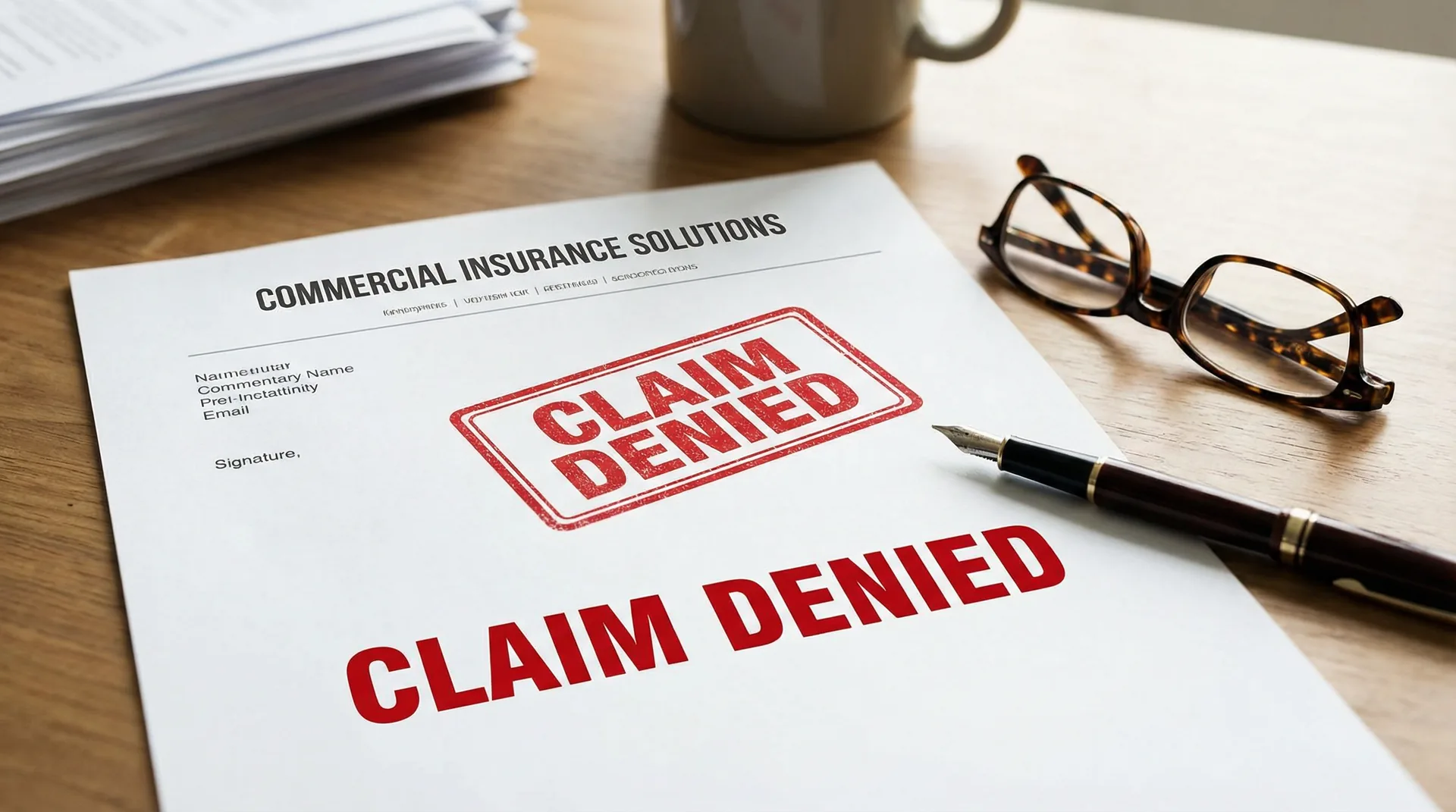
A denied commercial insurance claim is not final. Commercial denials frequently rest on a misapplied exclusion or on sudden damage classified as gradual wear and tear - stated bases that can be challenged with factual evidence. A licensed public adjuster re-evaluates the loss, challenges the denial with factual evidence, and asks to reopen your claim to pursue the settlement your policy provides.
Denied Commercial Insurance Claims in Houston: Methodology for Reversal
A commercial claim denial is not the end of the claim - it is the carrier's opening position. DCS challenges commercial denials by addressing the stated reasons with engineering evidence, policy-language analysis, causation documentation, and every review avenue the policy itself provides. We do not publish specific commercial settlement outcomes - our methodology is documented below and applies to every commercial denial we handle.
This page is part of our Houston public adjuster coverage of Harris County and the surrounding counties, served from our headquarters in Webster, TX.
Recent Houston-Area Events That Drive These Claims
Carrier causation disputes
Year-roundCommercial denials frequently hinge on whether damage was caused by a covered peril or an excluded cause (wear and tear, seepage, earth movement, faulty workmanship). DCS engages forensic engineers and consultants to document the actual cause.
Policy exclusion disputes
Year-roundWhere the exclusion cited in a denial does not match the facts of the loss, DCS reviews the policy form, documents the facts, and presents the scope and supplement accordingly.
Late notice and proof-of-loss denials
Year-roundLate notice defenses are raised on commercial claims where the reporting timeline is disputed. DCS documents the notice timeline and the facts around any delay; whether a late-notice defense holds is a legal question for a licensed attorney.
Houston-Area Rules and Local Notes
- The appraisal clause in most Texas commercial property policies is a binding process for resolving disputes over the amount of loss. DCS invokes commercial appraisal when the dispute is primarily valuation-based rather than coverage-based.
- Partial denials (where the carrier pays some components but denies others) can be documented and pursued the same way full denials are. Many commercial partial denials can be addressed with proper documentation of the denied components.
- A denial letter states the carrier's reasons in writing. DCS reads those stated reasons against the policy language and the documented facts of the loss as the first step of the reversal process.
Commercial Asset Classes & Scope
A denied commercial claim in Houston is the carrier's opening position, not the end of the claim, and the asset classes span the full commercial market: retail, office, medical, hospitality, warehouse, and industrial. Reversal methodology addresses the stated denial reasons with forensic-engineering causation evidence and policy-language analysis, and uses every avenue the policy provides, including the appraisal clause for valuation disputes and partial-denial challenges for claims where some components are paid and others denied.
Harris County Commercial Exposure
With 109,874 employer establishments in Harris County as of the week of March 12, 2022 (U.S. Census Bureau, 2022 County Business Patterns), commercial denials and partial denials surface across the metro after every major event. Claims tied to FEMA-declared catastrophes such as Hurricane Beryl (DR-4798, declared July 9, 2024), the May 2024 severe storms and derecho (DR-4781, declared May 17, 2024), and Hurricane Harvey (DR-4332, declared August 25, 2017) commonly involve causation and exclusion disputes that drive denials (FEMA).
Commercial Claim FAQs
What protections does a Texas commercial policyholder have after a denial?
The first protection is the policy itself: the denial letter states the carrier's reasons, and each reason can be tested against the policy language and the documented facts of the loss. That documentation work is what we do as public adjusters. Texas also has statutes that govern how carriers handle and pay claims; whether any of them apply to your denial, and what may follow, are legal questions for a licensed attorney, and we refer policyholders to counsel when they arise.
Can a partial commercial denial be challenged?
Yes. A partial denial, where the carrier pays some components but denies others, can be documented and pursued the same way a full denial can. Many partial denials can be addressed by documenting the denied components with engineering and policy-language evidence; pursuing any lawsuit, however, is attorney work that our public-adjusting firm does not provide.
How does appraisal help reverse a commercial denial?
When a denial is primarily a valuation dispute rather than a pure coverage dispute, the binding appraisal clause in most Texas commercial policies can resolve the amount of loss through the policy's own process. We can invoke commercial appraisal where appropriate; coverage disputes and litigation remain legal matters for a licensed attorney.
Reviewed by Josh Osteen
Founder & Licensed Public AdjusterJosh Osteen founded Dependable Claims Specialists after seven years as an insurance carrier field adjuster and team lead (2010-2017). He has represented Houston-area policyholders exclusively since 2017 and has worked major Gulf Coast catastrophes from Hurricane Harvey through Hurricane Beryl.
Other Houston-Area Claim Types We Handle
Every Houston claim type below is documented with Harris County peril history, named-carrier patterns, and the same policy-based scope documentation DCS brings to every claim.
A Commercial Denial Is a Starting Point, Not an Ending
Receiving a denial on a commercial insurance claim is a serious setback for any business. But a denial is not always the final word. Many legitimate claims are initially denied on the basis of incomplete documentation, disputed cause, or policy application issues that can be challenged.
We review your denial letter, your policy, and the evidence of your loss to determine whether the denial is well-founded or whether there is a basis to appeal. When we believe a denial is wrong, we work to get it overturned.
Our founder spent years working inside the insurance industry and understands exactly how commercial claims are evaluated and how denials are justified. We use that knowledge to build the strongest possible case for your appeal.
- Toll Free:833-4UR-LOSS
- Texas Office:936-522-6627
- Florida Office:954-849-3405
Common Damage Types We Document
- Disputed Cause of Loss: Claims denied on the basis that the damage was caused by an excluded peril such as wear and tear, gradual damage, or flooding.
- Documentation Deficiencies: Claims denied because the documentation submitted was insufficient to support the scope or cause of the loss.
- Business Interruption Disputes: Business interruption claims denied or underpaid on the basis of the covered period, the revenue calculation, or the connection to the property damage.
- Policy Exclusion Disputes: Claims denied based on policy exclusions that may be misapplied or that may not apply to the specific facts of the loss.
Why Legitimate Commercial Claims Get Denied - and How Each Basis Is Challenged
Commercial denials are not random. They cluster into a small number of categories, each tied to a specific policy provision and each with its own strategy for reversal. Knowing which category a denial falls into is the first step to answering it on the facts.
A sudden failure does not by itself establish coverage or defeat a wear-and-tear exclusion. We document the component's condition, failure mechanism, timeline, and any distinct resulting damage, then review the actual exclusion and ensuing-loss language. Counsel should address disputed legal interpretation.
Exclusion denials are the next largest category. The anti-concurrent-causation water exclusion, the earth-movement exclusion, the mold/fungi exclusion, and ordinance-driven exclusions are frequently applied to losses that do not actually fall within them, or applied without regard to an ensuing-loss carve-back. Whether your policy is written on a named-peril or all-risk (special-form) basis changes who carries the burden of proof, and we analyze the exact form language against the facts of the loss.
Business interruption is the most technically disputed area of commercial claims. Carriers challenge the period of restoration, the lost-revenue projection, the extra-expense calculation, or whether the income loss is properly connected to covered physical damage. A shortened restoration period or an unsupported projection can quietly cut a business-income payment by a large margin. We build the calculation from the policyholder’s own financial records so it is auditable but defensible.
Documentation and late-notice denials round out the field. A claim denied for insufficient documentation can often be answered by producing the records, photos, contractor estimates, and expert opinions the policy allows the carrier to request. A late-notice denial frequently turns on whether the insurer was actually prejudiced by the timing, not merely that notice was late; that is a question for a licensed attorney. We address each stated reason directly rather than treating a denial as a single, unanswerable conclusion.
What You Need to Know
Common Reasons for Commercial Claim Denial
The most common reasons for commercial claim denial include: the damage is attributed to an excluded peril such as wear and tear or flooding; the claim was not reported promptly; the documentation submitted was insufficient; or a policy exclusion is applied. Many of these can be challenged with the right evidence and advocacy.
Why Commercial Claims Get Denied - and the Policy Provisions That Decide Whether the Denial Holds
A denied commercial property claim turns on the exact provision the carrier cited and what your policy form actually says. These are the most common denial bases on Texas and Florida commercial property and business-income claims, what each really requires, and how DCS handles the valuation and documentation side of the challenge. (Legal rights, bad-faith, and litigation belong to an attorney - DCS handles the claim valuation and negotiation.)
Disputed cause of loss - wear-and-tear vs sudden event
A sudden failure does not by itself establish coverage or defeat a wear-and-tear exclusion. We document the component's condition, failure mechanism, timeline, and any distinct resulting damage, then review the actual exclusion and ensuing-loss language. Counsel should address disputed legal interpretation.
Late notice / failure of the Duties After Loss conditions
Commercial forms impose Duties in the Event of Loss - prompt notice, protecting the property from further damage, producing records and a sworn proof of loss, and submitting to an Examination Under Oath. A denial for late notice or non-cooperation often turns on whether the carrier was actually prejudiced, a question for a licensed attorney. DCS documents the discovery date, the mitigation you performed, and assembles the records the policy requires so a conditions-based denial is answered on the facts.
Misapplied policy exclusions
Denials frequently rest on the anti-concurrent-causation water exclusion, the earth-movement exclusion, a mold/fungi exclusion, or an ordinance-driven exclusion. These have real limits and sometimes ensuing-loss carve-backs, and a named-peril vs all-risk form changes who carries the burden. DCS reads the form and endorsement schedule before conceding any exclusion and scopes the covered, non-excluded portion of the loss.
Business Income / period-of-restoration disputes
Business Interruption denials and underpayments usually turn on the period of restoration, the lost-revenue projection, extra expense, or whether the income loss is properly tied to the covered physical damage. A short-changed period or an unsupported projection quietly cuts the payout. DCS builds the business-income calculation from your own financials - tax returns, P&Ls, sales records - so it is auditable by the carrier's accountant but hard to dismiss.
Underpayment via ACV-only or low scope (a partial denial)
An inadequate first offer is a partial denial of the documented loss. Carriers often pay Actual Cash Value with a depreciation holdback or scope only the visible damage, omitting tear-out/access, code upgrades, and the full damage path. DCS builds an independent line-item estimate, captures the omitted scope, and tracks recoverable depreciation through to recovery so it is actually collected.
Invoke the Appraisal clause for disputes over amount
When the dispute is about the amount of loss rather than coverage, most commercial property policies contain an Appraisal clause - each side names a competent appraiser, the two select an umpire, and any two of the three set the amount. It resolves valuation, not coverage. DCS helps you invoke appraisal and engage a qualified, disinterested appraiser to break a valuation stalemate without litigation.
Ordinance or Law and code-upgrade costs
Rebuilding a damaged commercial structure to current code (electrical, fire/life-safety, accessibility, structural) costs more than rebuilding what was there. An Ordinance or Law endorsement covers the increased cost of construction and the undamaged-portion demolition, but it is routinely left unclaimed. DCS checks whether the endorsement is on your declarations and scopes the full code-upgrade cost.
Supplemental and reopened claim rights
Discovering additional commercial damage after a claim closes is common, and you can generally ask to supplement or reopen within policy and statutory limits. Both states set deadlines for supplemental and reopened claims, and your policy sets its own - confirm the dates that apply to your claim. DCS documents the newly found damage and files before the deadline.
Coverage varies by carrier, policy form, and endorsement. These are common patterns in Texas and Florida homeowner and commercial property policies - not a description of your specific policy. Review your declarations page and endorsements, or have DCS review them with you. Educational information, not legal advice.
Handling the Claim Yourself vs Engaging DCS PIA
Texas policyholders can negotiate their own claim. Hiring a licensed public insurance adjuster is optional. The table below sets out, side by side, how the same claim tasks get done in each path so you can make an informed decision.
| Claim handling task | Self-represented | DCS PIA representation |
|---|---|---|
| A dated record of the claim | A manual calendar and a memory of phone calls; hard to reconstruct months later. | Every carrier contact, request, inspection and payment logged and timestamped from day one. |
| Scope of loss documentation | Photos plus a written list; rarely matches the carrier's estimating system line-by-line. | Xactimate estimate built in the same software the carrier uses, line-item-matched to scope. |
| Hidden or secondary damage assessment | You decide what to document. | Moisture mapping, thermal imaging, and engineering referrals when warranted; ensuing-loss tracking. |
| Appraisal clause invocation when valuation differs | Available to any insured under the policy appraisal clause. | Invoked when carrier scope materially undervalues the loss; appraisal and umpire fees disclosed up front. |
| Supplement filings for damage discovered during repair | You prepare the claim. | Tracked through repair; supplement scopes filed against the carrier as new damage is exposed. |
| Additional Living Expense / Extra Expense documentation | Receipts assembled at the end of displacement, often incomplete. | Receipt and mileage log discipline from day one; ALE / Extra Expense submitted per policy form. |
| Mold sub-limit endorsement pursuit | Your choice. | Mold cause, species, and remediation protocol documented to IICRC S520; sub-limit pursued. |
| Fee structure | No third-party fee. You handle the claim yourself. | In Texas: no recovery, no fee, and the public adjuster fee is capped under Tex. Ins. Code § 4102.104. Florida claims follow a separate written agreement. Hiring a public adjuster is optional. |
Educational comparison, not legal advice. Hiring a Texas-licensed public insurance adjuster is optional and capped at 10% of the recovery under Tex. Ins. Code § 4102.104. Public adjusters represent policyholders on claim valuation and negotiation. Legal claims for bad faith or prompt-payment damages are handled by attorneys, not public adjusters.
Tips That Protect Your Claim
Read the Denial Letter Carefully
Check that your denial letter states the specific reason for the denial and the policy provision on which the denial is based. Understanding the stated reason is the first step in evaluating whether it can be challenged.
Request Your Complete Claim File
You can request a complete copy of your claim file from your insurance company. This file contains the adjuster notes, reports, and all documentation submitted with your claim.
Gather Additional Evidence
If your claim was denied due to insufficient documentation, gather additional evidence, including photos, contractor estimates, weather data, financial records, and expert opinions.
Act Quickly
There are deadlines for appealing denied claims and for filing suit against an insurer. Contact us as soon as possible after receiving a denial to preserve all of your options.
Do Not Accept the Denial Verbally
If an adjuster tells you verbally that your claim is denied, request the denial in writing. Check that a written denial states the specific reason and the policy provision.
Contact Us Before Giving Up
Before accepting a denial as final, contact us for a free review. We will tell you honestly whether we believe the denial can be challenged and what your options are.
Critical: Document the Damage Before Permanent Repairs
Protect people first, notify your insurer promptly, and document damage before repairs when safe. Take photos or video, keep receipts, and give the insurer a reasonable opportunity to inspect before nonurgent permanent repairs where practical. Do not wait for a claim to settle before addressing urgent safety needs or preventing further damage. Follow qualified professional and public-health guidance for contaminated or hazardous materials; document them safely before disposal when possible, but do not keep unsafe items merely for an inspection.
What to Do Right Now
Get the Denial in Writing
Request a written denial letter that states the specific reason for the denial and cites the policy provision the carrier is relying on. A verbal denial is not enough to evaluate.
Request Your Complete Claim File
Ask the carrier in writing for a full copy of your claim file, including adjuster notes, reports, and every document submitted. What comes back shows how the denial was reached.
Preserve Evidence and Mitigate
Photograph damaged items and make an inventory when safe. Follow public-health and local disposal requirements for hazardous or contaminated items rather than retaining them for inspection. Keep supporting records and check with the insurer before discarding other items. Do not delay urgent safety work or reasonable mitigation.
Gather Financial and Damage Records
Collect contractor estimates, photos, weather data, and - for business-income claims - tax returns, profit-and-loss statements, and sales records that establish the loss.
Note Every Deadline
Identify the deadlines in your own policy, and have a licensed attorney confirm any legal deadline, so no option is lost while the file is rebuilt.
Contact DCS PIA for a Free Denial Review
We review the denial letter, the policy, and the evidence at no cost and tell you honestly whether the denial can be challenged and on what basis.
Prepare and Submit a Formal Supplement
We prepare a written response with an independent line-item estimate and forensic accounting that addresses the carrier’s specific stated reason for denial.
Escalate If Necessary
If the supplement does not resolve it, we escalate through the policy’s appraisal clause, a state insurance department complaint, or other available remedies.
Why Professional Representation Matters
Challenging a commercial denial requires policy expertise, independent damage and financial documentation, and persistence against an adjuster who has handled hundreds of these files. The stakes - lost business income, displacement, and the cost to rebuild - make professional representation especially valuable on commercial losses.
We read the commercial property form and endorsement schedule and identify every coverage and carve-back the carrier may have overlooked, including named-peril vs all-risk burden-of-proof differences.
Disputed cause of loss is the most common commercial denial basis. We rebuild the cause and timeline with independent inspection, storm data, and engineering causation to defeat improper wear-and-tear classifications.
Business-income denials turn on the period of restoration and the revenue projection. We build forensic accounting calculations from your own records that the carrier’s accountant can audit but cannot easily dismiss.
Ordinance or Law code-upgrade costs and recoverable depreciation are routinely left unclaimed on commercial rebuilds. We make sure the full scope and the depreciation holdback are pursued.
We work on contingency. No recovery means no fee.
The insurance company has a team of professionals working for them. You deserve one working for you.
Why Policyholders Trust DCS PIA
We bring carrier-side experience, construction expertise, and genuine care to every claim.
Our founder worked inside the insurance industry and knows exactly how commercial denials are justified and how to challenge them.
We review your denial letter, your policy, and all available evidence to evaluate your options.
We prepare and submit reconsideration requests with supporting documentation and arguments.
We represent policyholders in the commercial appraisal process.
We are fully licensed and bonded in Texas and Florida.
No recovery, no fee. You pay us nothing unless we help you recover money.
We handle every step of the appeal process.
We will tell you honestly whether we believe your denial can be challenged.
Frequently Asked Questions
Related Texas Claim Types We Handle
Property losses rarely fall into a single category. Explore related claim types DCS PIA documents and negotiates for Texas policyholders - each handled on a no recovery, no fee basis.
More Related Claim Types
A Property Claim Is a Process With Tripwires - Not Just a Form
Filing is the easy part. Once you report a loss, the carrier runs a process governed by your policy’s conditions and by timelines that move faster than most people expect - and most underpaid and denied claims trace back to a single step the policyholder never knew was load-bearing.
A commercial denial usually rests on a specific provision - a disputed cause of loss, an alleged failure of the Duties After Loss conditions, a misapplied exclusion, or a business-interruption period-of-restoration dispute - and the right answer depends on which one, ranging from a re-inspection and written supplement to invoking the policy's appraisal clause over the amount of loss.
Duties After Loss
Policies impose duties after loss, which may include prompt notice, reasonable protection from further damage, records and cooperation. Follow the requirements in your policy. The effect of any alleged failure depends on the policy, facts and law; ask an attorney about legal consequences or an examination under oath.
Reservation of Rights (ROR)
A reservation-of-rights letter means the carrier is investigating while reserving the right to deny coverage later. It signals the claim is contested - not a settlement - and it changes how every photo, statement, and estimate should be handled from that point forward.
Request for Information (RFI)
Carriers send repeated requests for documents, receipts, measurements, and recorded statements. Incomplete or late responses stall the file and become the carrier’s stated reason to delay payment or pay less than the loss is worth.
Proof of Loss (POL)
A sworn proof of loss is a signed, deadline-bound itemization of your damages. Understate it, overstate it, or miss the deadline, and the figure on that form can be used to cap - or contest - your recovery.
A claim moves at the speed of its documentation. Your policy sets out what you agreed to do after a loss - report it promptly, protect the property from further damage, keep records, and provide the information your carrier asks for. Meeting those obligations, with a scope that reflects the real damage, is what keeps a claim moving. That documentation work is exactly what a licensed public adjuster does.
Each of these is a place a legitimate claim quietly loses value. This is why policyholders hire DCS PIA - Dependable Claims Specialists, licensed public insurance adjusters - to document the loss, build the proof of loss, answer the carrier’s requests on time, and negotiate the valuation correctly from day one. You handle one claim in your life; the carrier handles thousands. A public adjuster levels that.
DCS represents policyholders on claim valuation and negotiation. Interpreting your legal rights, bad-faith, and litigation are matters for a licensed attorney - not a public adjuster. This is general educational information, not legal advice.
Educational Information - Not Legal Advice
The information on this page is for general educational purposes only. Dependable Claims Specialists is a licensed public adjusting firm - not a law firm. Public adjusters help policyholders inspect, document, evaluate, and negotiate property insurance claims, which includes reading and applying your policy in the ordinary course of adjusting (coverage parts, exclusions, endorsements, scope). We do not practice law and we do not provide legal advice. For legal opinions, demand letters, Chapter 542A pre-suit notices, statutory remedies under the Insurance Code, or litigation, consult a licensed attorney in your state. Texas public adjusters operate under TX Ins. Code Chapter 4102; Florida public adjusters operate under FL Statute §626.854.
