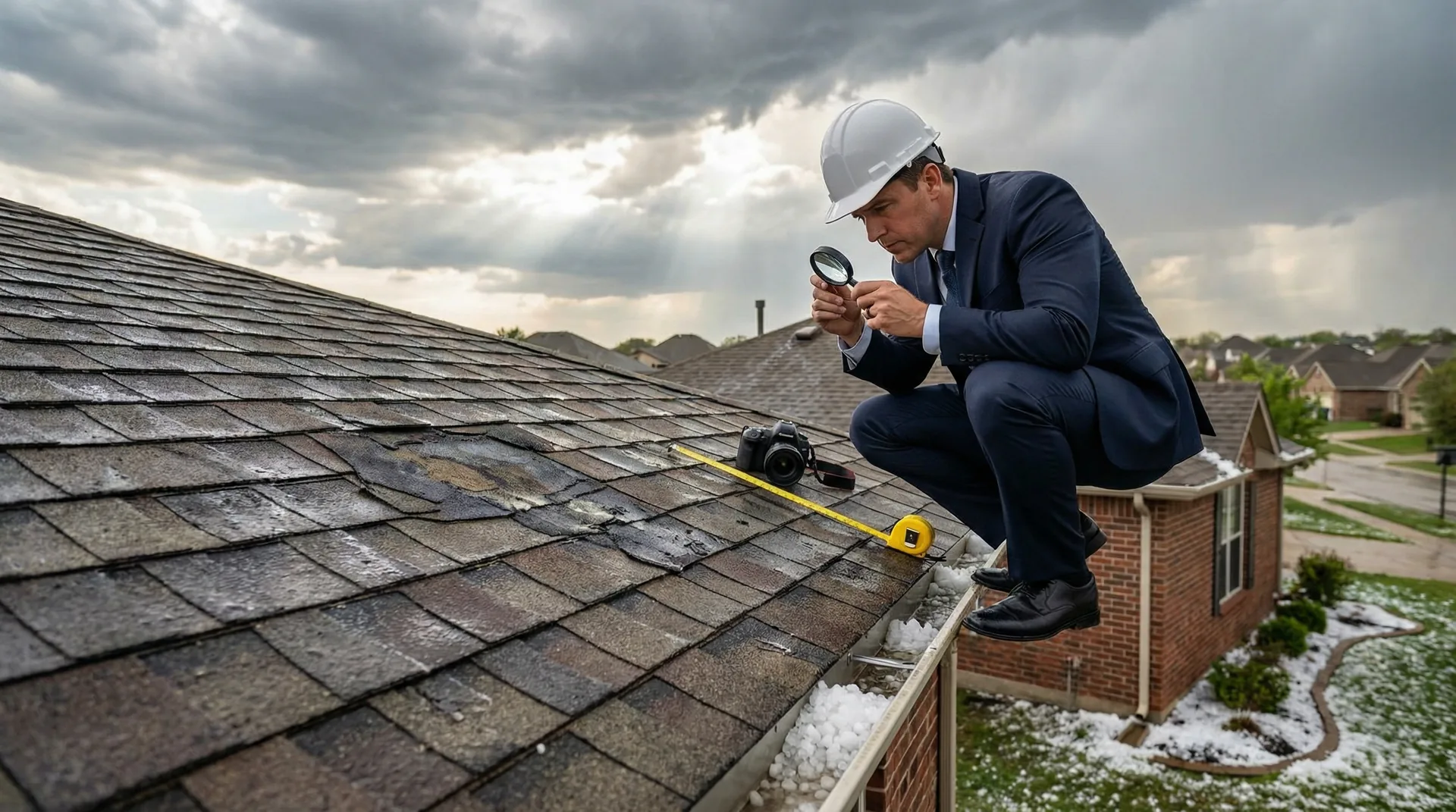
Hail Damage Claims Done Right
One hailstorm can cost tens of thousands of dollars in hidden damage. We know exactly where to look and how to prove it.
Hail Damage Is Rarely What It Appears on the Surface
A hailstorm passes in minutes, but the damage it leaves behind can take years off the life of your roof, compromise your siding, and destroy your HVAC equipment. What looks like minor cosmetic denting to an untrained eye may actually be granule loss that exposes your shingles to UV degradation, or impact fractures that allow water infiltration during the next rain.
Insurance companies often send adjusters who count visible dents and move on. We conduct a full forensic inspection of every surface, document damage with calibrated tools, and build a claim that reflects the true scope of what the storm did to your property.
Common Damage Types We Document
- Roof Damage: Granule loss, bruising, cracking, and punctures on shingles, tiles, and metal roofing
- Siding Damage: Impact dents, cracks, and fractures on vinyl, aluminum, wood, and fiber cement siding
- HVAC Damage: Bent fins, damaged coils, and compressor damage on exterior AC and heat pump units
- Gutters and Flashing: Dented gutters, downspouts, and damaged metal flashing around penetrations
- Skylights and Windows: Cracked or shattered skylights, window screens, and frame damage
- Decking and Fencing: Dents and splits on wood decking, fencing, and outbuildings
Understanding Hail: Size, Speed, and the Damage It Causes
Hailstones form when updrafts in thunderstorms carry water droplets into freezing altitudes. Each time the stone is lofted back up by the updraft, it gains another layer of ice. The stronger the storm, the larger the hail. Size matters enormously for damage potential, but so does density, shape, and the angle at which stones strike a surface.
Quarter-size hail (1 inch) is the threshold at which most insurance policies consider damage significant. However, even marble-size hail (0.75 inch) can strip protective granules from asphalt shingles, exposing the underlying mat to UV rays and accelerating deterioration. This damage is not always visible from the ground and requires close-up inspection.
Hailstones fall at speeds between 20 and 100 mph depending on size. A golf ball-size stone falling at 44 mph delivers approximately 11 foot-pounds of kinetic energy per impact. Multiply that by thousands of impacts across a roof and you begin to understand why a single storm can require a full roof replacement.
Functional damage versus cosmetic damage is a critical distinction in hail claims. Functional damage impairs the performance of the material, such as granule loss that shortens shingle life or cracks that allow water infiltration. Cosmetic damage affects appearance only. Many policies have cosmetic damage exclusions, but insurers sometimes misclassify functional damage as cosmetic to reduce payouts. We know the difference and we document it properly.
What You Need to Know
Wind Deductibles and Hail
Many Texas policies carry a separate wind and hail deductible, often expressed as a percentage of your dwelling coverage rather than a flat dollar amount. A 2% deductible on a $400,000 home means you pay the first $8,000 out of pocket. Understanding your deductible before you file is critical.
Matching and Uniformity
When hail damages part of your roof or siding, Texas law and most policy language require that replaced sections match the undamaged sections in color and appearance. If a matching product is no longer available, the insurer may owe you for a full replacement. This is a frequently disputed issue that we handle regularly.
Hail Reports and Weather Data
We obtain certified hail reports from NOAA and private weather verification services to document the exact hail size, duration, and path of the storm at your property address. This evidence is essential when an insurer disputes whether hail actually struck your home.
The Cosmetic Damage Endorsement: What It Means and When It Is Misapplied
A cosmetic damage endorsement limits or eliminates coverage for damage that affects only the appearance of a surface without impairing its function. Insurers most often invoke this endorsement on hail claims involving metal roofing, gutters, and siding, arguing that dents are cosmetic because the material still sheds water. However, this endorsement is frequently misapplied to damage that is actually functional. Hail impacts that fracture roof coatings, strip protective granules from asphalt shingles, compromise the adhesion of sealing strips, or create micro-fractures that allow water intrusion are not cosmetic -- they are functional. A dented metal panel that no longer lies flat and channels water correctly, a shingle that has lost the granules that protect it from UV degradation, or a surface that has been structurally weakened by repeated impacts is impaired in its function. If an insurer invokes a cosmetic damage endorsement to limit your hail claim, that classification is a factual question that can be challenged. We document functional impairment using close-up photography, granule loss measurements, moisture testing, and infrared scanning to distinguish genuine cosmetic dents from functional damage that your policy covers.
Tips That Protect Your Claim
Photograph Before Any Cleanup
Take hundreds of photos of every damaged surface before touching anything. Photograph hailstones on the ground next to a ruler or coin for size reference. Document dents on vehicles, AC units, and soft metals as corroborating evidence.
Do Not Sign Anything at the Door
Roofing contractors who knock on your door after a storm may ask you to sign an Assignment of Benefits or a direction to pay. Do not sign anything until you understand what rights you are transferring. Contact us first.
Preserve Damaged Materials
If any shingles or siding pieces blow off, save them. Do not allow contractors to remove damaged materials before your adjuster has inspected them. Once materials are gone, your documentation of the damage goes with them.
File Within Your Policy Window
Texas policies typically require you to report a claim promptly. Some policies have a one-year or two-year deadline from the date of loss. Do not wait. The longer you wait, the harder it becomes to prove storm causation.
Get an Independent Inspection
The insurance company adjuster works for the insurance company. Before accepting any settlement, have an independent licensed public adjuster inspect the damage. There is no cost for our initial review.
Understand Replacement Cost vs. ACV
Replacement Cost Value (RCV) pays to replace damaged items at today's prices. Actual Cash Value (ACV) deducts depreciation. If your policy pays ACV initially and holds back recoverable depreciation, you must complete repairs and submit documentation to receive the full amount.
How to Reduce Your Risk
Install impact-resistant roofing materials rated Class 3 or Class 4 by UL 2218. Many Texas insurers offer premium discounts for Class 4 roofs.
Inspect your roof annually and after every significant storm. Look for missing granules in gutters and downspout discharge areas.
Cover or store outdoor furniture, grills, and equipment before severe weather arrives.
Protect HVAC units with hail guards, which are wire mesh covers that deflect hailstones while allowing airflow.
Trim trees near your home to reduce the risk of branches being driven into the roof or siding by storm winds.
Install storm shutters or impact-resistant windows to protect glass from hail damage.
Keep gutters clean so that water from the first post-storm rain drains properly and does not back up under damaged roofing.
Document the pre-storm condition of your roof and exterior with dated photographs stored in the cloud.
Critical: Protect Your Claim Before Starting Any Repairs
Do not begin full repairs until your claim is fully settled. Damage is evidence. Altering or removing it before your insurer has properly documented it can eliminate coverage entirely. Insurance companies only pay for what can be proven. Only perform emergency repairs necessary to prevent further damage, and document everything with photos and video before touching anything.
What to Do Right Now
Ensure Safety First
Do not walk on a damaged roof. Stay clear of broken glass or debris. If the storm also brought high winds, check for downed power lines before exiting your home.
Document Everything Immediately
Photograph all exterior surfaces, gutters, HVAC units, vehicles, and any hailstones still on the ground. Use a coin or ruler for scale. Take video as well as photos.
Make Emergency Repairs Only
Place tarps over any areas where the roof is clearly breached to prevent water intrusion. Keep all receipts. Do not make permanent repairs until your claim is settled.
Report the Claim to Your Insurer
Notify your insurance company of the loss. Write down the claim number, the adjuster name, and the date of every conversation. Do not give a recorded statement without representation.
Contact DCS PIA Before the Adjuster Arrives
The earlier we are involved, the better. We will be present during the insurance company adjuster inspection to ensure nothing is missed and nothing is misrepresented.
Do Not Accept the First Offer Without Review
Initial settlement offers are often based on a scope of damage that is incomplete. We review every estimate line by line and negotiate for the full amount your policy provides.
Complete Repairs and Submit for Recoverable Depreciation
Once repairs are complete, submit your contractor invoices to recover any depreciation that was withheld in the initial payment.
Only a Fool Represents Themselves
There is a reason the legal profession has a saying: a lawyer who represents himself has a fool for a client. The same principle applies to insurance claims. The insurance company employs trained adjusters, engineers, and attorneys whose job is to evaluate your claim within the boundaries of what the company wants to pay. When you represent yourself, you are negotiating against professionals without the same tools, knowledge, or leverage.
Self-represented claimants routinely miss hidden damage. Hail damage to roofing underlayment, HVAC coils, and siding substrates requires trained eyes and often specialized tools to identify.
Without knowledge of policy language, policyholders often accept ACV settlements and never file for recoverable depreciation, leaving thousands of dollars on the table.
Insurers may use depreciation schedules that are overly aggressive. A licensed public adjuster challenges these calculations with industry-standard pricing data.
Policyholders who give recorded statements without preparation often inadvertently say things that are used to limit or deny their claim.
Missing the deadline to dispute a settlement or invoke appraisal can permanently limit your recovery. We track every deadline and never miss one.
The insurance company has a team of professionals working for them. You deserve one working for you.
Get a Licensed Public Adjuster on Your SideWhy Policyholders Trust DCS PIA
We bring insider knowledge, construction expertise, and genuine care to every claim.
Joshua Osteen worked as a field adjuster and team lead for insurance carriers from 2010 to 2017. He knows exactly how the other side evaluates claims.
We have handled thousands of hail damage claims across Texas and Florida and know the local storm patterns, common damage types, and insurer tendencies in each market.
Our inspections use calibrated measurement tools, certified weather data, and construction cost databases to build a claim that is difficult to dispute.
We work on contingency. You pay nothing unless we recover money for you. Our interests are perfectly aligned with yours.
We handle all communication with the insurance company so you can focus on your family and your recovery.
Frequently Asked Questions
Related Claim Types
Ready to Get What Your Policy Owes You?
Schedule a free, no-obligation consultation with a licensed public adjuster today. No recovery, no fee. No risk to you.