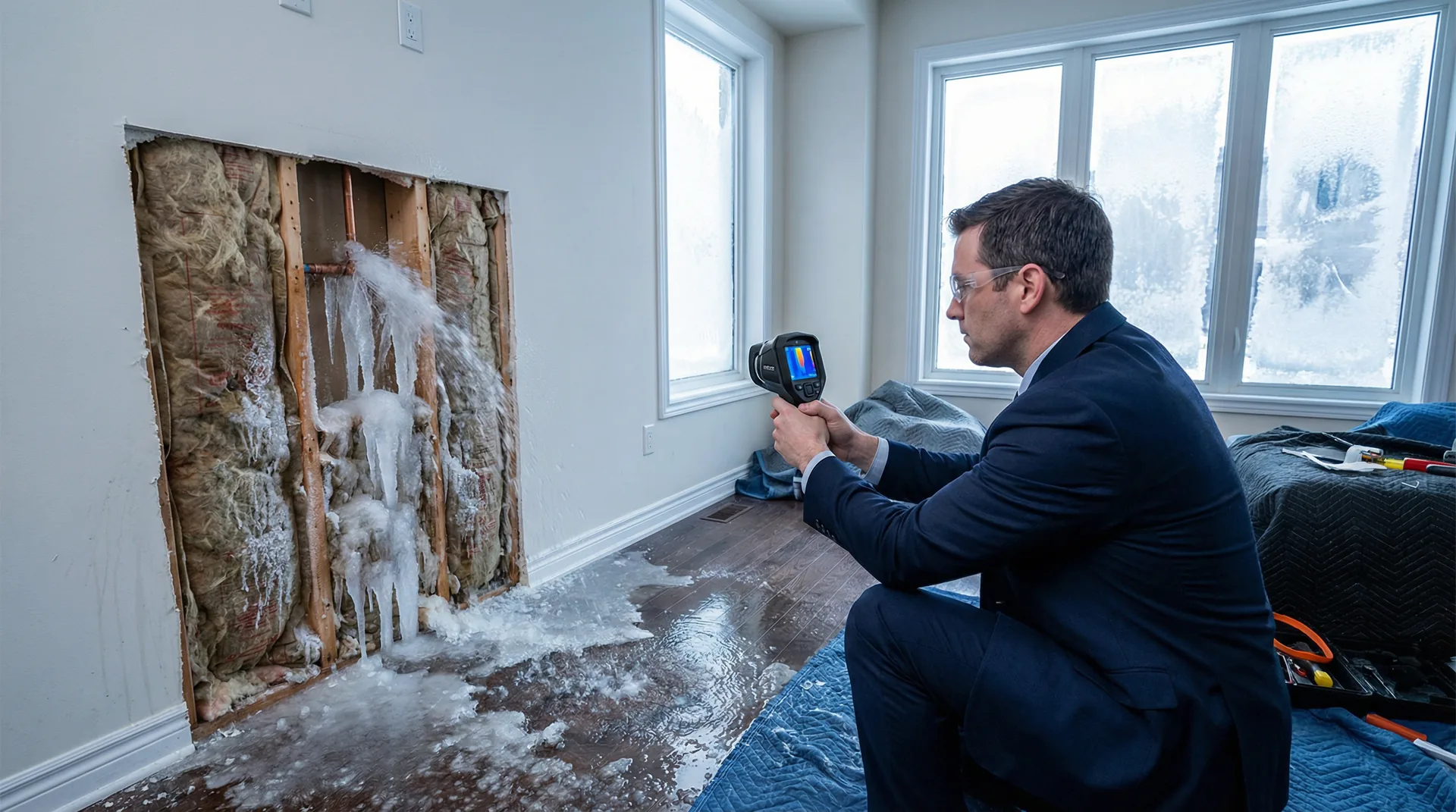
Freeze and Burst Pipe Claims That Cover the Full Damage
One hard freeze can burst multiple pipes and flood an entire home. We document every room the water reached.
Winter Storm Damage Is More Extensive Than It Appears
When temperatures drop below freezing, water in uninsulated pipes expands as it freezes, creating pressure that can rupture pipes throughout a home. A single freeze event can burst multiple pipes simultaneously, releasing water into walls, ceilings, and floors across the entire structure before the damage is even discovered.
Texas homes are particularly vulnerable to freeze damage because they are not designed for prolonged sub-freezing temperatures. Pipes in exterior walls, attics, garages, and crawl spaces that would be insulated in colder climates are often left exposed in Texas construction. When a hard freeze hits, the damage can be catastrophic and widespread.
Common Damage Types We Document
- Burst Pipe Water Damage: Extensive water damage from ruptured supply lines throughout the structure
- Ceiling and Wall Damage: Collapsed ceilings, saturated drywall, and damaged insulation from water above
- Flooring Damage: Buckled hardwood, delaminated laminate, and saturated carpet from water below
- Cabinet and Millwork Damage: Swollen and warped cabinets, trim, and built-ins from prolonged moisture exposure
- Personal Property: Furniture, electronics, and personal belongings damaged by water or humidity
- Mold Risk: Mold growth from water that was not discovered and dried promptly during the freeze event
The Physics of Frozen Pipes: Why Pipes Burst and Where to Expect Damage
Understanding why and where pipes freeze helps explain why freeze damage claims are often more extensive than they initially appear and why a thorough inspection is essential.
Water expands approximately 9% in volume when it freezes. In a closed pipe, this expansion creates enormous pressure. The pipe does not actually burst at the point where the ice forms. Instead, the pressure builds in the liquid water between the ice blockage and a closed faucet or fitting, and the pipe ruptures at its weakest point, which may be far from the freeze location.
Pipes most at risk are those in exterior walls without adequate insulation, pipes in unheated spaces such as attics, garages, and crawl spaces, pipes near exterior doors and windows, and pipes in cabinets against exterior walls. In Texas, where homes are not designed for sustained freezing temperatures, virtually any pipe in an unheated space is at risk during an extended hard freeze.
The Winter Storm Uri event in February 2021 caused catastrophic freeze damage across Texas, with an estimated 12 million homes experiencing burst pipes. The scale of the event overwhelmed insurance carriers and contractors alike, and many policyholders received incomplete settlements because adjusters were handling enormous claim volumes with limited time for thorough inspections.
Common ways freeze damage claims are minimized include arguing that the homeowner failed to maintain adequate heat (which can trigger a policy exclusion), limiting the scope to only the visible burst pipe location rather than all areas the water reached, and applying aggressive depreciation to flooring and cabinets. We document the full scope of water migration and address each of these arguments.
What You Need to Know
The Maintenance Exclusion and Freeze Claims
Most homeowner policies require you to maintain adequate heat in your home during cold weather. If you were away and turned the heat off, the insurer may attempt to deny or limit your claim under a maintenance exclusion. However, the application of this exclusion depends on the specific policy language and the circumstances of the loss. We review the facts and challenge improper exclusion applications.
Multiple Pipe Bursts in One Event
A single freeze event can burst multiple pipes in different locations throughout the home. Each burst pipe creates its own water loss that travels to different areas. We inspect the entire structure, not just the visible burst locations, to document the full scope of water migration.
Delayed Discovery and Mold
Many freeze losses are not discovered until the homeowner returns from travel or until temperatures rise and the ice melts. By the time the damage is discovered, water may have been sitting for days, creating significant mold risk. We document the timeline and ensure mold remediation costs are included when applicable.
Tips That Protect Your Claim
Shut Off the Water Immediately
When you discover a burst pipe, shut off the main water supply immediately. Every minute the water runs increases the damage and your claim complexity.
Document Before Drying
Photograph all wet surfaces, water lines, and damaged materials before any drying equipment is placed or any materials are removed.
Do Not Discard Damaged Materials
Do not remove and discard wet drywall, flooring, or cabinets until the insurance adjuster has inspected. Photograph everything first if emergency removal is necessary.
Report Promptly
Report the claim to your insurer as soon as you discover the damage. Delayed reporting can complicate your claim.
Document the Temperature Record
Obtain weather records showing the temperatures during the freeze event. This documentation supports the cause of loss and helps establish the timeline.
Contact DCS PIA Before the Adjuster Arrives
We will be present during the inspection to ensure the full scope of water migration is documented, not just the visible burst pipe locations.
How to Reduce Your Risk
Keep your home heated to at least 55 degrees Fahrenheit even when you are away during cold weather.
Know where your main water shutoff valve is and make sure every adult in the household can operate it quickly.
Open cabinet doors under sinks on exterior walls during a freeze to allow warm air to circulate around the pipes.
Let faucets drip slowly during a hard freeze to keep water moving through pipes and reduce pressure buildup.
Insulate pipes in unheated spaces such as attics, garages, and crawl spaces with foam pipe insulation.
Disconnect and drain garden hoses before the first freeze of the season.
Seal gaps and cracks in exterior walls and around pipe penetrations to reduce cold air infiltration.
Consider installing an automatic water shutoff device that detects leaks and closes the main supply valve.
Critical: Protect Your Claim Before Starting Any Repairs
Do not begin full repairs until your claim is fully settled. Damage is evidence. Altering or removing it before your insurer has properly documented it can eliminate coverage entirely. Insurance companies only pay for what can be proven. Only perform emergency repairs necessary to prevent further damage, and document everything with photos and video before touching anything.
What to Do Right Now
Shut Off the Main Water Supply
Find and close the main water shutoff valve immediately to stop the flow of water.
Document Before Any Cleanup
Photograph all wet surfaces, water lines, and damaged materials throughout the home before touching anything.
Call a Licensed Plumber
Have a licensed plumber locate and repair all burst pipes. Get documentation of every pipe that was repaired.
Call a Licensed Water Mitigation Company
Professional drying equipment is essential to prevent mold. Ask for daily moisture logs.
Report the Claim to Your Insurer
Notify your insurance company promptly. Write down the claim number and adjuster name.
Contact DCS PIA Before the Adjuster Arrives
We will inspect the full extent of water migration and ensure nothing is missed.
Do Not Accept a Settlement Without Review
Freeze damage claims are frequently scoped incompletely. Review any settlement offer with us before accepting.
Only a Fool Represents Themselves
Freeze damage claims are complex because the water from burst pipes travels extensively through the structure, often reaching areas far from the burst location. Insurance adjusters may inspect only the visible burst pipe areas and miss the full extent of water migration. Additionally, maintenance exclusion arguments and aggressive depreciation are common tactics that require a professional response.
Water from burst pipes travels through wall cavities, under flooring, and into lower levels. Adjusters who inspect only the visible burst locations miss a significant portion of the damage.
Maintenance exclusion arguments require a factual and policy-based response. We document the circumstances and challenge improper exclusion applications.
Multiple pipe bursts in a single event create complex, overlapping water damage patterns that require systematic documentation.
Mold resulting from delayed discovery of freeze damage is frequently excluded from initial estimates. We ensure mold remediation is included when it results from the covered loss.
Depreciation on flooring, cabinets, and personal property is frequently applied more aggressively than policy language supports. We challenge these calculations.
The insurance company has a team of professionals working for them. You deserve one working for you.
Get a Licensed Public Adjuster on Your SideWhy Policyholders Trust DCS PIA
We bring insider knowledge, construction expertise, and genuine care to every claim.
We handled thousands of freeze damage claims following Winter Storm Uri in 2021 and know the common scope disputes and insurer arguments in Texas freeze claims.
We use moisture meters and thermal imaging to document the full extent of water migration from burst pipes.
We work on contingency. No recovery means no fee.
Our construction background gives us a detailed understanding of water damage repair costs and building assembly requirements.
We handle all communication with the insurer and the mitigation and repair contractors to ensure your claim is properly supported.
Frequently Asked Questions
Related Claim Types
Ready to Get What Your Policy Owes You?
Schedule a free, no-obligation consultation with a licensed public adjuster today. No recovery, no fee. No risk to you.