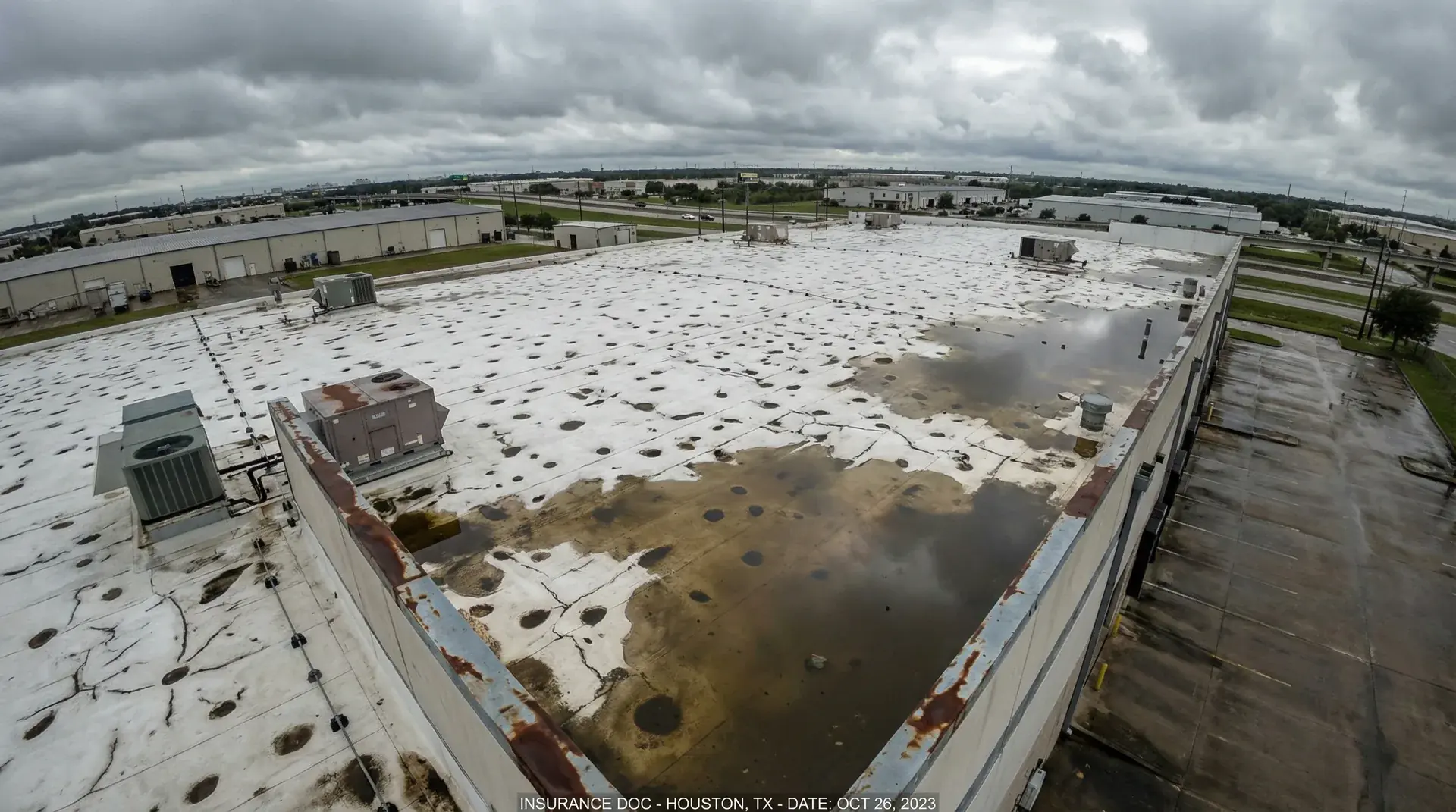
Commercial Roof Damage Claims: Protect Your Business Investment
Commercial roofing systems are complex and expensive. When storm, hail, or wind damage occurs, the difference between a complete settlement and an insufficient one often comes down to documentation. We make sure every dollar is accounted for.
Commercial Roof Claims Require Specialized Knowledge
Commercial roofing systems -- including TPO, EPDM, modified bitumen, built-up roofing, and metal panel systems -- require specialized knowledge to inspect and document properly. The damage patterns for each system are different, and the cost to repair or replace each system varies significantly.
Insurance companies frequently undervalue commercial roof damage claims by limiting the scope of damage to visible punctures or tears while missing impact damage, membrane delamination, seam failures, and flashing damage that compromise the entire system.
We document commercial roof damage using close-up photography, moisture testing, and infrared scanning to capture the full scope of damage and present a complete claim.
Common Damage Types We Document
- Wind Damage to Roofing Systems: Wind uplift, membrane blow-off, seam failures, and flashing damage caused by high winds.
- Hail Impact Damage: Impact damage to membrane systems, metal panels, skylights, HVAC equipment, and roof-mounted systems.
- Water Intrusion and Interior Damage: Water intrusion through compromised roofing systems causing damage to insulation, decking, and interior finishes.
- HVAC and Roof Equipment Damage: Damage to HVAC units, exhaust fans, skylights, and other roof-mounted equipment.
- Business Interruption: Lost revenue and continuing expenses during the period your business operations are affected by roof damage and repairs.
- Code Upgrade Requirements: Code-required upgrades when repairing or replacing a commercial roof, which may be covered under Ordinance or Law coverage.
Understanding Commercial Roof Damage
Commercial roofing systems are designed to protect large, flat or low-slope surfaces from weather. Unlike residential shingle roofs, commercial systems use membranes, coatings, and built-up assemblies that respond to storm damage differently. Hail impacts on TPO and EPDM membranes may not create visible punctures but can cause delamination and membrane weakening that leads to premature failure. Wind uplift can separate seams and flashings without leaving obvious visible damage. Infrared scanning can detect moisture trapped in roofing assemblies that is invisible from the surface. A complete commercial roof damage assessment requires more than a visual inspection.
- Commercial roof replacement costs range from $10 to $25 per square foot depending on the roofing system.
- Hail damage to commercial roofing systems is frequently underestimated by insurance adjusters who are not trained in commercial roofing.
- Water intrusion through a compromised commercial roof can cause interior damage that far exceeds the cost of the roof itself.
- Commercial roof claims with professional representation consistently result in higher settlements than self-represented claims.
What You Need to Know
Cosmetic Damage Endorsements and Commercial Roofing
Some commercial property policies contain a cosmetic damage endorsement that limits coverage to damage that impairs the function of the roofing system, excluding damage that affects only appearance. Insurers sometimes invoke this endorsement on hail claims involving metal roofing panels, arguing that dents are cosmetic because the panel still sheds water. However, this endorsement is frequently misapplied. Hail impacts that fracture coatings, compromise seam integrity, damage flashing, or structurally weaken panels are functional damage -- not cosmetic. We document functional impairment and challenge misclassifications.
Ordinance or Law Coverage for Commercial Roofs
When a commercial roof is damaged and requires repair or replacement, local building codes may require upgrades to the roofing system to bring it into compliance with current standards. This can include upgraded insulation R-values, improved drainage, or changes to the roofing system type. Standard commercial property policies do not cover the cost of these code-required upgrades unless you have Ordinance or Law coverage. We identify applicable code requirements and include upgrade costs in your claim.
Matching and Uniformity in Commercial Roofing
When a commercial roof is partially damaged, the repaired section may not match the existing roofing system in color, texture, or performance due to weathering, discontinued product lines, or system changes. We document matching issues and argue for the appropriate scope of replacement when a match cannot be achieved.
Tips That Protect Your Claim
Document Damage Immediately After the Storm
Photograph all visible roof damage, including membrane tears, punctures, dents, displaced flashings, and damaged equipment. Document the date and time of your photos.
Implement Emergency Repairs to Prevent Further Damage
Apply emergency tarps or temporary coatings to prevent water intrusion. Your policy requires you to mitigate further loss. Keep all receipts for emergency repairs.
Request Infrared Scanning
Ask your roofing contractor or inspector to perform infrared scanning to detect moisture trapped in the roofing assembly. This documentation supports a broader scope of damage.
Obtain Weather Data
Request certified weather data for your location on the date of the storm. Hail size, wind speed, and storm path documentation supports the cause of loss.
Do Not Accept a Cosmetic Damage Classification Without Review
If the insurer invokes a cosmetic damage endorsement to limit your claim, contact us before accepting the classification. We document functional impairment and challenge misapplications of this endorsement.
Track Business Interruption Losses
If roof damage forces you to close or reduce operations, begin tracking lost revenue and continuing expenses from the first day of impact.
Critical: Protect Your Claim Before Starting Any Repairs
Do not begin full repairs until your claim is fully settled. Damage is evidence. Altering or removing it before your insurer has properly documented it can eliminate coverage entirely. Insurance companies only pay for what can be proven. Only perform emergency repairs necessary to prevent further damage, and document everything with photos and video before touching anything.
What to Do Right Now
Implement emergency repairs to prevent water intrusion and further damage.
Contact your insurance carrier to report the loss and obtain a claim number.
Document all visible damage with photographs and video.
Request infrared scanning to detect hidden moisture in the roofing assembly.
Obtain certified weather data for the date of the storm.
Contact DCS PIA before signing any documents or accepting any settlement offers.
Only a Fool Represents Themselves
Commercial roofing systems require specialized knowledge to inspect and document properly.
Insurance adjusters who are not trained in commercial roofing frequently miss impact damage, membrane delamination, and seam failures.
Cosmetic damage endorsements are frequently misapplied to functional damage on commercial roofs.
Code upgrade requirements can add significant cost to commercial roof replacements that standard policies may not cover without Ordinance or Law coverage.
Early acceptance of an insufficient settlement offer can leave you responsible for the full cost of a roof replacement.
The insurance company has a team of professionals working for them. You deserve one working for you.
Get a Licensed Public Adjuster on Your SideWhy Policyholders Trust DCS PIA
We bring insider knowledge, construction expertise, and genuine care to every claim.
We have documented commercial roof damage losses across Texas and Florida since 2010.
We understand the damage patterns for all major commercial roofing systems including TPO, EPDM, modified bitumen, built-up, and metal panel.
Our Level 2 Xactimate certified estimators document every line item of your roofing and interior damage.
We handle the entire claims process from initial documentation through final settlement.
We work on contingency. We only get paid when you do, and our fee is a percentage of the settlement we recover for you.
Frequently Asked Questions
Ready to Get What Your Policy Owes You?
Schedule a free, no-obligation consultation with a licensed public adjuster today. No recovery, no fee. No risk to you.