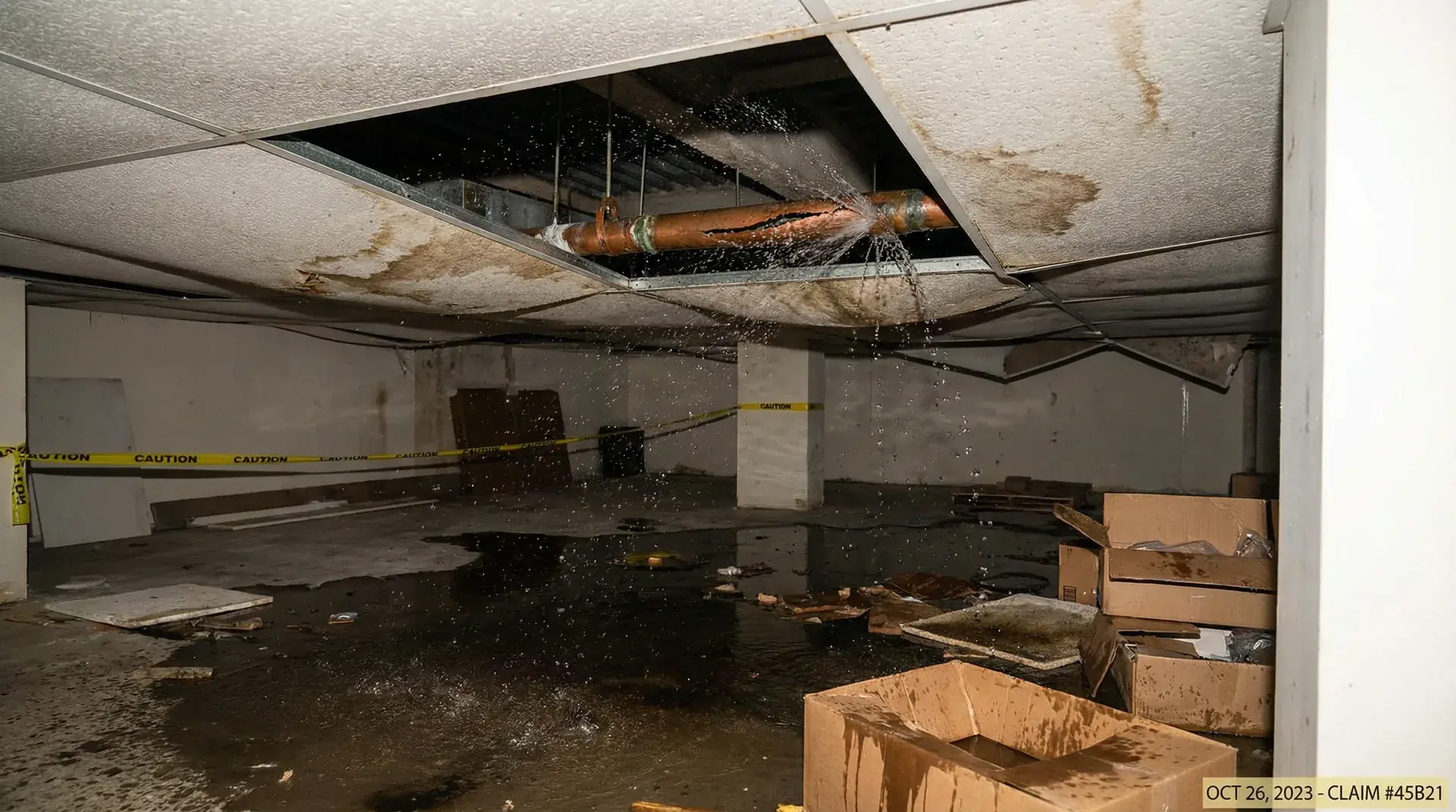
Commercial Plumbing Leak Claims: Recover the Full Cost of Your Business Water Loss
A burst pipe or plumbing failure at your commercial property can cause extensive damage to the building, contents, and your business operations. We document every dollar so your recovery is complete.
Commercial Plumbing Claims Are More Complex Than They Appear
A plumbing leak at a commercial property can cause damage that extends far beyond the visible wet area. Water migrates through walls, under flooring, and into structural cavities, creating conditions for mold growth and long-term structural deterioration. The full scope of damage is rarely visible without moisture mapping and thermal imaging.
Insurance companies frequently limit commercial plumbing claims by disputing the source of the leak, arguing that the damage resulted from a maintenance issue rather than a sudden and accidental loss, or by underestimating the scope of secondary water damage.
We document the source, path, and full extent of water damage using professional moisture mapping equipment and present a complete claim that includes all affected materials, contents, and business interruption losses.
Common Damage Types We Document
- Structural Water Damage: Water damage to walls, floors, ceilings, insulation, and structural framing caused by the plumbing leak.
- Business Personal Property: Damage to equipment, inventory, furniture, and business personal property caused by water intrusion.
- Mold and Microbial Growth: Secondary mold growth resulting from water intrusion that was not immediately detected or remediated.
- Business Interruption: Lost revenue and continuing expenses during the period your business operations are suspended due to covered water damage.
- Remediation and Restoration: The cost of professional water extraction, drying, dehumidification, and structural restoration.
- Code Upgrade Requirements: Code-required upgrades triggered by the repair work, which may be covered under Ordinance or Law coverage.
How Commercial Plumbing Leaks Cause Damage
Water from a plumbing leak follows the path of least resistance, migrating through wall cavities, under flooring, and into structural assemblies. In commercial buildings, water can travel significant distances from the source before becoming visible. Within 24 to 48 hours of water intrusion, mold can begin to grow in concealed areas. Moisture meters and thermal imaging cameras are required to map the full extent of water migration. Without proper moisture mapping, a significant portion of the damage may be missed in the initial claim.
- Water damage is one of the most common commercial property insurance claims filed each year.
- Mold remediation can add 30 to 50 percent to the total cost of a commercial water damage claim.
- Insurance companies dispute the scope of commercial water damage claims more frequently than almost any other claim type.
- Professionally represented commercial water damage claims consistently result in higher settlements than self-represented claims.
What You Need to Know
Sudden and Accidental vs. Maintenance Issues
Commercial property policies typically cover water damage from sudden and accidental plumbing failures, but exclude damage resulting from gradual leaks, deferred maintenance, or deterioration. Insurers sometimes deny or limit commercial plumbing claims by characterizing the loss as a maintenance issue. We document the nature of the failure and the timeline of the damage to establish that the loss was sudden and accidental and therefore covered under your policy.
Mold Coverage in Commercial Policies
Many commercial property policies limit or exclude mold coverage, particularly mold resulting from a long-term water intrusion. However, mold that results from a covered sudden water loss may be covered under the water damage provisions of your policy. We document the relationship between the covered water loss and the resulting mold growth to support coverage for remediation costs.
Business Interruption from Water Damage
If a plumbing leak forces you to close or significantly curtail your business operations, your business interruption coverage may apply. The covered period begins when your operations are affected and ends when the property is restored to its pre-loss condition. We document your business interruption losses from day one and present a complete claim for lost revenue and continuing expenses.
Tips That Protect Your Claim
Document All Damage Before Cleanup
Photograph and video all visible water damage, wet materials, and affected areas before any water extraction or cleanup begins. This documentation is essential to your claim.
Mitigate Further Damage Immediately
Stop the source of the leak if possible, extract standing water, and begin drying the affected area. Your policy requires you to mitigate further loss. Keep all receipts for emergency mitigation work.
Request Moisture Mapping Documentation
Ask your water mitigation contractor to provide moisture readings and thermal imaging documentation. This data supports the scope of your claim and documents the extent of hidden water damage.
Preserve Damaged Materials for Inspection
Do not dispose of damaged flooring, drywall, or other materials until the insurance adjuster has inspected them. Preserve samples if possible.
Do Not Accept a Limited Scope
Insurance adjusters sometimes limit the scope of water damage claims to only the visibly wet areas. We use moisture mapping data to document the full extent of water migration and ensure the complete scope is included in your claim.
Track Business Interruption Losses
If the water damage forces you to close or reduce operations, begin tracking lost revenue and continuing expenses from the first day of impact. This documentation is required for your business interruption claim.
Critical: Protect Your Claim Before Starting Any Repairs
Do not begin full repairs until your claim is fully settled. Damage is evidence. Altering or removing it before your insurer has properly documented it can eliminate coverage entirely. Insurance companies only pay for what can be proven. Only perform emergency repairs necessary to prevent further damage, and document everything with photos and video before touching anything.
What to Do Right Now
Stop the source of the leak and shut off water supply to the affected area.
Contact your insurance carrier to report the loss and obtain a claim number.
Begin emergency water extraction and drying to mitigate further damage.
Document all damage with photographs and video before cleanup begins.
Request moisture mapping documentation from your mitigation contractor.
Contact DCS PIA before signing any documents or accepting any settlement offers.
Only a Fool Represents Themselves
Commercial water damage claims are among the most frequently disputed claim types because the full scope of damage is often hidden.
Insurance adjusters sometimes limit claims to visible damage, missing water that has migrated into walls, floors, and structural cavities.
Mold coverage disputes are common and require documentation of the relationship between the covered water loss and the resulting mold growth.
Business interruption claims require detailed financial documentation that most policyholders are not prepared to provide.
Early mistakes -- including premature cleanup, failure to document damage, or accepting an initial offer -- can permanently reduce your recovery.
The insurance company has a team of professionals working for them. You deserve one working for you.
Get a Licensed Public Adjuster on Your SideWhy Policyholders Trust DCS PIA
We bring insider knowledge, construction expertise, and genuine care to every claim.
We have documented commercial water damage losses across Texas and Florida since 2010.
We use professional moisture mapping equipment and thermal imaging to document the full extent of hidden water damage.
Our Level 2 Xactimate certified estimators document every line item of your structural and contents loss.
We handle the entire claims process from initial documentation through final settlement.
We work on contingency. We only get paid when you do, and our fee is a percentage of the settlement we recover for you.
Frequently Asked Questions
Ready to Get What Your Policy Owes You?
Schedule a free, no-obligation consultation with a licensed public adjuster today. No recovery, no fee. No risk to you.