Stop the Damage Now - Dispatch an emergency tarping and water mitigation crew
Most carriers treat any post-loss water intrusion as preventable once the storm has passed. Tarp and dry the property before the carrier sends their adjuster.
Most standard property policies obligate the insured to take reasonable steps to mitigate further damage. Failing to do so can give the carrier grounds to reduce or deny the claim.
Independent referral - no fees, no commissions. DCS does not accept any compensation from network vendors. Vendors are paid for their work through the insurance claim DCS is adjusting. Recommendations are based on what is best for your claim, not on who pays us.
Quick Answer
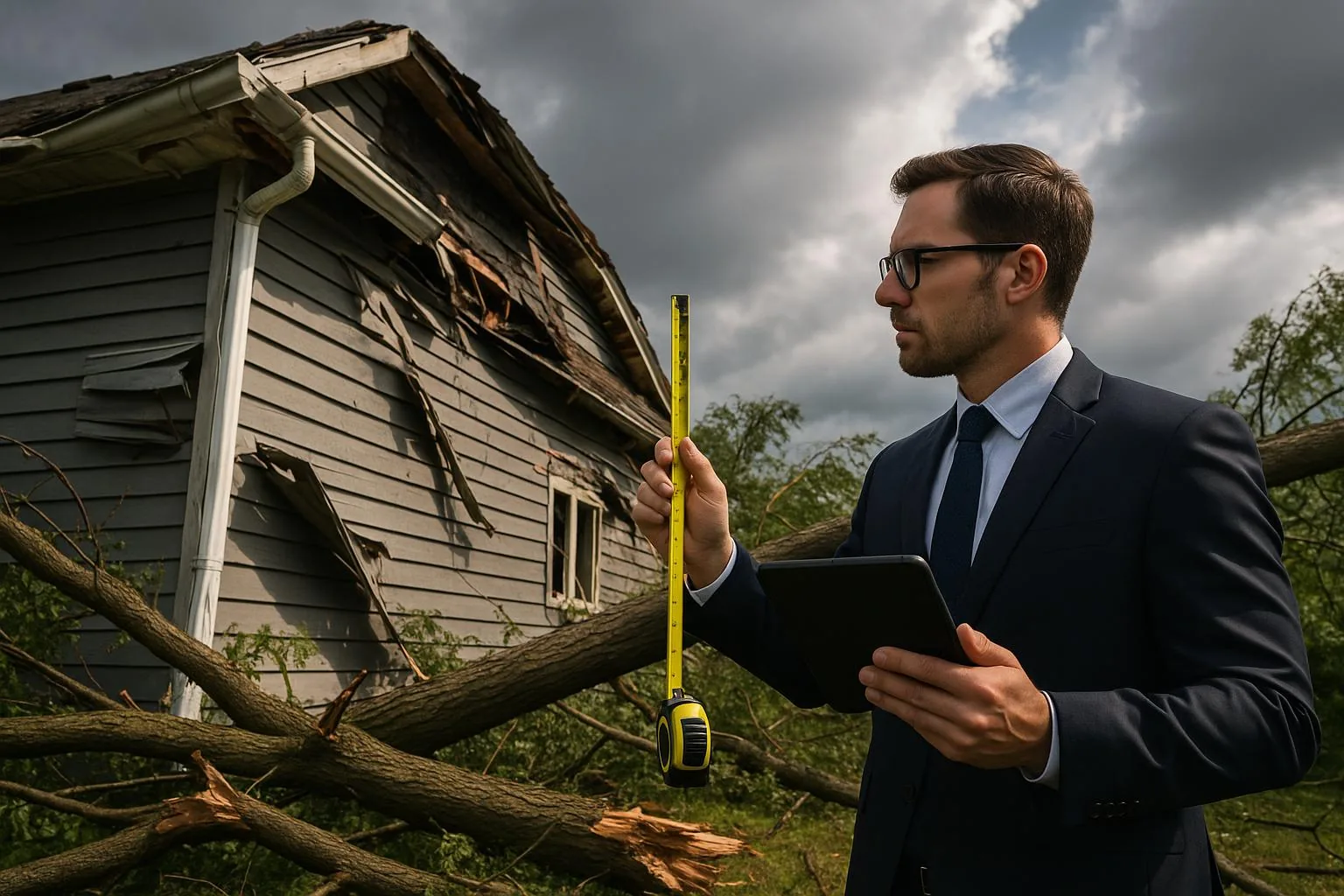
Storm damage insurance claims are frequently underpaid when adjusters overlook hidden structural racking and wind-driven rain infiltration. A licensed public adjuster meticulously documents the full scope of exterior and interior damage, working to ensure your policy covers everything from roof replacement to interior water mitigation.
Texas Insurance Code Chapter 542 — Your Carrier's Statutory Clock
Under Texas Insurance Code Chapter 542 (the Prompt Payment of Claims Act), a property insurer has fixed statutory deadlines to acknowledge, decide, and pay a covered claim. Missing those deadlines triggers 18% statutory interest plus reasonable attorney's fees on the amount of the claim under § 542.060. The deadlines below are the carrier's, not yours.
| Code | What the carrier MUST do | Deadline | When the clock starts |
|---|---|---|---|
| § 542.055 | Acknowledge the claim | 15 days | Insurer must commence investigation and request all items, statements, and forms reasonably needed. |
| § 542.056 | Accept or reject the claim | 15 days | Clock starts after the insurer receives all requested items, statements, and forms needed. |
| § 542.057 | Pay the accepted claim | 5 business days | Clock starts the date the insurer notifies the insured of acceptance. |
| § 542.058 | Outside trigger for prompt-payment damages | 60 days | If the claim has not been paid within 60 days of receiving all items, the prompt-payment damages and attorney-fee provisions of § 542.060 may apply. |
Applies to the amount of the claim when a carrier violates the prompt-payment deadlines — per Tex. Ins. Code § 542.060(a).
A policyholder who prevails on a prompt-payment violation is entitled to recover reasonable and necessary attorney's fees, in addition to the 18% interest and the underlying claim amount.
“If an insurer that is liable for a claim under an insurance policy is not in compliance with this subchapter, the insurer is liable to pay the holder of the policy, in addition to the amount of the claim, interest on the amount of the claim at the rate of 18 percent a year as damages, together with reasonable and necessary attorney's fees.”
Educational summary, not legal advice. DCS PIA is licensed as a public insurance adjuster (TDI Firm License #3134924); we represent policyholders on claim valuation and negotiation, not legal claims for damages. Bad-faith and prompt-payment damages actions are litigation matters handled by counsel.
Reviewed by Joshua Osteen · Texas Public Adjuster Lic. #2237777 · Florida Lic. #W045717 · Dependable Claims Specialists
Professional Storm Damage Claim Services
When severe weather strikes, the damage left behind requires immediate attention and accurate documentation. Insurance companies often deploy catastrophic (CAT) adjusters who may rush through inspections, leading to overlooked damages and undervalued settlements.
At Dependable Claims Specialists (DCS PIA), we conduct a comprehensive, methodical inspection of your property. We document every lifted shingle, every water stain, and every damaged personal item to ensure your claim is complete and undeniable.
- Toll Free:833-4UR-LOSS
- Texas Office:936-522-6627
- FL:954-849-3405
Common Damage Types We Document
- Roof & Structural Damage: Missing shingles, damaged decking, compromised trusses, and structural shifts caused by high winds.
- Interior Water Intrusion: Ruined drywall, flooring, insulation, and personal property from rain entering through storm-created openings.
- Exterior & Siding Damage: Dented or torn siding, broken windows, and damaged fences or outbuildings.
- Fallen Trees & Debris: Structural impacts from fallen trees and the costs associated with safe debris removal.
What You Need to Know
The "Opening in the Roof" Limitation
Many policies state they will only cover interior water damage if the storm first created an opening in the roof or walls through which the water entered. Establishing this connection is a critical part of a successful storm claim.
Actual Cash Value vs. Replacement Cost
Understand whether your policy pays Replacement Cost Value (RCV) or Actual Cash Value (ACV). Insurance companies generally hold back depreciation until repairs are actually completed.
Matching Undamaged Materials
If only one side of your roof or siding is damaged, the insurance company may only want to pay for that side. If the new materials do not match the old, you may be entitled to full replacement for a uniform appearance.
Handling the Claim Yourself vs Engaging DCS PIA
Texas policyholders have the right to negotiate their own claim. Hiring a licensed public insurance adjuster is optional. The table below sets out, side by side, how the same claim tasks get done in each path so you can make an informed decision.
| Claim handling task | Self-represented | DCS PIA representation |
|---|---|---|
| Statute deadline tracking (Tex. Ins. Code §§ 542.055-542.057) | Manual calendar; missed deadlines do not always trigger remedies without documentation. | Structured Chapter 542 timeline maintained from day one; every carrier action timestamped. |
| Scope of loss documentation | Photos plus a written list; rarely matches the carrier's estimating system line-by-line. | Xactimate estimate built in the same software the carrier uses, line-item-matched to scope. |
| Hidden or secondary damage assessment | Visible damage only. | Moisture mapping, thermal imaging, and engineering referrals when warranted; ensuing-loss tracking. |
| Appraisal clause invocation when valuation differs | Available to any insured but rarely invoked because the policy mechanic is unfamiliar. | Invoked when carrier scope materially undervalues the loss; appraisal and umpire fees disclosed up front. |
| Supplement filings for damage discovered during repair | Often skipped after the initial check is cashed. | Tracked through repair; supplement scopes filed against the carrier as new damage is exposed. |
| Additional Living Expense / Extra Expense documentation | Receipts assembled at the end of displacement, often incomplete. | Receipt and mileage log discipline from day one; ALE / Extra Expense submitted per policy form. |
| Mold sub-limit endorsement pursuit | Frequently left unclaimed. | Mold cause, species, and remediation protocol documented to IICRC S520; sub-limit pursued. |
| Fee structure | No third-party fee. You handle the claim yourself. | Contingency fee capped under Tex. Ins. Code § 4102.158; no recovery, no fee. Hiring a public adjuster is optional under Texas law. |
Educational comparison, not legal advice. Hiring a Texas-licensed public insurance adjuster is optional and capped at 10% of the recovery under Tex. Ins. Code § 4102.158. Public adjusters represent policyholders on claim valuation and negotiation. Legal claims for bad faith or prompt-payment damages are handled by attorneys, not public adjusters.
Tips That Protect Your Claim
Document Everything Immediately
Take photos and videos of all damage inside and out before moving anything or beginning temporary repairs.
Mitigate Further Loss
Tarp your roof, board up broken windows, and extract standing water to prevent secondary damage like mold. Keep all receipts.
Do Not Start Permanent Repairs
Wait until the insurance adjuster and your public adjuster have fully inspected the property before making permanent repairs.
Keep a Detailed Inventory
Make a list of all damaged personal property, including make, model, age, and replacement cost.
Critical: Protect Your Claim Before Starting Any Repairs
Do not begin full repairs until your claim is fully settled. Damage is evidence. Altering or removing it before your insurer has properly documented it can eliminate coverage entirely. Insurance companies only pay for what can be proven. Only perform emergency repairs necessary to prevent further damage, and document everything with photos and video before touching anything.
Why Policyholders Trust DCS PIA
We bring carrier-side experience, construction expertise, and genuine care to every claim.
Deep Industry Experience -- Insurance industry experience since 2010, advocating for policyholders since 2017.
Comprehensive damage assessment ensuring no detail is overlooked.
We handle all negotiation and communication with your insurance company.
Licensed and Bonded professionals protecting your interests.
24/7 Emergency Response availability.
No Recovery, No Fee -- You only pay if we successfully increase your settlement.
Frequently Asked Questions
Related Claim Types
Statutes That Touch DCS Work
Texas (home base) and Florida statutes that govern public adjusting, appraisal, prompt-pay, and policyholder rights. DCS reviews and applies these statutes in the ordinary course of adjusting. Legal questions belong to a licensed attorney in your state.
Texas (Home Base)
DCS Firm License #3134924
- TX Ins. Code Ch. 4102. Public adjusters. Caps PA fees at 10% of recovery for public adjusting work. Requires written contract on TDI-approved form. Three-business-day cancellation right.
- TX Ins. Code Ch. 542. Prompt Payment of Claims Act. Acknowledge / decide / pay deadlines, 18% statutory interest plus attorney fees on violations.
- TX Ins. Code Ch. 542A. Pre-suit notice for weather-related property claims. Attorney work; outside the public adjusting role.
- TX Ins. Code Ch. 2210 (TWIA). Texas Windstorm Insurance Association. Statutory wind/hail insurer of last resort for 14 designated coastal counties and parts of Harris County.
- TX Ins. Code Ch. 2211 (TFPA). Texas FAIR Plan Association. Statutory residential insurer of last resort, statewide availability for policyholders unable to obtain voluntary-market coverage.
- TX Ins. Code §541. Unfair Settlement Practices. Statutory cause of action; attorney work.
- License authority: Texas Department of Insurance (TDI).
- Statute of limitations: Generally 2 years for property claims (varies by policy and loss type).
Florida
DCS Firm License #W820363
- Fla. Stat. §626.854. Public adjusters. Caps PA fees at 20% of recovery for most claims, reduced to 10% during the first year following a state-declared emergency.
- Fla. Stat. §626.9744. Matching uniform appearance. Carriers must match the rest of the line, side, room, or other continuous area when repairing or replacing damaged property.
- Fla. Stat. §627.70131. Prompt-pay statute. Following 2022 reforms, the deadline to pay or deny most residential property claims was reduced to 60 days.
- Fla. Stat. §627.70132. Supplemental and reopened claims. Three years from date of loss; longer for hurricane claims.
- Fla. Stat. §627.7015. Mandatory mediation precondition for some residential property disputes.
- Fla. Stat. §624.155. Civil Remedy Notice (CRN). Attorney work; outside the public adjusting role.
- 2022 reforms (SB 2-D, SB 2-A). Eliminated one-way attorney fees for property claims; restricted Assignment of Benefits.
- License authority: Florida Department of Financial Services (DFS).
Important. This summary is general educational information, not legal advice. The application of any statute to a specific claim, the determination of whether a denial supports a statutory cause of action, and any pre-suit or litigation strategy are legal questions for a licensed attorney in your state. DCS Public Insurance Adjusters read and apply policy language in the ordinary course of adjusting (coverage parts, exclusions, endorsements, scope), but do not provide legal advice or pursue statutory remedies.
Educational Information - Not Legal Advice
The information on this page is for general educational purposes only. Dependable Claims Specialists is a licensed public adjusting firm - not a law firm. Public adjusters help policyholders inspect, document, evaluate, and negotiate property insurance claims, which includes reading and applying your policy in the ordinary course of adjusting (coverage parts, exclusions, endorsements, scope). We do not practice law and we do not provide legal advice. For legal opinions, demand letters, Chapter 542A pre-suit notices, statutory remedies under the Insurance Code, or litigation, consult a licensed attorney in your state. Texas public adjusters operate under TX Ins. Code Chapter 4102; Florida public adjusters operate under FL Statute §626.854.
